


A business continuity policy template gives you the short, signed document that sits at the top of your continuity program and tells everyone what the organization commits to when disruption hits. This guide gives you a fill-in version aligned to ISO 22301:2019, then shows how it connects to your business continuity plan and disaster recovery plan.
Many teams confuse the three documents. The policy states intent and commitments. The plans state what people actually do. Get that split right and both your auditor and your incident team will thank you.
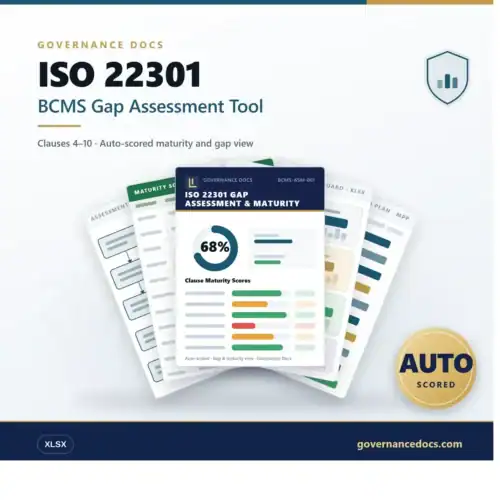
Free gap assessment
Would your continuity programme survive an audit?
Score every clause of ISO 22301:2019, free, including the business impact analysis and exercise records most programmes fail on.
Run the free ISO 22301 gap assessment → or View premium report sample
What ISO 22301:2019 Requires of a Business Continuity Policy
ISO 22301:2019 is the current edition of the business continuity management system (BCMS) standard. Its 2024 amendment added climate change text to the context clauses, so check whether climate is a relevant issue when you set your scope.
The policy requirement sits in clause 5.2. It has two parts:
- 5.2.1 Establishing the business continuity policy. Top management must set a policy that is appropriate to the organization’s purpose, provides a framework for setting business continuity objectives, includes a commitment to satisfy applicable requirements, and includes a commitment to continual improvement of the BCMS.
- 5.2.2 Communicating the business continuity policy. The policy must be available as documented information, communicated within the organization, and available to interested parties as appropriate.
That is a short list, and any business continuity policy template you adopt should cover all four points in plain words. A good business continuity policy is usually two to four pages. If yours runs to twenty, plan content has crept in. One more check: if a template you downloaded cites a different clause number for the policy, it was probably written against the withdrawn 2012 edition. Rebuild it on the 2019 clause map.
Business Continuity Policy Template (Fill-In)
Replace the bracketed text. Each row of this business continuity policy template maps to something an ISO 22301 auditor will look for. Sections 3 and 4 carry the clause 5.2.1 commitments, so do not delete them even if they feel formal.
| Section | What to write | Example wording |
|---|---|---|
| 1. Purpose | Why the organization manages continuity | “[Company] maintains a business continuity management system so it can continue delivering its key products and services at acceptable levels during and after a disruption.” |
| 2. Scope | Sites, products, services and exclusions | “This policy applies to [all operations at sites X and Y] and the delivery of
|
| 3. Commitments | The two commitments clause 5.2.1 requires | “[Company] commits to satisfy applicable legal, regulatory, contractual and customer requirements, and to continually improve the BCMS.” |
| 4. Objectives framework | How objectives are set and measured | “Business continuity objectives are set annually by [the BC Steering Group], are measurable, and are reviewed at management review.” |
| 5. Principles | The rules that shape the plans | “Recovery priorities are based on a business impact analysis. Life safety comes first. Plans are tested before they are relied upon.” |
| 6. Roles | Who owns what | “The [CEO] is accountable for the BCMS. The BC Manager maintains the program. Department heads own their recovery plans.” |
| 7. Risk appetite | Tolerance for disruption | “Prioritized activities must be resumed within the timeframes approved in the BIA. Residual risks above [threshold] require executive acceptance.” |
| 8. Testing | Exercise commitment | “Each business continuity plan is exercised at least [annually]. Results and corrective actions are reported to management.” |
| 9. Communication | Who gets the policy and how | “This policy is published on [intranet], included in induction, and available to customers and regulators on request.” |
| 10. Review and approval | Owner, frequency, signature | “Reviewed at least annually and after significant change. Approved by: [Name, Title, Date].” |







Keep the business continuity policy template free of phone trees, recovery steps and supplier contacts. Those belong in the plans, where they change often without needing top management to re-sign the policy.
For the full list of documents that support this policy, see our ISO 22301 templates guide.
Policy vs Business Continuity Plan vs Disaster Recovery Plan
| Aspect | Business continuity policy | Business continuity plan | Disaster recovery plan |
|---|---|---|---|
| Purpose | States intent, scope and commitments | Keeps prioritized business activities running | Restores IT systems, data and infrastructure |
| Audience | Everyone, plus interested parties | Response teams and department heads | IT operations and technical recovery teams |
| Approved by | Top management | BC manager and plan owners | IT leadership |
| Typical length | 2–4 pages | One plan per site or function | One runbook per critical system |
| ISO 22301:2019 link | Clause 5.2 | Clause 8.4 | Clauses 8.3 and 8.4 (IT recovery solutions and procedures) |
| Changes | Rarely; annual review | Whenever people, sites or suppliers change | Whenever systems or architecture change |
ISO 22301 does not use the phrase “disaster recovery plan.” It asks for business continuity plans and procedures, and IT recovery fits inside them. Most organizations still keep a separate DR plan because the technical audience and change rate are different.
Business Continuity and Disaster Recovery Plan Template
Smaller organizations often prefer one combined document. This business continuity and disaster recovery plan template outline covers both the business and IT sides. Use it as a table of contents and fill each section.
1. Scope, assumptions and activation
“This plan covers [sites, services and systems]. It assumes [loss of primary office, loss of primary data center, loss of key supplier]. The plan is activated by [the Incident Lead] when a disruption is expected to exceed [2 hours] for any prioritized activity.”
2. Business impact analysis summary
Summarize the BIA required by clause 8.2.2: prioritized activities, impacts over time, and the resources each needs. Attach or reference the full BIA rather than copying it.
Free business impact analysis
How long can each activity really be down?
Rate the impact of an outage over time, set RTOs and maximum tolerable periods of disruption, map the people, systems and suppliers behind each activity, and get a recovery sequence back, free.
Run the free business impact analysis → or View premium report sample
3. Risk assessment summary
List the disruption risks from clause 8.2.3 that the plan addresses. Our business continuity risk assessment example shows the level of detail auditors expect.
Free business continuity risk assessment
What could stop your most important activities?
List your prioritized activities and what they depend on, pick from 32 disruption scenarios, rate them and choose continuity measures for each. Built to ISO 22301 clause 8.2.3, and free.
Run the free continuity risk assessment → or View premium report sample
4. Recovery objectives (RTO and RPO)
The recovery time objective (RTO) is how quickly an activity or system must be back. The recovery point objective (RPO) is how much data loss, measured in time, you can tolerate. The values below are examples only. Yours must come from your BIA.
| Activity or system | Example RTO | Example RPO | Recovery strategy |
|---|---|---|---|
| Customer order processing | Example: 4 hours | Example: 15 minutes | Failover to secondary cloud region |
| Payroll | Example: 3 days | Example: 24 hours | Provider’s alternate site; manual run as backup |
| Email and collaboration | Example: 8 hours | Example: 1 hour | SaaS provider resilience; tested account recovery |
| Office workspace | Example: 1 day | Not applicable | Remote working for all staff with laptops |
5. Recovery strategies and solutions
Clause 8.3 asks you to determine resource requirements across people, information and data, physical infrastructure, equipment and consumables, ICT systems, transportation, finance, and partners and suppliers. Write one short paragraph per resource type stating the chosen solution and who maintains it.
6. Response structure and communications
The policy names who owns continuity; the plan names who acts. Name the incident team, deputies, meeting point (physical and virtual), and who speaks to staff, customers, regulators and media. Include pre-approved message templates.
7. IT disaster recovery runbooks
One runbook per critical system: dependencies, recovery order, step-by-step restore instructions, backup locations, credentials vault reference (never the credentials themselves), validation checks and the person authorized to declare the system recovered. NIST SP 800-34 Rev. 1, the contingency planning guide for federal information systems, publishes a free BIA template as supplemental material, and its plan structure is a useful model for this section.
8. Return to normal
Define how operations move back from workaround to normal, including data reconciliation, supplier re-engagement and stand-down criteria. Record who authorizes the stand-down and when the post-incident review takes place.
9. Exercising and evaluation
Clause 8.5 requires an exercise program, and clause 8.6 requires evaluation of your business continuity documentation and capabilities. Record a schedule (tabletop, walkthrough, technical failover) and how findings become corrective actions.
If you need a deeper version of the plan side, our guide to the ISO 22301 business continuity plan walks through clause 8.4 in detail.
Common Audit Findings on Business Continuity Policies
- Missing commitments. The policy talks about resilience but never commits to meeting applicable requirements or to continual improvement.
- No link to objectives. There is no framework for setting objectives, so clause 6.2 objectives float free.
- Not communicated. Staff interviews show nobody has seen the policy.
- Stale approval. The signature is three years old and the scope no longer matches the business.
- RTOs without a BIA. Recovery times in the DR plan were picked by IT, not derived from business impact.
Every one of these is avoidable with a structured business continuity policy template and a yearly review date in the calendar.
Business Continuity Policy Template FAQ
Is a business continuity policy mandatory for ISO 22301 certification?
Yes. Clause 5.2 requires top management to establish one, and clause 5.2.2 requires it to be available as documented information. A certification auditor will ask to see it in the stage 1 audit.
Can I combine the policy with the business continuity plan?
You can, but it rarely helps. A business continuity policy template produces a document that needs top management approval and changes rarely. Plans change often. Keeping them separate lets you update plans without re-approving the policy.
What is the difference between a business continuity disaster recovery plan template and a BIA?
The BIA is analysis: it identifies prioritized activities and how quickly they must recover. A business continuity disaster recovery plan template is the response document built on those results. Do the BIA first, or your plan’s recovery times are guesses.
How often should I review the business continuity policy template once adopted?
At least annually, usually at management review, and after any major change such as an acquisition, a new site or a significant incident. Record the review even if nothing changes.
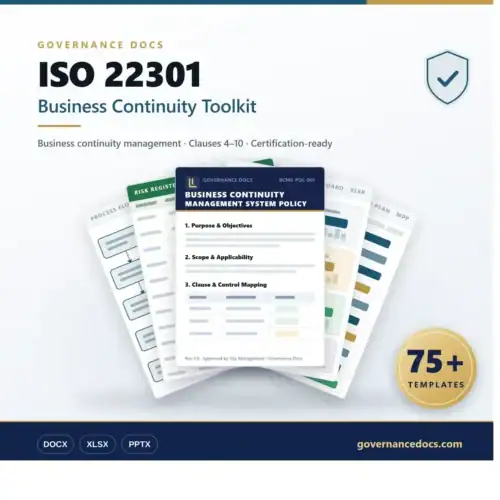
Our ISO 22301 Toolkit provides 88 editable templates for building a certifiable BCMS — including a business continuity policy, a business impact analysis tool and a combined business continuity and disaster recovery plan — for $99.
When a standard changes, know first
One email a month: edition changes, new deadlines, and what they mean for documentation you already have. No sales sequence.

Recent Posts

November 26, 2026

November 26, 2026

November 26, 2026

November 26, 2026
November 26, 2026