

Good hygiene practices are most of the Codex text and almost none of the average HACCP checklist. Which is why inspections fail on allergen changeover cleaning and pest trending rather than on critical limits. The 2020 revision made the point structurally: GHPs became Chapter One, placed before HACCP, and must be demonstrably effective before HACCP is built on top.
This assessment covers the whole of CXC 1-1969 — 61 questions with the good hygiene practices carrying roughly forty per cent of them, plus the twelve application steps, the seven principles, and the US and EU overlays where they go beyond Codex. It is free, it saves as you go, and you can stop and come back to it.
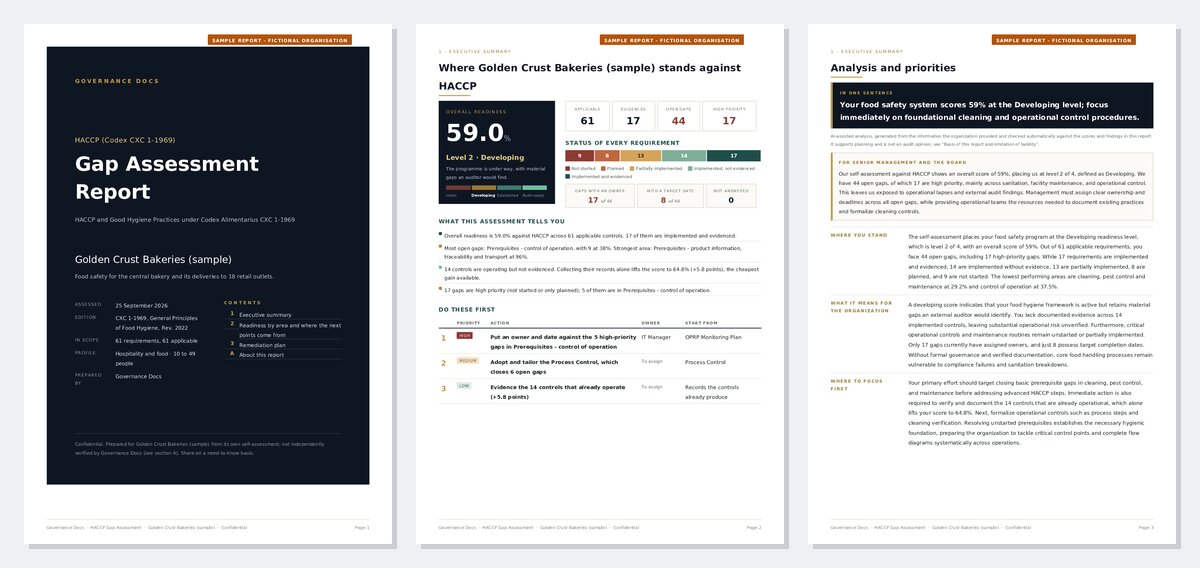
Premium report
See what the premium HACCP gap assessment report looks like
A worked sample for a fictional organization: readiness by area, every open gap in a remediation plan, an AI-assisted analysis with priorities and a 30/60/90-day roadmap, plus the live Excel workbook.
What this is
The text to cite is CXC 1-1969, General Principles of Food Hygiene, revised 2022. Most circulating copies still carry the 2020 front matter, and citing Rev. 2020 is the common error. HACCP is no longer an annex: since the 2020 revision it is Chapter Two of the main body.
Three wording changes from that revision are worth knowing because pre-2020 checklists miss all of them. Principle 1 now includes identifying control measures. Principle 3 requires critical limits to be validated. Principle 6 front-loads validation of the plan ahead of verification. Step 1 now includes identifying scope, and Step 5 is on-site confirmation of the flow diagram — walked, across shifts, not desk-checked.
The background is elsewhere — the seven principles, writing the plan, hazard analysis, critical limits, the team, validation against verification, HACCP against HARPC and ISO 22000 against HACCP. Come here when you want a score.
What it covers
61 questions, about 40 minutes.
| Section | Questions |
|---|---|
| Prerequisites – premises, equipment and people | 8 |
| Prerequisites – cleaning, pest control and maintenance | 6 |
| Prerequisites – control of operation | 10 |
| Prerequisites – product information, traceability and transport | 6 |
| HACCP steps 1-5 – preparation | 6 |
| HACCP principles 1-3 – hazards, CCPs and limits | 6 |
| HACCP principles 4-7 – monitoring, action, validation and records | 9 |
| Management system, jurisdiction and certification | 10 |
How the scoring works
| Status | Weight | Means |
|---|---|---|
| Not started | 0% | No policy, process or activity exists |
| Planned | 25% | Agreed and scheduled, nothing in place yet |
| Partially implemented | 50% | In place for part of the scope, or applied inconsistently |
| Implemented, not evidenced | 75% | Operating as intended, but you could not prove it today |
| Implemented and evidenced | 100% | Operating as intended, with records someone could sample |
| Not applicable | — | A justified exclusion, removed from the score |
Records are where this assessment gets uncomfortable. Monitoring completed at the end of the shift from memory scores as implemented but not evidenced, which is exactly what an inspector concludes when the handwriting is uniform down a column.
Free score, or the full report
The assessment and your overall score are free. The full report is a one-off $39 and gives you every question with your status and notes, the score broken down by section, a prioritised gap list, and the documents from the HACCP Toolkit that close each gap — as a PDF and a working Excel file.
How long does it take?
About 40 minutes. Control of operation is the longest section, and allergen management within it is the single most common serious finding in food audits.
What to do with your score
Below 40% — work the prerequisites first. A HACCP plan built on good hygiene practices that have never been shown to be effective is a plan with fifteen critical control points nobody can monitor.
40–70% — the usual shape. The plan is written and the critical control points are monitored; validation of critical limits, cleaning effectiveness monitoring and the tested recall are where the evidence thins.
Above 70% — run a mock recall and time it. A recall procedure that has never been exercised, with no reconciliation percentage recorded, is the gap that turns a routine incident into a serious one.
Frequently asked questions
Is this assessment really free?
Yes. All 61 questions, the breakdown by section and your overall score cost nothing. The $39 report is optional.
Is HACCP a certification?
Not in itself. Codex HACCP is a system, and certification comes through a scheme built on top of it — ISO 22000, FSSC 22000, BRCGS, IFS or SQF. A GFSI-recognised certificate is what most retailers and manufacturers actually require.
Does this cover the US preventive controls rules?
It flags them. 21 CFR Part 117 needs no critical control points and no critical limits, but adds economically motivated adulteration, a mandatory supply-chain programme, a written recall plan and a preventive controls qualified individual. Seafood stays under Part 123, juice under Part 120 and meat and poultry under USDA FSIS 9 CFR 417.
Which FSSC 22000 version applies?
Version 7.0 was published on 1 May 2026, but audits against Version 6 are permitted until 30 April 2027, with upgrade audits from 1 May 2027. So today you are most likely still being audited against Version 6.
Can I use this for a client?
Yes. Run one assessment per client organisation.
What happens to my answers?
They are stored against your account so you can come back to them, and they are never shared. You can delete them at any time.