Description
About the DORA Toolkit
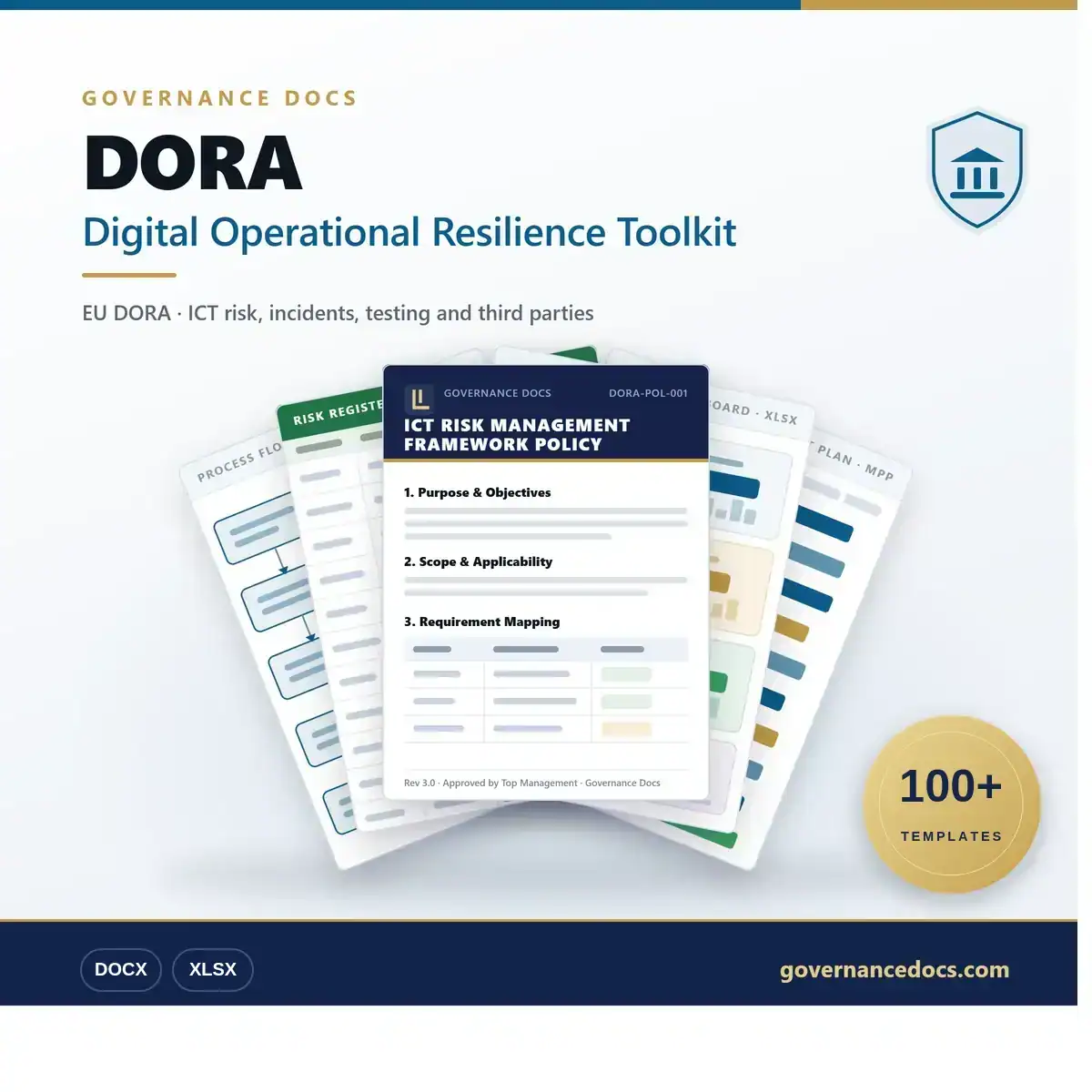
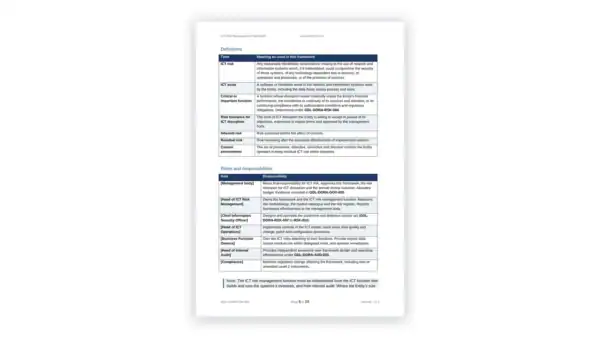
The DORA Toolkit is a complete documentation pack for organisations in scope of Regulation (EU) 2022/2554, the Digital Operational Resilience Act. It contains 100+ ready-to-edit templates covering all five DORA pillars, structured to mirror the Regulation itself.
Every document states the exact DORA article it implements, so you can evidence coverage article by article rather than hoping a generic security pack is enough.
What makes this toolkit different
- Register of Information — a multi-sheet workbook structured to the Implementing Technical Standards, covering contractual arrangements, providers, services, functions supported, criticality and subcontracting chains. This is DORA’s most demanding artefact and the one competent authorities request annually.
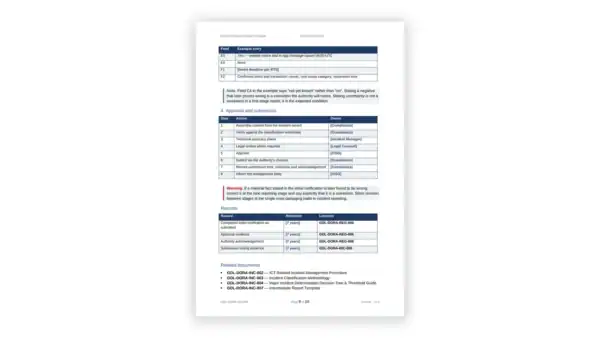
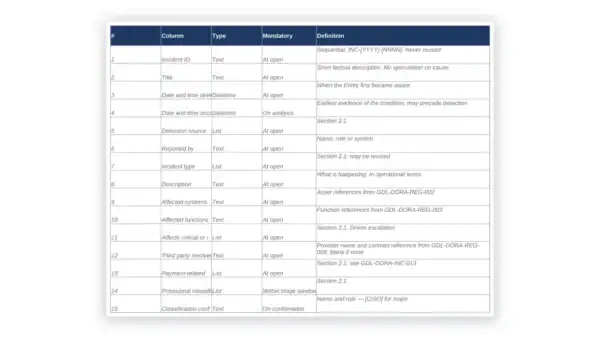
- Incident classification and three-stage reporting — a classification methodology built on the Article 18 criteria, with separate initial, intermediate and final report templates.
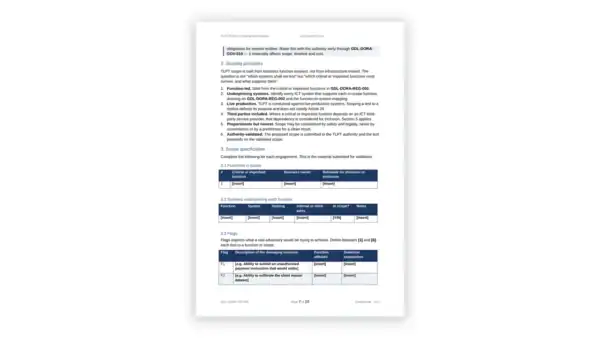
- Resilience testing and TLPT — an annual testing programme plus the full threat-led penetration testing set: scoping, threat intelligence, red team and control team, closure and attestation.
- Article 30 contractual provisions — clause checklist, clause library, subcontracting assessment, concentration risk and exit strategies for critical ICT services.
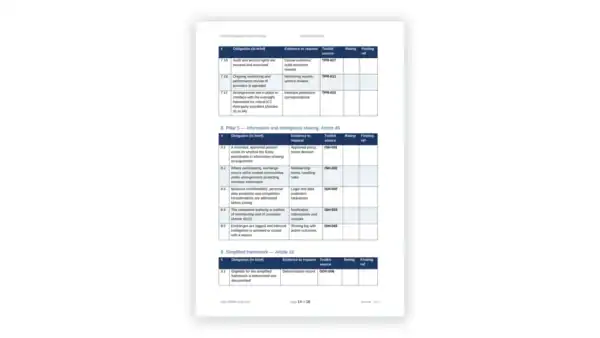
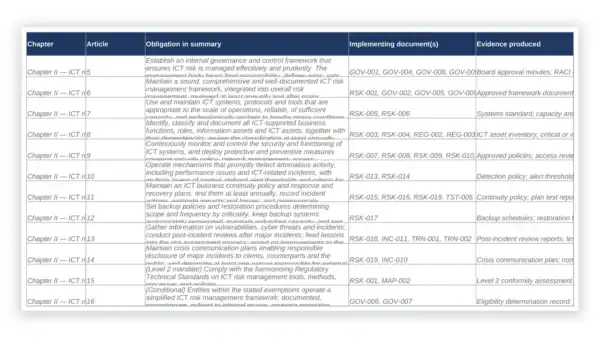
- Article-by-article traceability — plus crosswalks to ISO/IEC 27001:2022 and NIS2, so entities with existing certifications can reuse evidence instead of starting over.
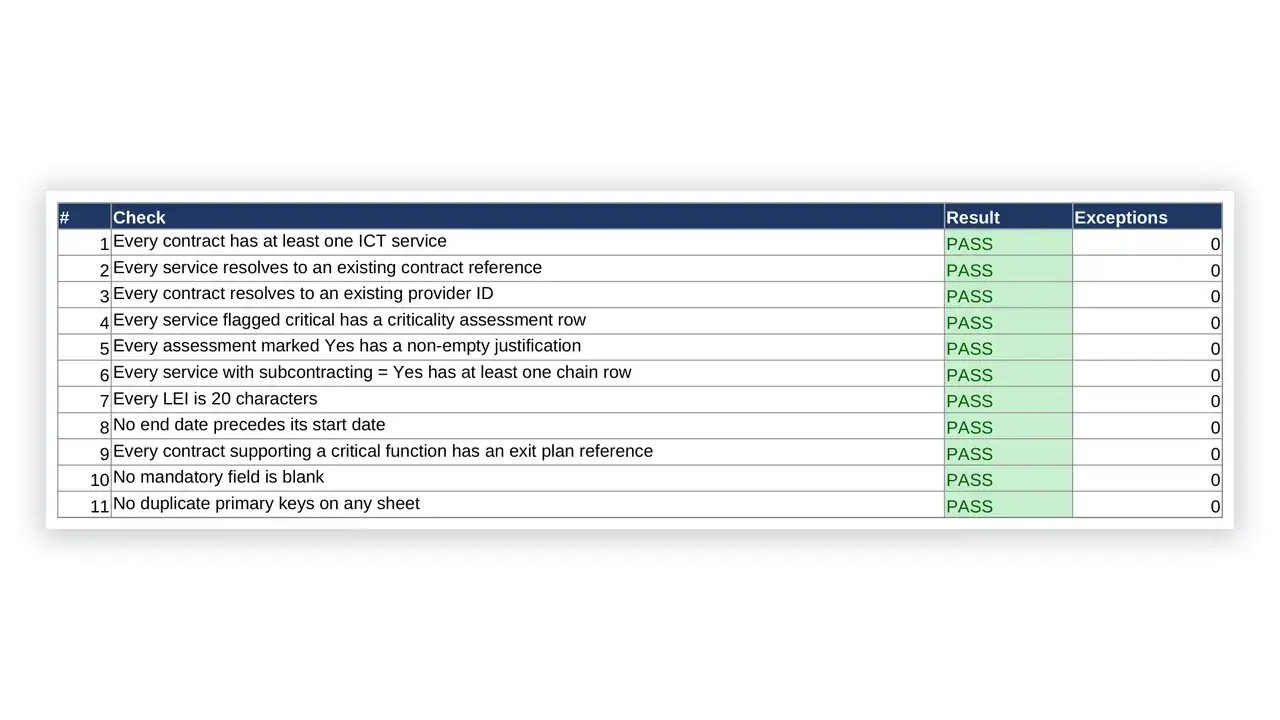
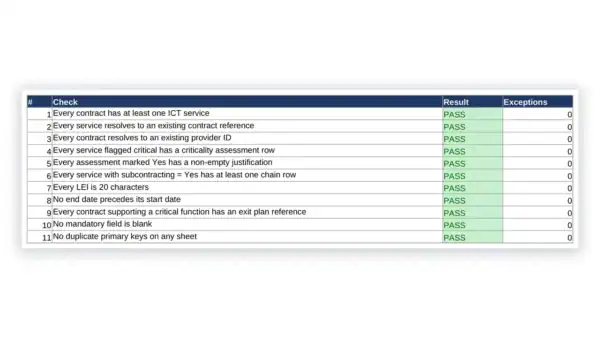
- 25 working spreadsheets — registers ship as real Excel workbooks with dropdown validation and built-in checks, not Word tables.
Why Do Organizations Need to Comply with DORA?
DORA requires financial entities to strengthen their digital operational resilience by ensuring ICT systems are secure, reliable and capable of withstanding disruption. Compliance is both a regulatory obligation and a commercial necessity, protecting against cyberattacks, system failures and operational outages.
Compliance demonstrates accountability to customers and supervisors, limits the financial and reputational damage of ICT incidents, and keeps services running. It also aligns with wider global regulatory trends, supporting cross-border consistency for international firms.
This toolkit consists of the following documents:
106 templates across ten folders, organised to match DORA’s five pillars.
01 — Programme Foundation & Governance (12)
Scope, accountability and the mandate for everything that follows.
- DORA Compliance Framework Manual
- Digital Operational Resilience Strategy
- DORA Scope & Applicability Assessment Procedure
- Management Body Responsibilities & Accountability Statement
- ICT Risk Management Framework — Board Approval & Annual Review Record
- Proportionality & Microenterprise Determination Procedure
- Simplified ICT Risk Management Framework (Article 16)
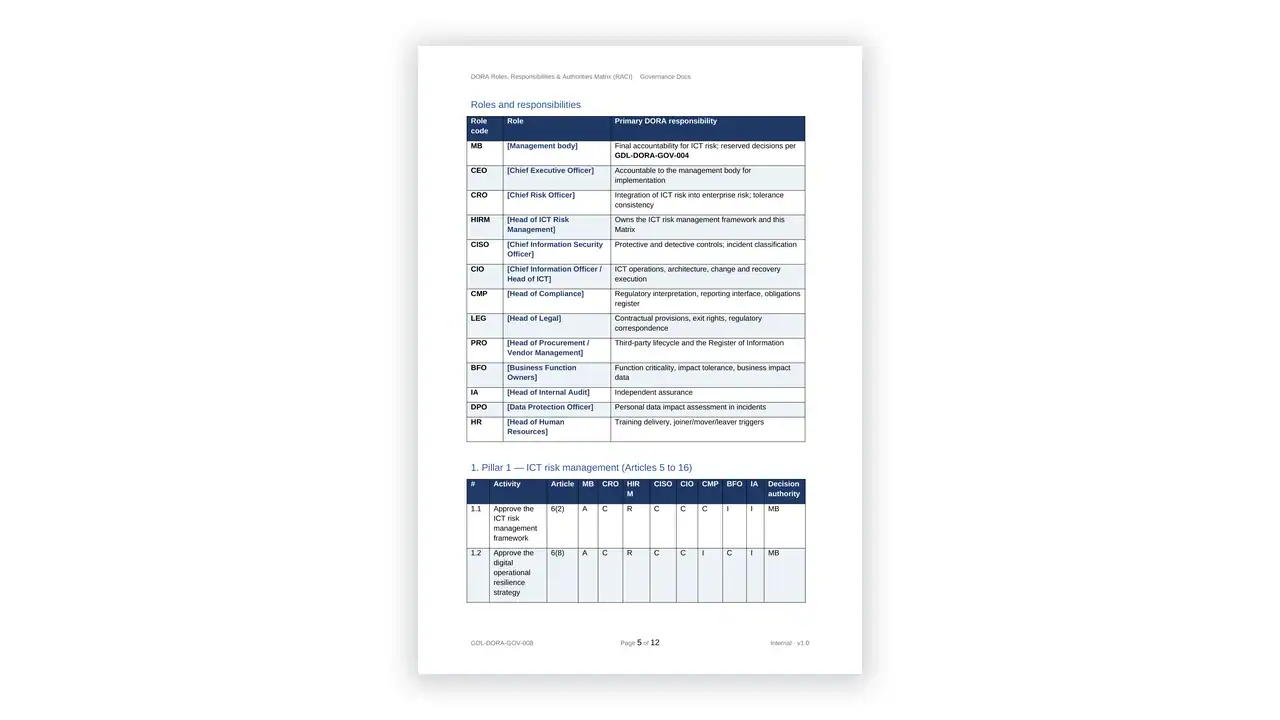
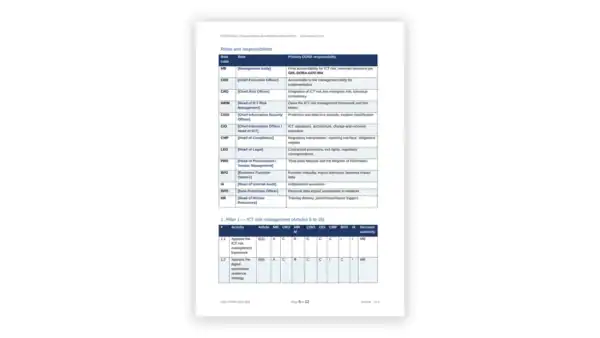
- DORA Roles, Responsibilities & Authorities Matrix (RACI)
- ICT Risk Management Function Charter
- Competent Authority Liaison & Regulatory Engagement Procedure
- DORA Compliance Policy Statement
- Management Body ICT Risk Training Register
02 — ICT Risk Management, Pillar 1 (19)
The ICT risk management framework and its control set.
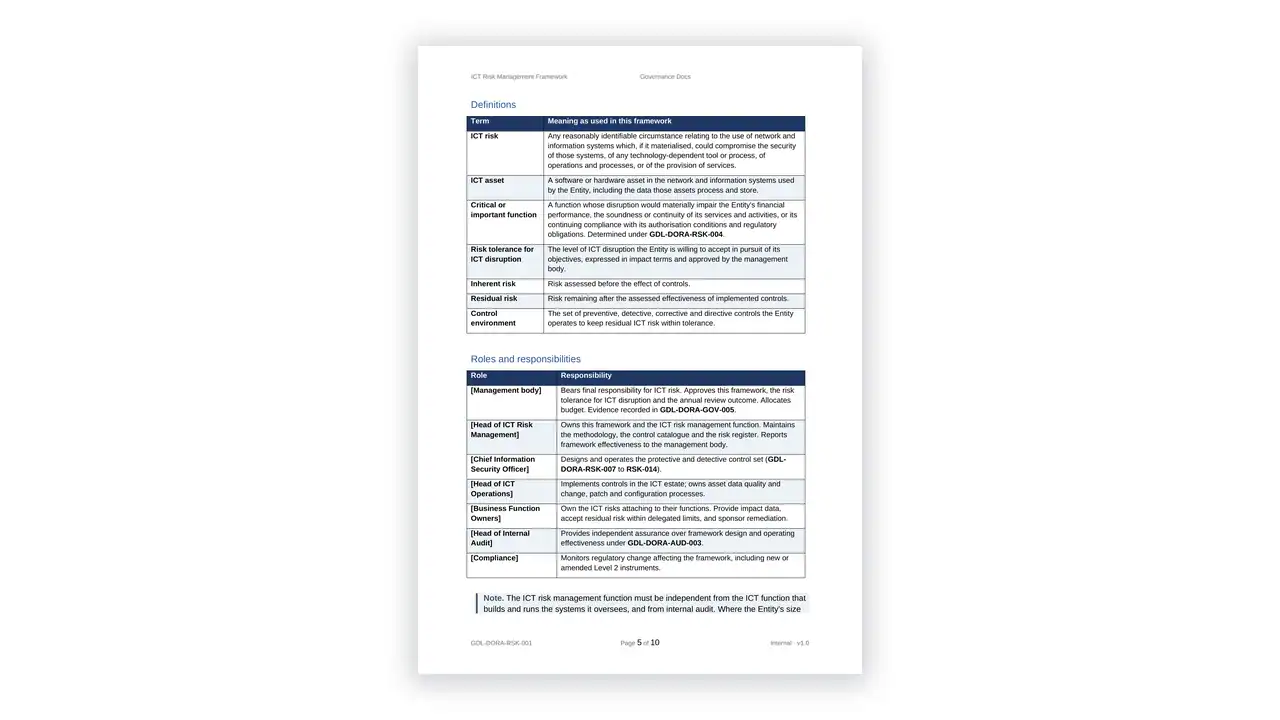
- ICT Risk Management Framework
- ICT Risk Assessment Methodology & Procedure
- ICT Asset Identification & Classification Procedure
- Critical or Important Functions Identification Procedure
- ICT Systems, Protocols & Tools Standard
- Legacy ICT Systems Assessment Procedure
- ICT Protection & Prevention Policy
- Identity & Access Management Policy
- Cryptography & Key Management Policy
- Network Security & Segmentation Standard
- ICT Change Management Procedure
- Patch & Vulnerability Management Procedure
- ICT Detection & Anomalous Activity Policy
- Logging & Monitoring Standard
- ICT Business Continuity Policy
- ICT Response & Recovery Plans
- Backup, Restoration & Recovery Procedure
- Learning & Evolving Procedure
- ICT-Related Crisis Communication Plan
03 — Incident Management & Reporting, Pillar 2 (14)
Detecting, classifying and reporting incidents to the competent authority.
- ICT-Related Incident Management Policy
- ICT-Related Incident Management Procedure
- Incident Classification Methodology
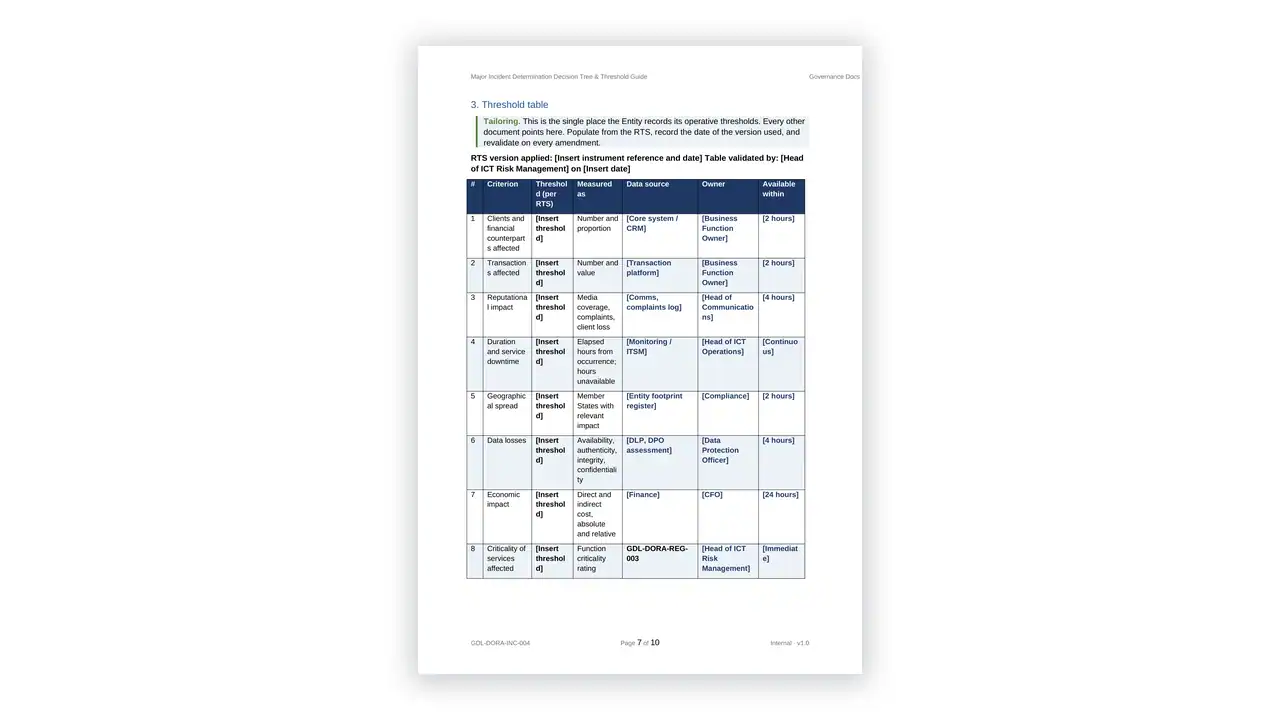
- Major Incident Determination Decision Tree & Threshold Guide
- Significant Cyber Threat Assessment & Voluntary Notification Procedure
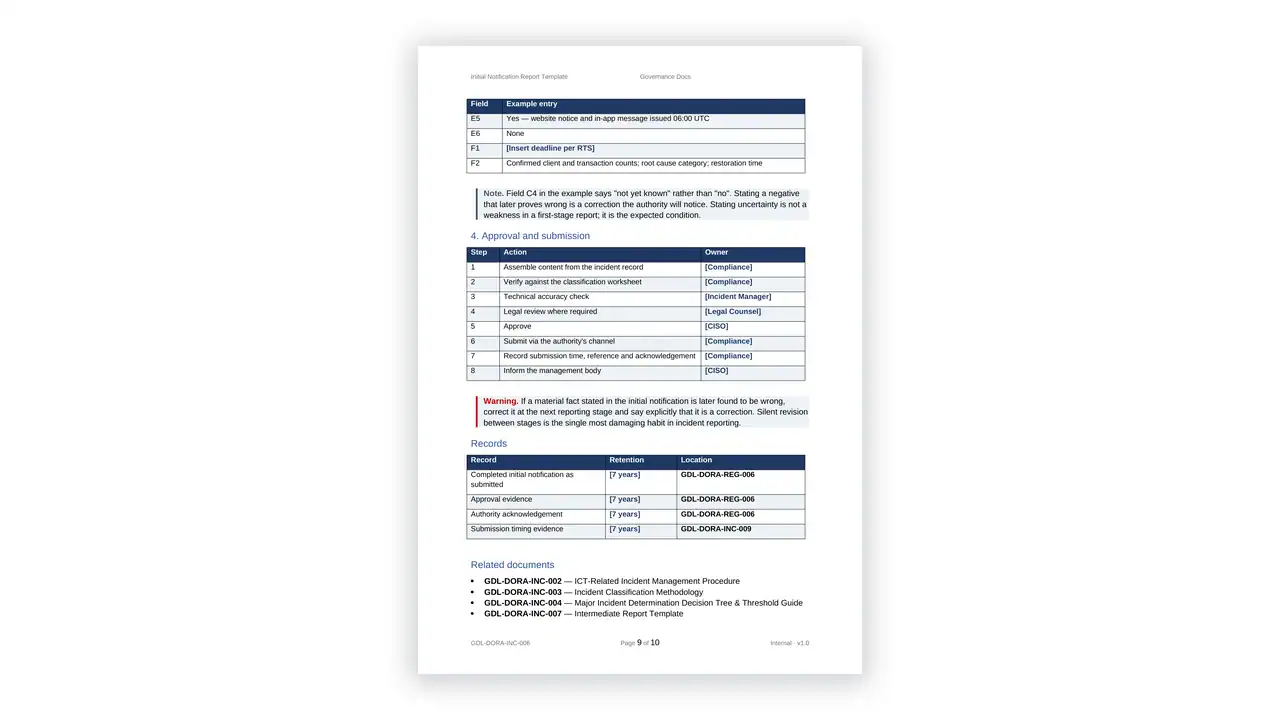
- Initial Notification Report Template
- Intermediate Report Template
- Final Report Template
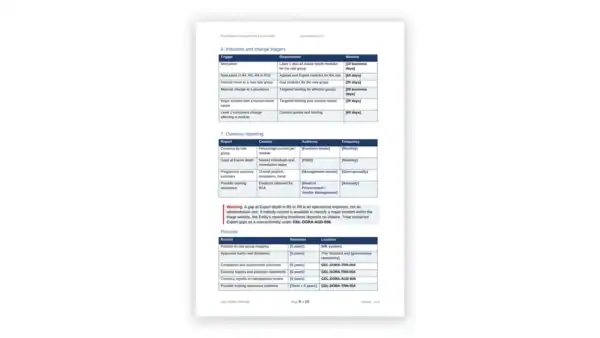
- Incident Reporting Timeline & Deadline Tracker
- Client & Stakeholder Notification Procedure
- Root Cause Analysis Procedure
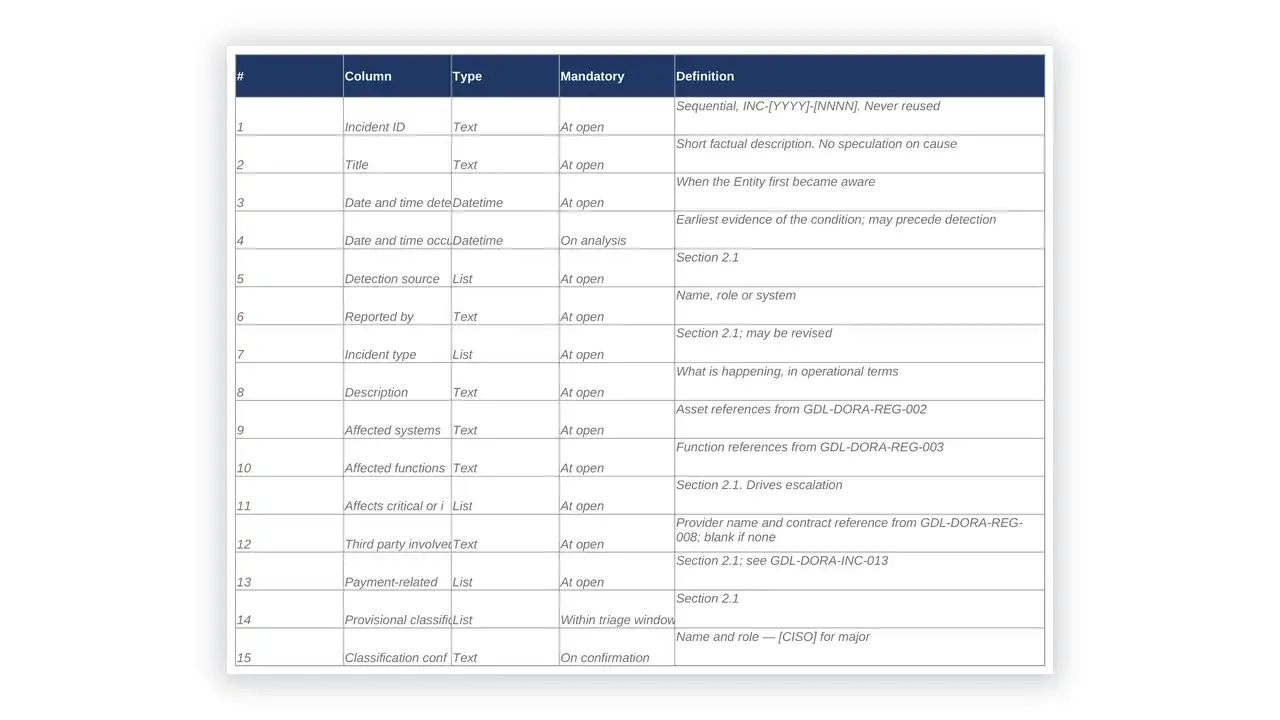
- ICT Incident Log
- Payment-Related Operational or Security Incident Procedure
- Incident Classification Worksheet
04 — Resilience Testing & TLPT, Pillar 3 (12)
The testing programme, including threat-led penetration testing.
- Digital Operational Resilience Testing Policy
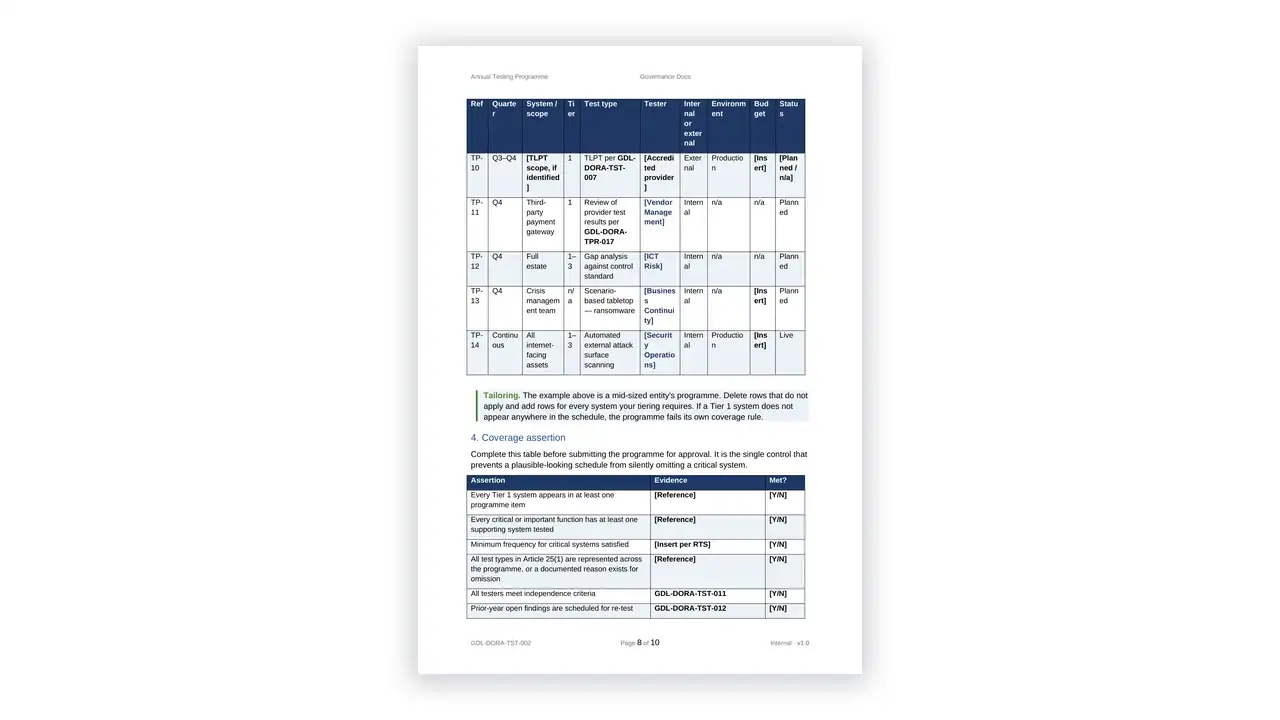
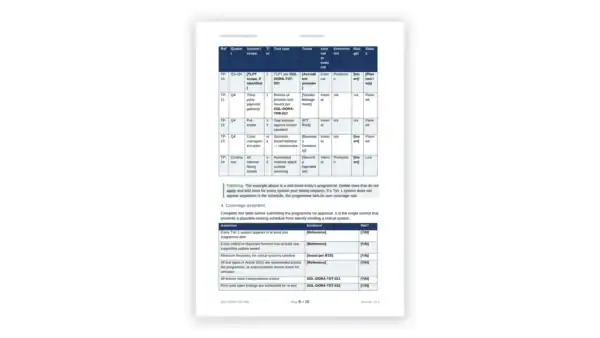
- Annual Testing Programme
- Test Planning, Scoping & Prioritisation Procedure
- Vulnerability Assessment & Scanning Procedure
- Scenario-Based & Performance Testing Procedure
- Testing of ICT Tools & Systems Standard
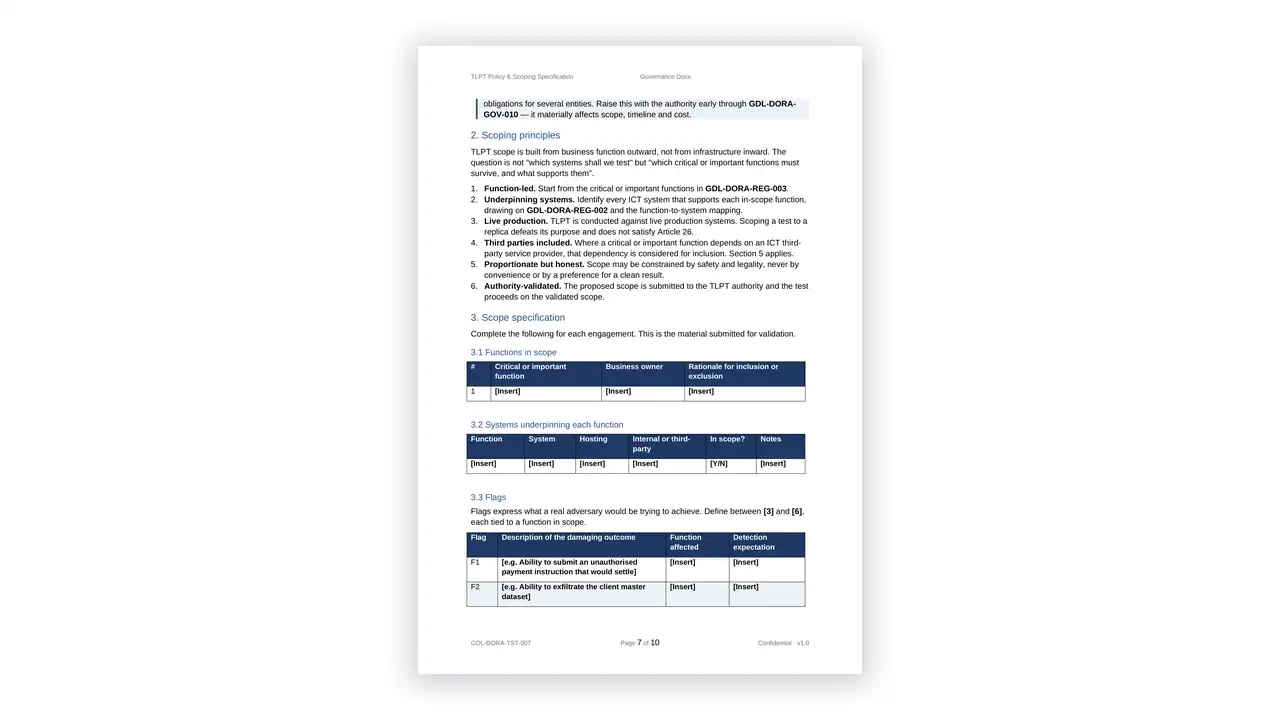
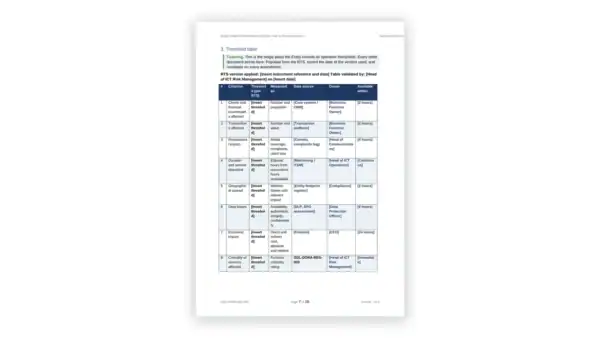
- TLPT Policy & Scoping Specification
- TLPT Threat Intelligence Requirements Procedure
- TLPT Red Team & Control Team Engagement Procedure
- TLPT Closure, Attestation & Remediation Procedure
- Tester Selection & Independence Criteria
- Test Inventory, Schedule & Remediation Tracker
05 — ICT Third-Party Risk, Pillar 4 (18)
Due diligence, contracts, concentration risk and exit.
- ICT Third-Party Risk Management Policy
- Strategy on ICT Third-Party Risk
- Policy on ICT Services Supporting Critical or Important Functions
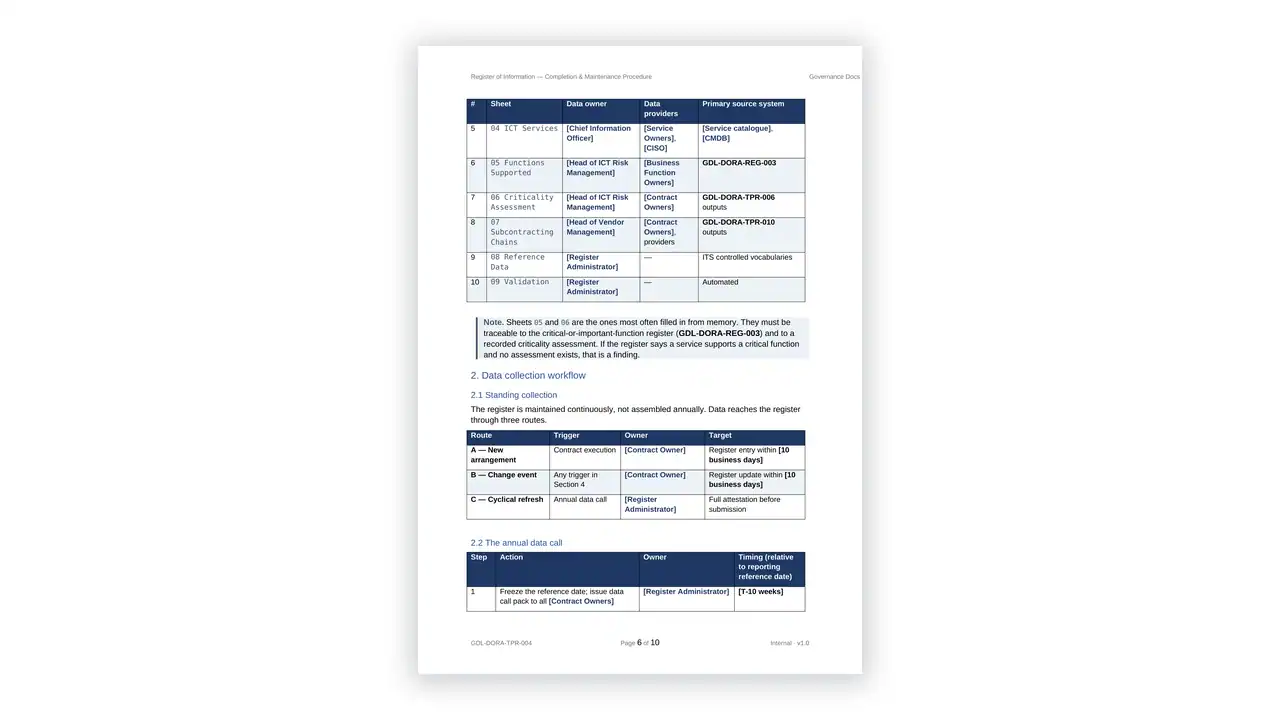
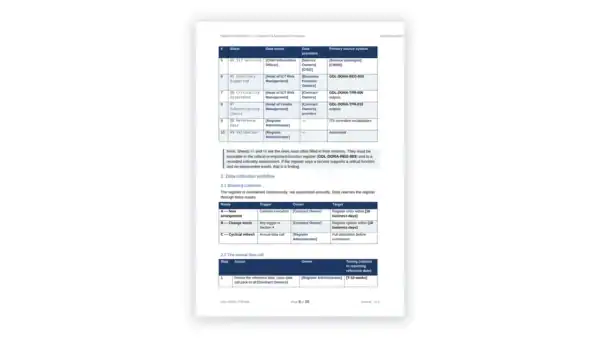
- Register of Information — Completion & Maintenance Procedure
- Pre-Contractual Due Diligence Procedure
- ICT Service Criticality Assessment Procedure
- ICT Concentration Risk Assessment Procedure
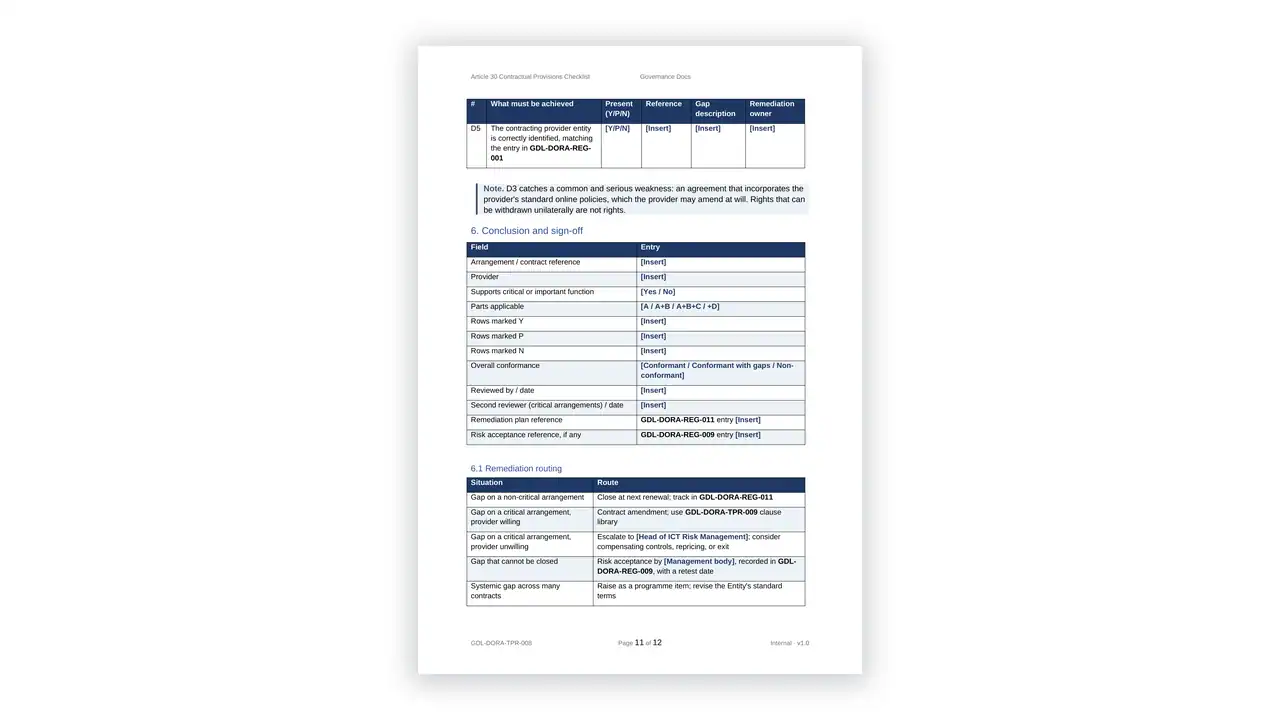
- Article 30 Contractual Provisions Checklist
- Contractual Clause Library — Critical or Important Functions
- Subcontracting Assessment & Monitoring Procedure
- Ongoing Monitoring & Performance Review Procedure
- Exit Strategy & Substitutability Policy
- Exit Plan Template — Critical ICT Service
- Contract Termination Rights & Triggers Procedure
- CTPP Oversight Framework Interface Procedure
- Third-Party Incident & Vulnerability Notification Requirements
- Audit & Access Rights Procedure
- ICT Third-Party Risk Assessment Worksheet
06 — Information & Intelligence Sharing, Pillar 5 (3)
Voluntary sharing of cyber threat information.
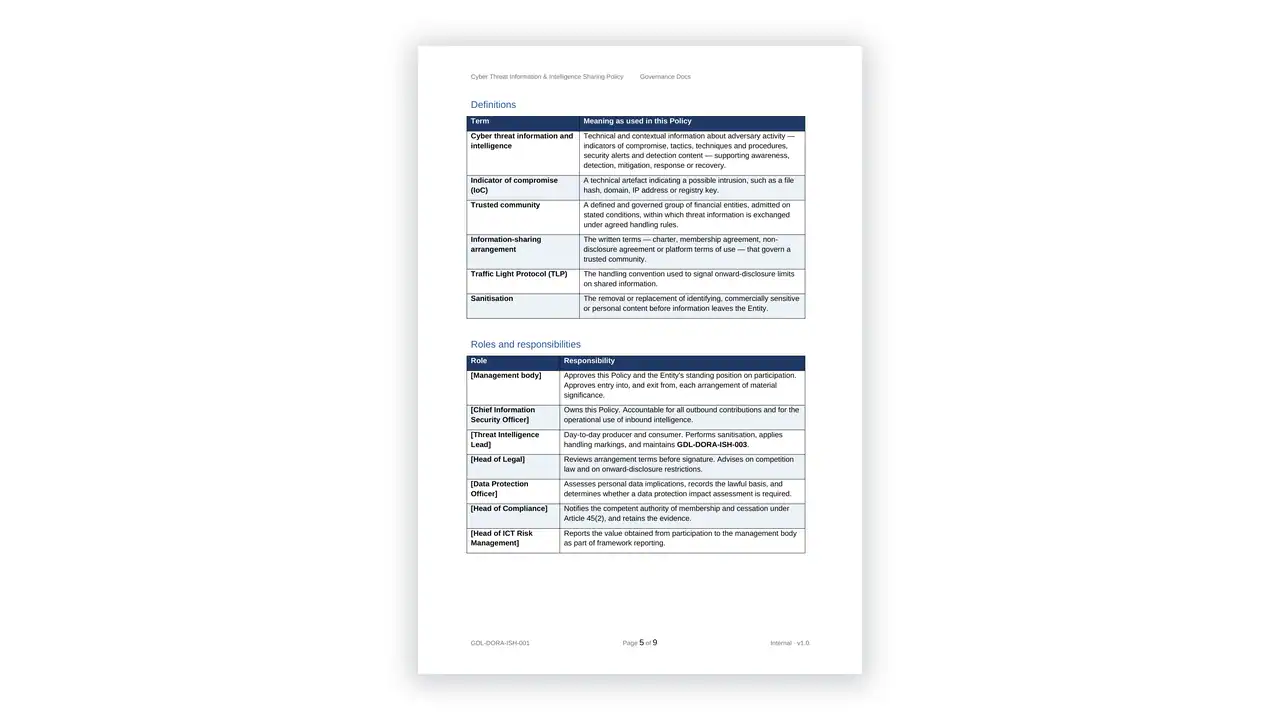
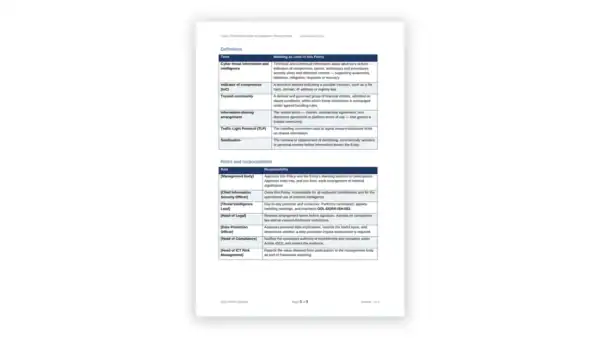
- Cyber Threat Information & Intelligence Sharing Policy
- Information Sharing Arrangement Participation Procedure
- Threat Intelligence Sharing Log
07 — Registers, Logs & Working Tools (12 Excel workbooks)
Every one a real spreadsheet with validation and built-in checks.
- Register of Information (multi-sheet, ITS-structured)
- ICT Asset Inventory & Criticality Register
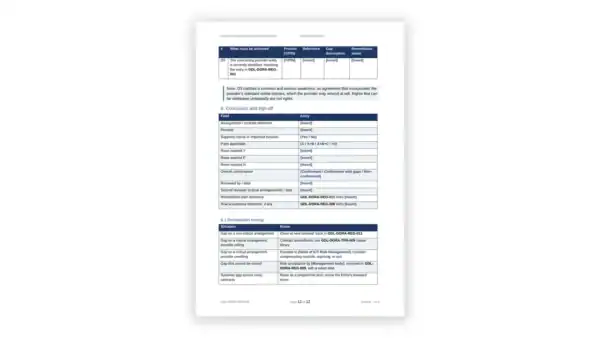
- Critical or Important Functions Register
- ICT Risk Register
- ICT Incident Register
- Major Incident Reporting Tracker
- Testing Programme Register
- ICT Third-Party Contract Register
- Exception & Risk Acceptance Register
- Legal & Regulatory Obligations Register
- Remediation & Action Tracker
- Digital Operational Resilience KPI / KRI Dashboard
08 — Audit, Assurance & Management Review (7)
Independent assurance and the management review cycle.
- DORA Internal Audit Programme & Plan
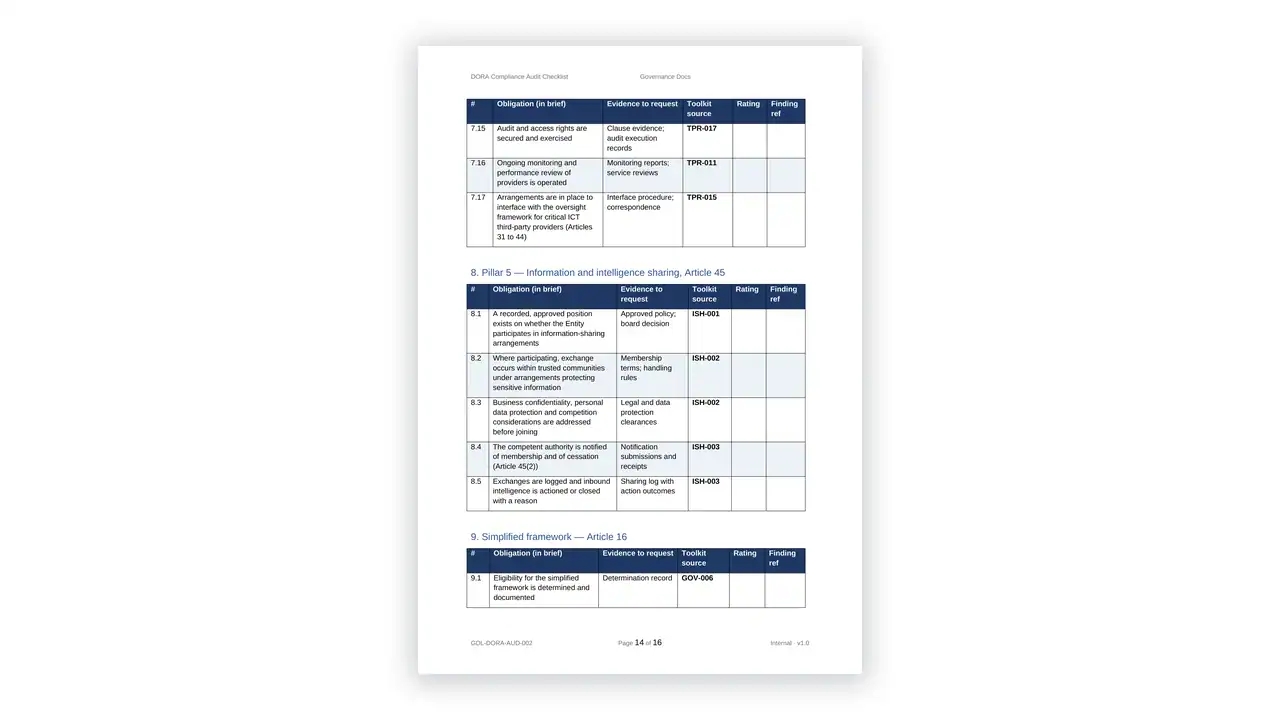
- DORA Compliance Audit Checklist
- ICT Risk Management Framework Audit Procedure
- Management Review Procedure & Agenda
- Management Review Minutes Template
- Nonconformity & Corrective Action Procedure
- Audit Findings & CAPA Tracker
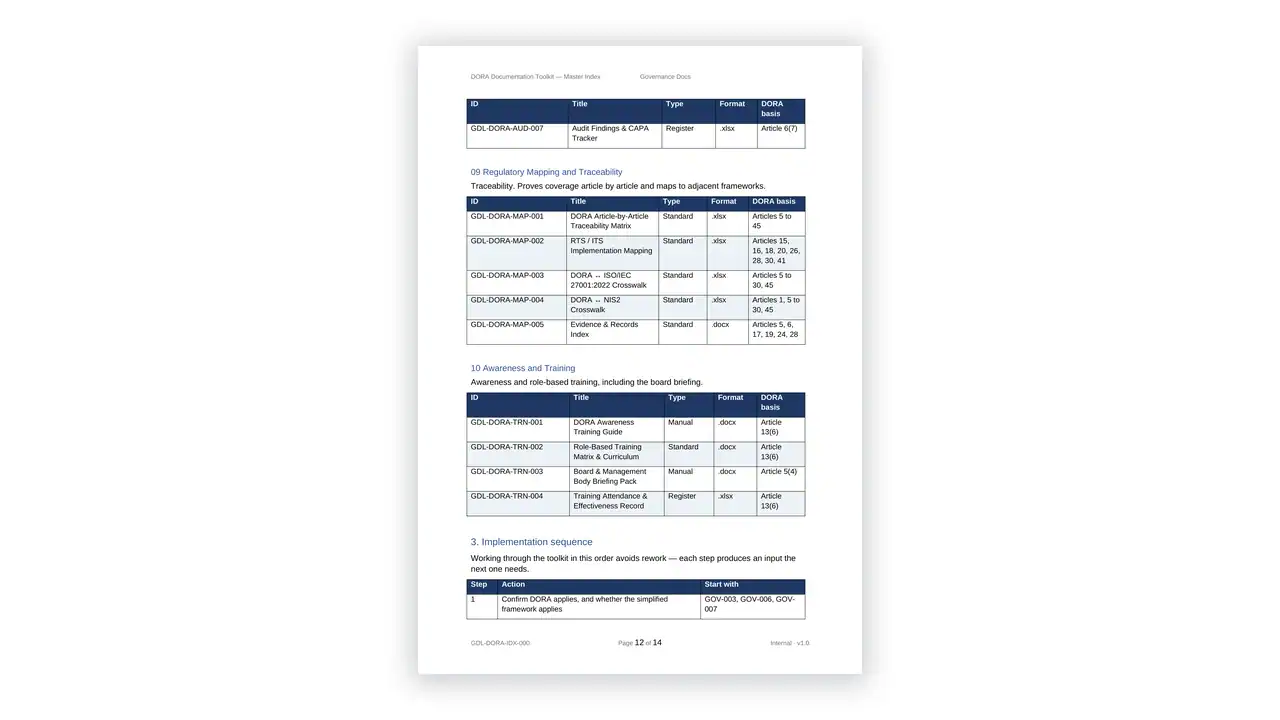
09 — Regulatory Mapping & Traceability (5)
Proves coverage article by article and maps to adjacent frameworks.
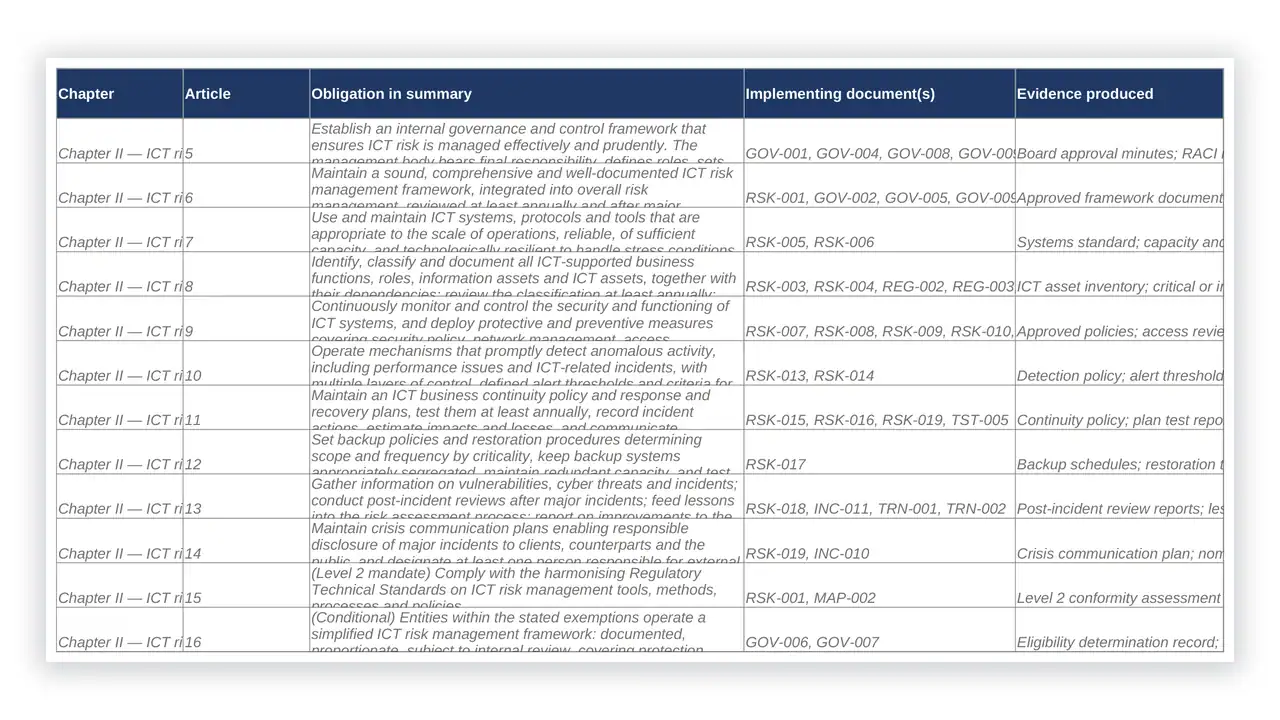
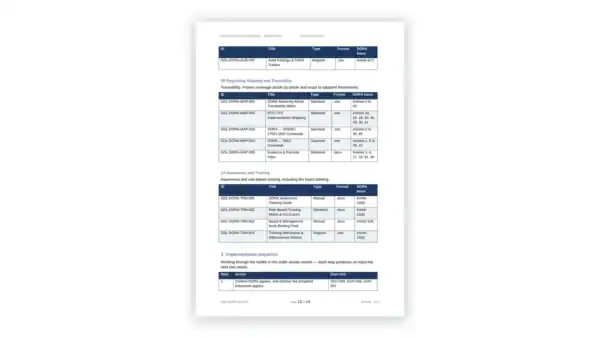
- DORA Article-by-Article Traceability Matrix
- RTS / ITS Implementation Mapping
- DORA ↔ ISO/IEC 27001:2022 Crosswalk
- DORA ↔ NIS2 Crosswalk
- Evidence & Records Index
10 — Awareness & Training (4)
Staff, role-based and board-level training.
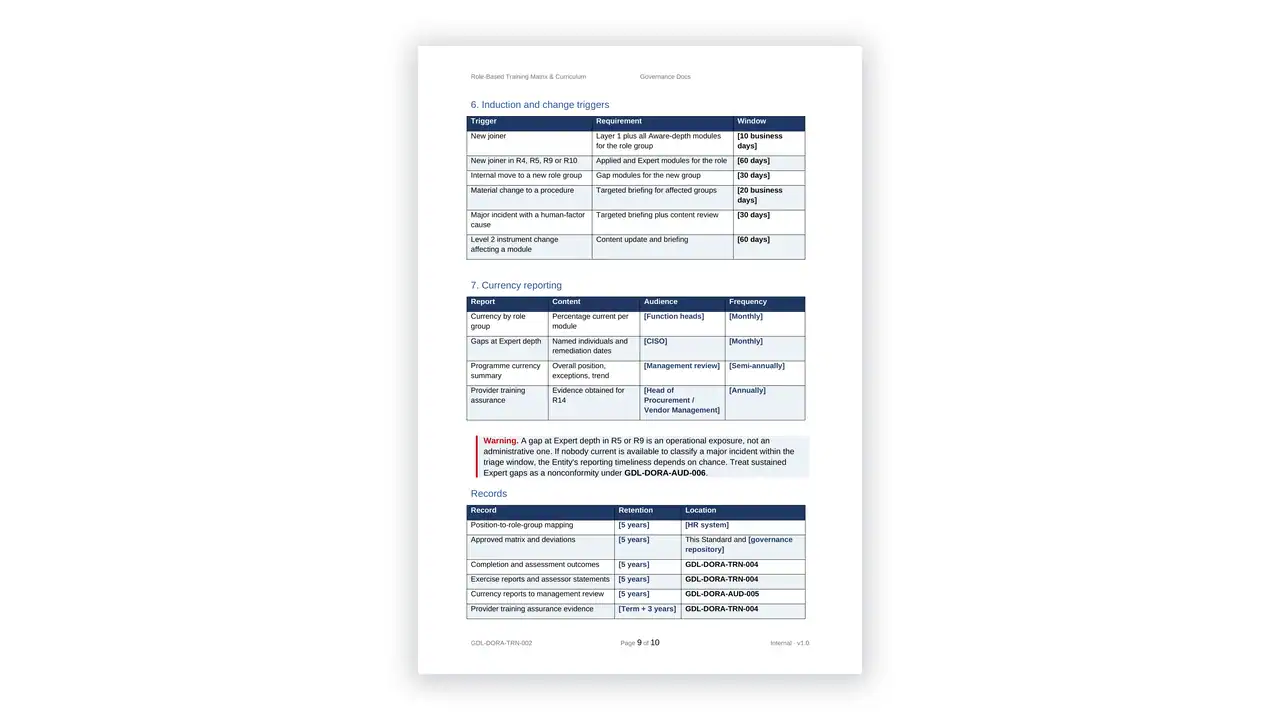
- DORA Awareness Training Guide
- Role-Based Training Matrix & Curriculum
- Board & Management Body Briefing Pack
- Training Attendance & Effectiveness Record
Plus a Master Index, a How to use this Toolkit guide and a Toolkit FAQ.
How to Use This Toolkit?
Start with the Master Index and the How to use this Toolkit guide, which set out a 12-step implementation sequence. Add your organisation’s name and logo, replace the clearly marked placeholder values, remove anything that does not apply, and route each document for approval at the level it specifies.
Based on Which Regulation Are These Documents Written?
All documents are based on Regulation (EU) 2022/2554 (DORA) and the Regulatory and Implementing Technical Standards adopted by the European Supervisory Authorities. They are adaptable to other jurisdictions with minimal adjustment.
Ready to transform your digital resilience strategy? Invest in the DORA Toolkit and take the first step towards unwavering operational resilience and compliance.
Frequently Asked Questions (FAQ)
What is the DORA Toolkit?
The DORA Toolkit is a comprehensive set of ready-to-edit documentation templates designed to help financial sector organisations comply with the Digital Operational Resilience Act (DORA). It includes policies, procedures, registers and report templates covering ICT risk management, incident classification and reporting, resilience testing, third-party risk and information sharing.
Who should use this toolkit?
This toolkit is ideal for banks, fintech companies, insurance providers, investment firms, crypto-asset service providers and any financial entity in scope of DORA. It suits compliance teams, CISOs, auditors and consultants managing digital operational resilience.
What documents are included in the DORA Toolkit?
You receive 100+ editable templates across ten folders, including the Register of Information, incident classification and three-stage reporting templates, the resilience testing and TLPT set, Article 30 contractual checklists, exit strategies, 12 Excel registers, and article-by-article traceability matrices.
Does it cover the Register of Information?
Yes. The Register of Information is provided as a multi-sheet Excel workbook structured to the Implementing Technical Standards, with a completion and maintenance procedure explaining who supplies each field and in what order. Field names should be mapped to the ITS templates in force before submission.
Is the DORA Toolkit customizable?
Yes. All documents are provided in Microsoft Office format with clearly marked placeholder text. You can insert your company name and logo and tailor the content to match your internal processes and ICT environment.
Does this toolkit help with audit readiness?
Absolutely. It includes an internal audit programme, a DORA compliance audit checklist, an article-by-article traceability matrix and an evidence index, so you can demonstrate coverage during supervisory engagement.
We already hold ISO 27001. Is this still needed?
Yes. ISO 27001 covers much of DORA’s ICT risk management pillar, and the included crosswalk shows what you can reuse. But ISO 27001 has no equivalent of the Register of Information, DORA’s incident classification and reporting, the resilience testing programme or Article 30 contractual provisions.
Is the DORA Toolkit suitable for global use?
Yes. While built for DORA compliance in the EU, it is flexible enough to adapt to other regulatory frameworks with minor edits, making it suitable for international financial firms seeking cross-border alignment.
Find More Products:
Implementing for clients? The Consultant Package bundles 87 toolkits — 7,900+ editable templates — under one firm-wide licence that covers unlimited client engagements. $1,399 one-time.
Looking for one document? DORA has applied since January 2025 and the register of information is the artefact supervisors ask for first. Our guide to the DORA compliance checklist covers what it has to contain.
Want to see the documents first? Five templates from this toolkit are free by email — get the DORA samples.
Guides for the DORA Toolkit
Free articles that explain the requirements this toolkit covers.

 DORA Toolkit - 100+ Comprehensive Templates$99.00



I have purchased and am using several sets of templates. They are very professionally designed and ready to use. They have reduced the implementation time by more than 70%.
Thank you
Really helpful pack with everything nicely organized and ready to use, which saved me a lot of time.
A well prepared and professional documentation pack that provides clear, practical resources for handling compliance requirements efficiently.