
CART
No products in the cart.
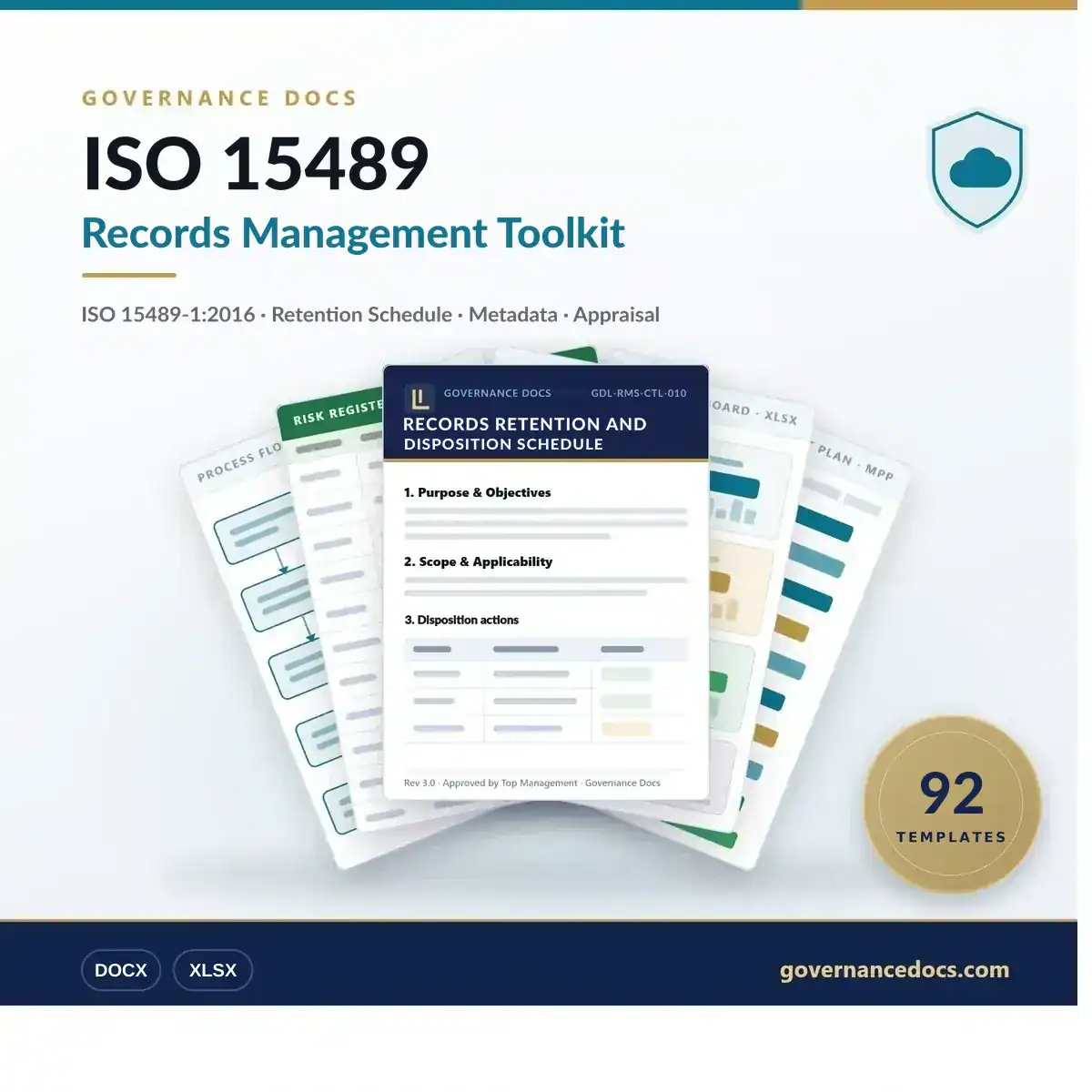
ISO 15489 Toolkit: 92 editable records management templates — 49 Word documents and 43 Excel workbooks — built on the clause structure of ISO 15489-1:2016. Every one of the 180 recommendation items in clauses 4 to 9 is mapped to the document that answers it. Records management policy, appraisal method, business classification scheme, metadata schema, access rules, a retention and disposition schedule with 44 record classes, legal hold, destruction, migration and digital continuity. Instant download.
$99.00
✓ In stock — instant download after checkout
ISO 15489-1:2016 is the international standard for records management. It is the second edition, published in April 2016, and ISO reviewed and confirmed it in 2021, so it is the current edition. It sets out the concepts and principles that every records programme rests on: what makes a record authoritative, what a records system has to do, who is responsible, how to decide which records to create and keep, the four records controls, and the processes from creation to disposition.
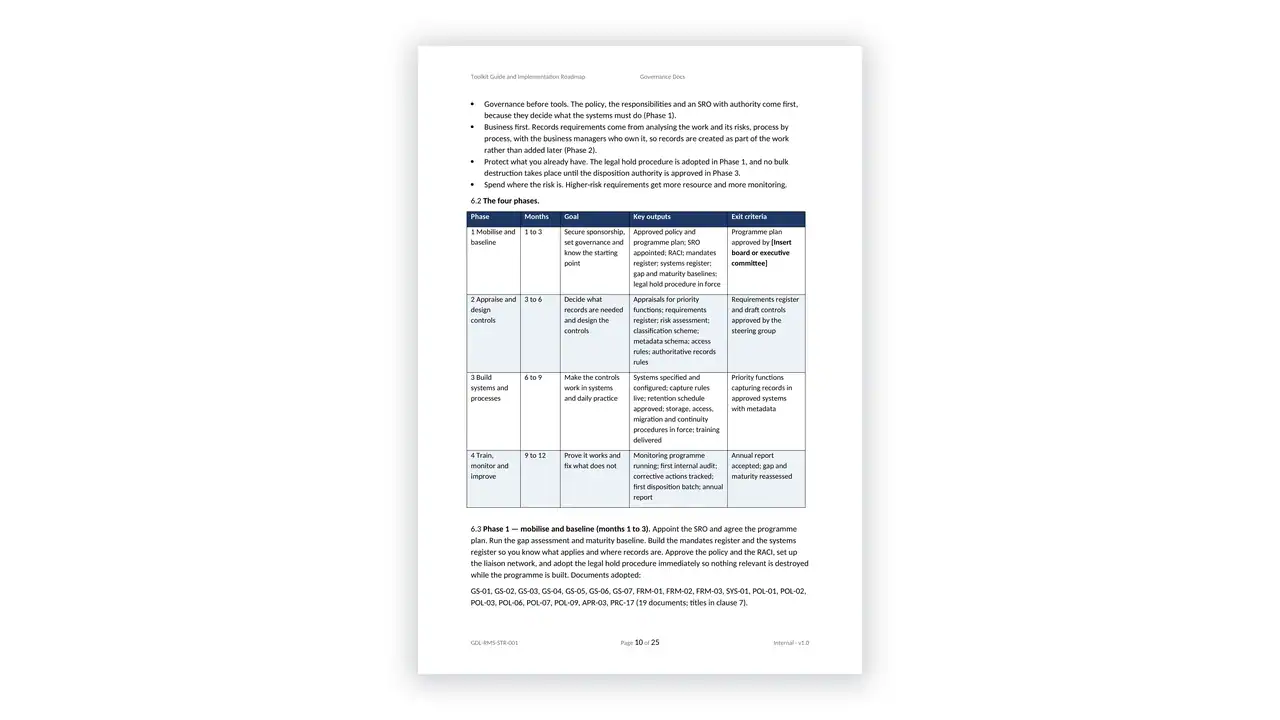
The ISO 15489 Toolkit is organised the way the standard is. Its sections are the standard’s clauses 4 to 9, so the pack reads in the same order an auditor or reviewer works through it. 92 editable templates: 49 Word documents and 43 Excel workbooks, in ten sections.
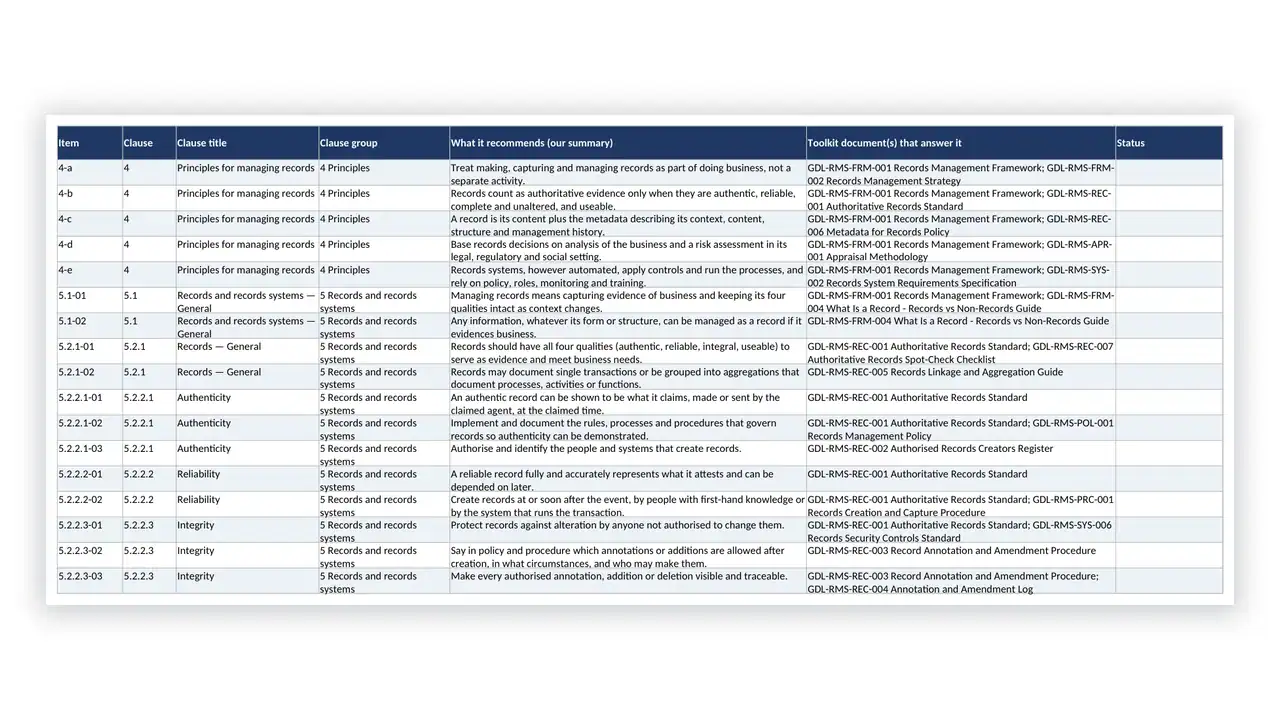
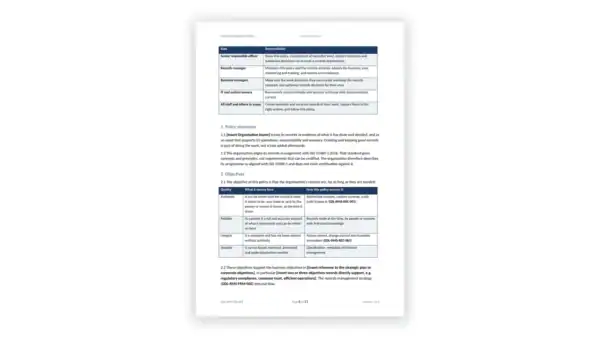
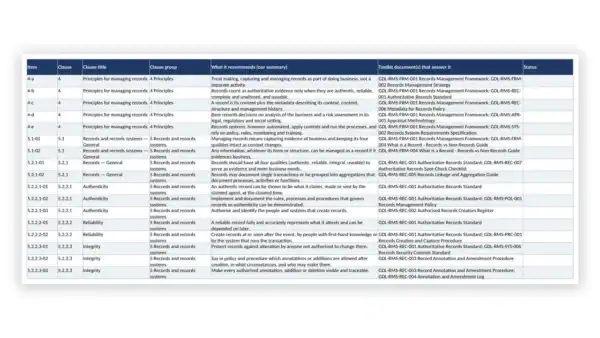
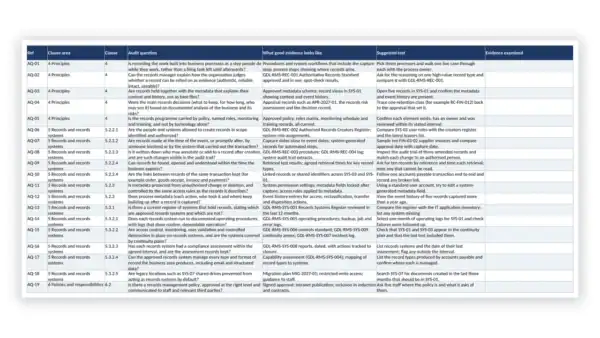
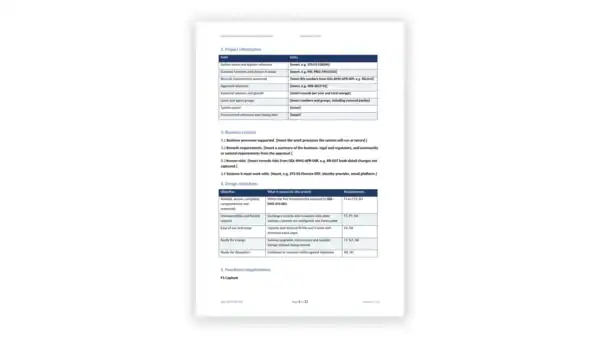
We broke clauses 4 to 9 into 180 recommendation items, one for each thing the standard recommends or each element of a list it gives. Every Word document opens with a Requirements addressed table naming the items it answers and the part of the document that answers each one. The pack is built from a single register, and the build fails if any item is left without a document that answers it. That is a check we run, not a claim we make.
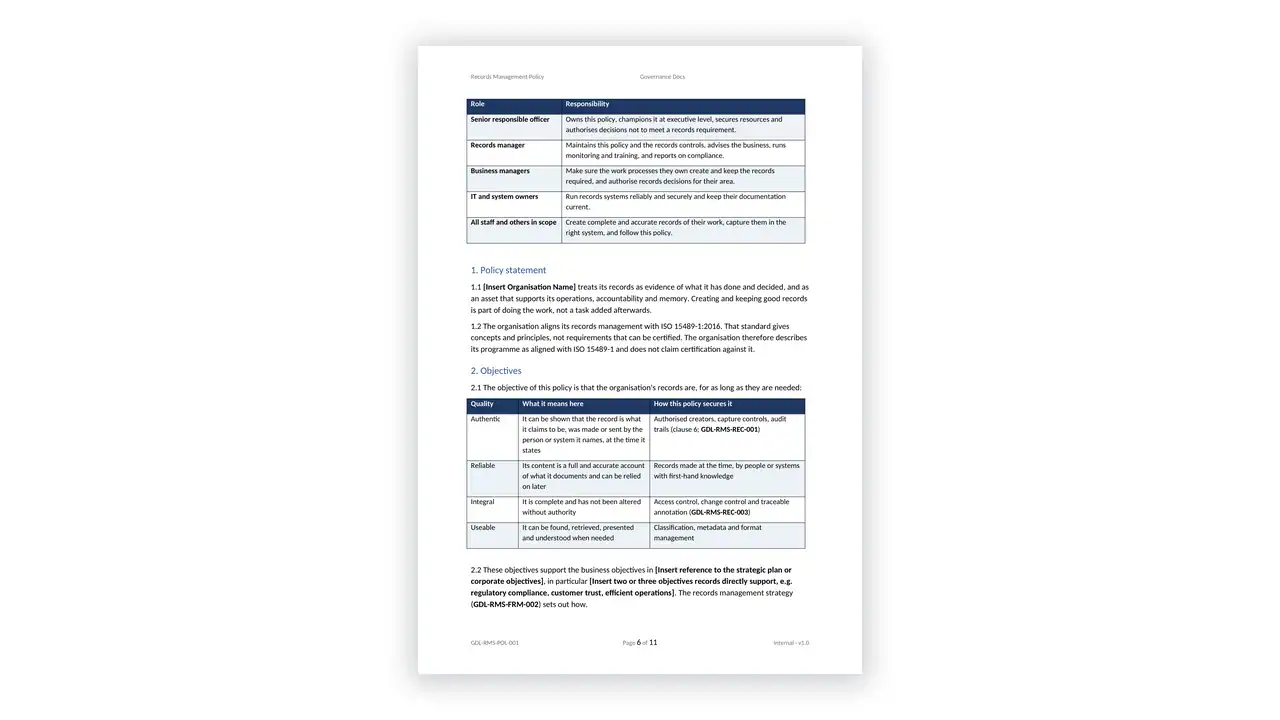
ISO 15489-1 recommends; it does not contain requirements an auditor can certify against. Nobody holds an “ISO 15489 certificate”, and a supplier who offers one is selling something the standard does not provide. The toolkit says so in the policy, the framework and the guide, and it gives you the wording to describe your programme correctly: aligned with ISO 15489-1.
If you need a certifiable management system for records, that is ISO 30301. ISO 15489-1 is the operational base underneath it, and this toolkit is where you start.
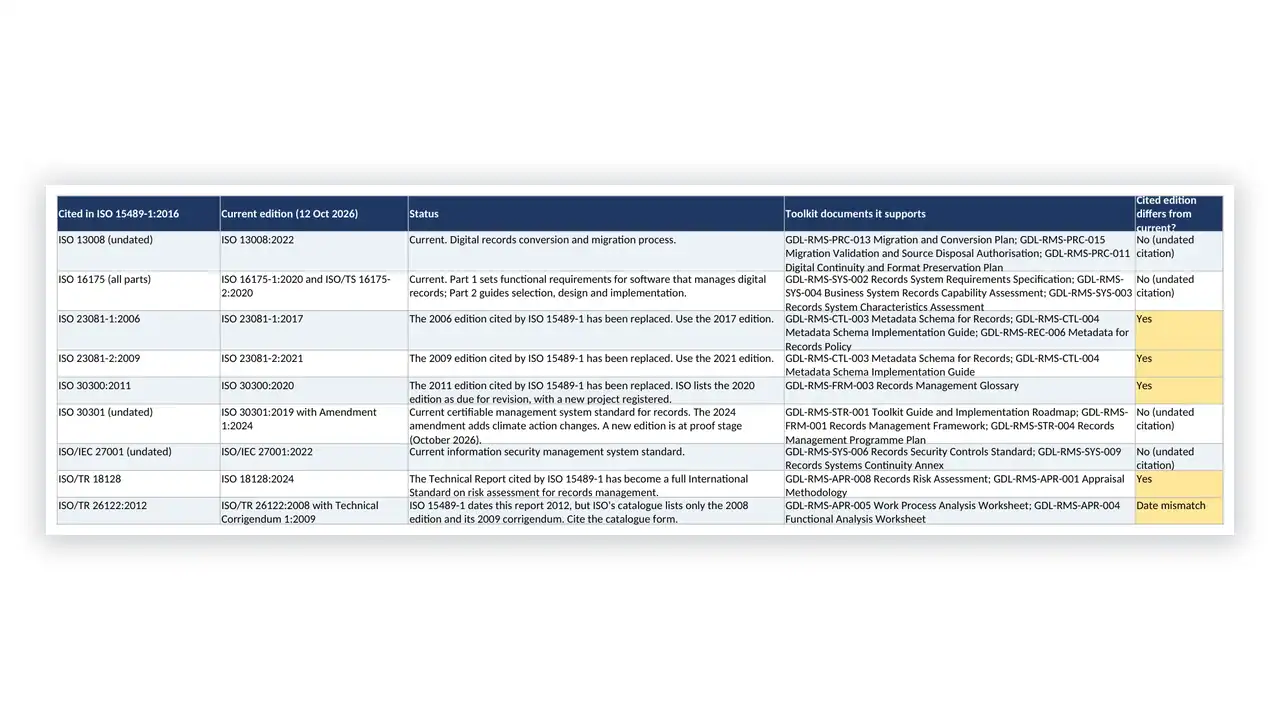
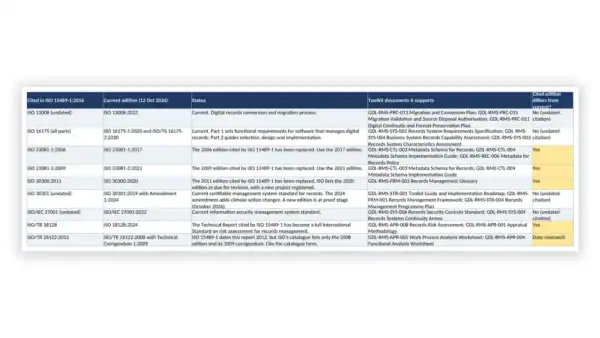
ISO 15489-1:2016 still points to standards that have since been replaced. Its bibliography cites ISO 23081-1:2006 (now the 2017 edition), ISO 23081-2:2009 (now 2021), ISO 30300:2011 (now 2020), and the Technical Report ISO/TR 18128, which has since become the full standard ISO 18128:2024. Its foreword names ISO/TR 15489-2, which ISO has withdrawn.
The Records Standards Family Crosswalk maps each of the 9 standards the bibliography cites to its current edition, checked against ISO’s catalogue in October 2026, and links each one to the toolkit documents it supports. Your documents, contracts and system specifications then cite what is current, not what was current in 2016.
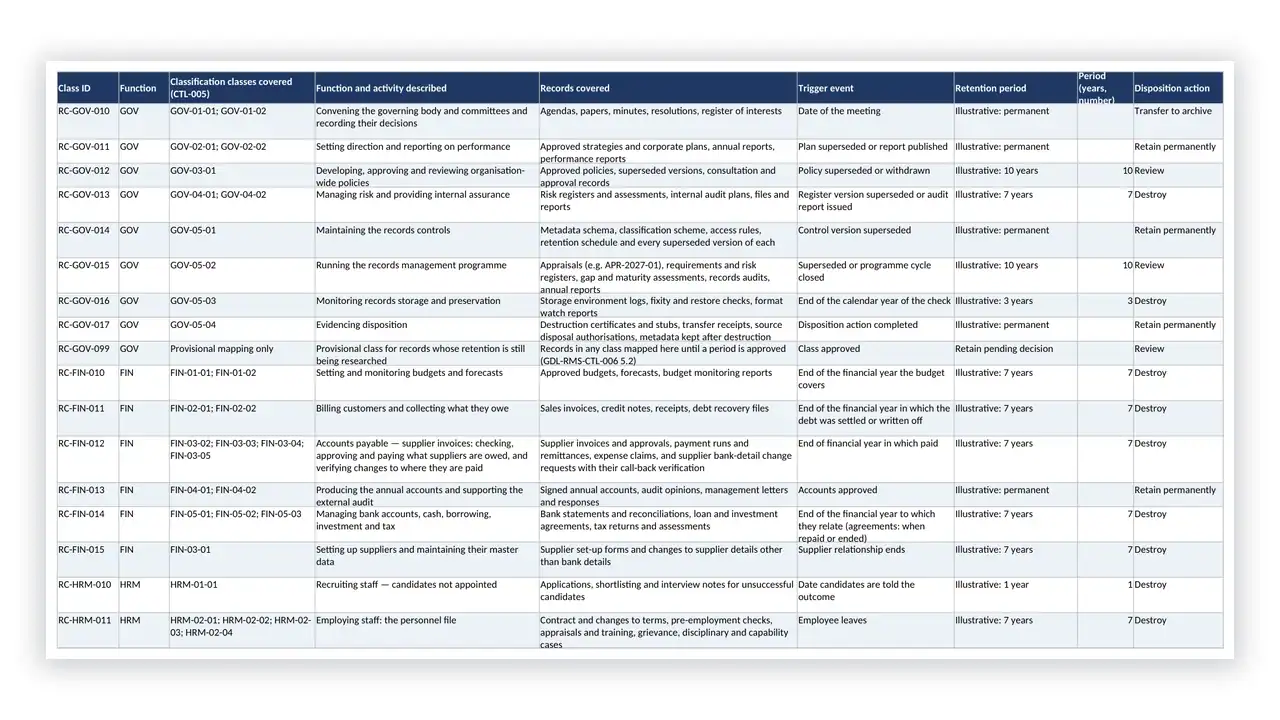
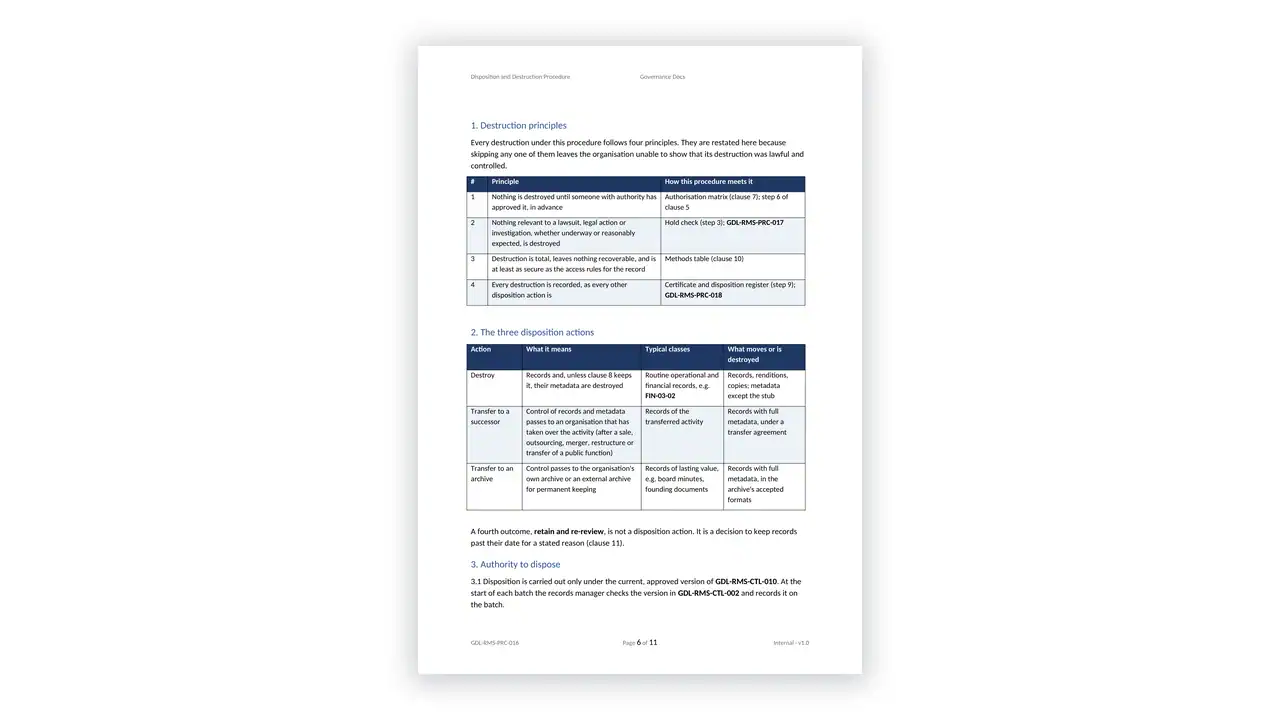
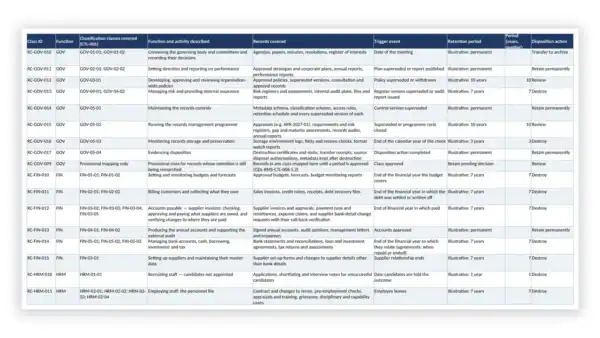
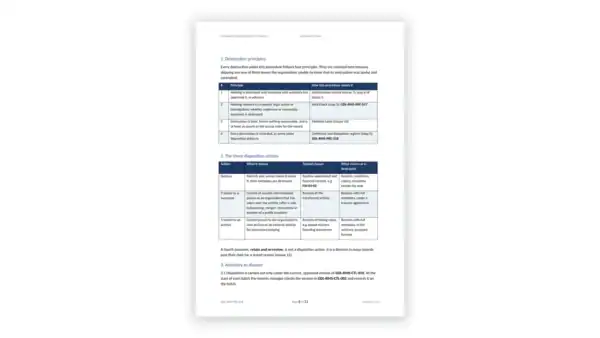
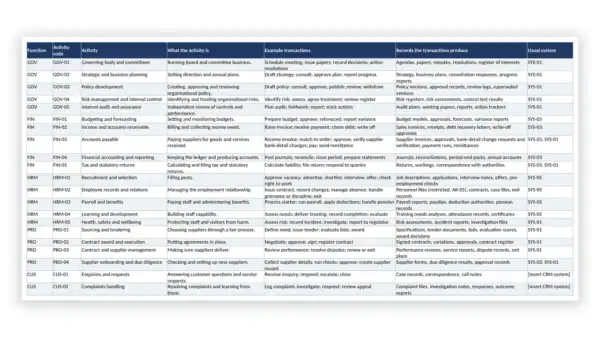
The retention and disposition schedule is the document most organisations need first. The toolkit’s schedule arrives with 44 function-based record classes across ten business functions, each with a class identifier, a description, the records it covers, a trigger event, an example retention period and a disposition action: the fields clause 8.5 says a disposition authority needs.
Every period is marked as illustrative. Retention law differs by country, sector and contract, and a schedule copied from a template carries someone else’s law. The schedule links each class to a records mandates register where you record the law, regulation or business need behind each period, for each jurisdiction you operate in, before you approve it.
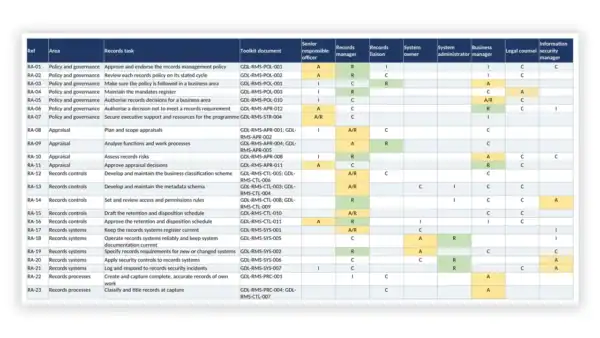
ISO 15489-1 names four records controls. The toolkit gives you each one as a working workbook, plus the procedure that governs it:
| Records control | What arrives in the workbook |
|---|---|
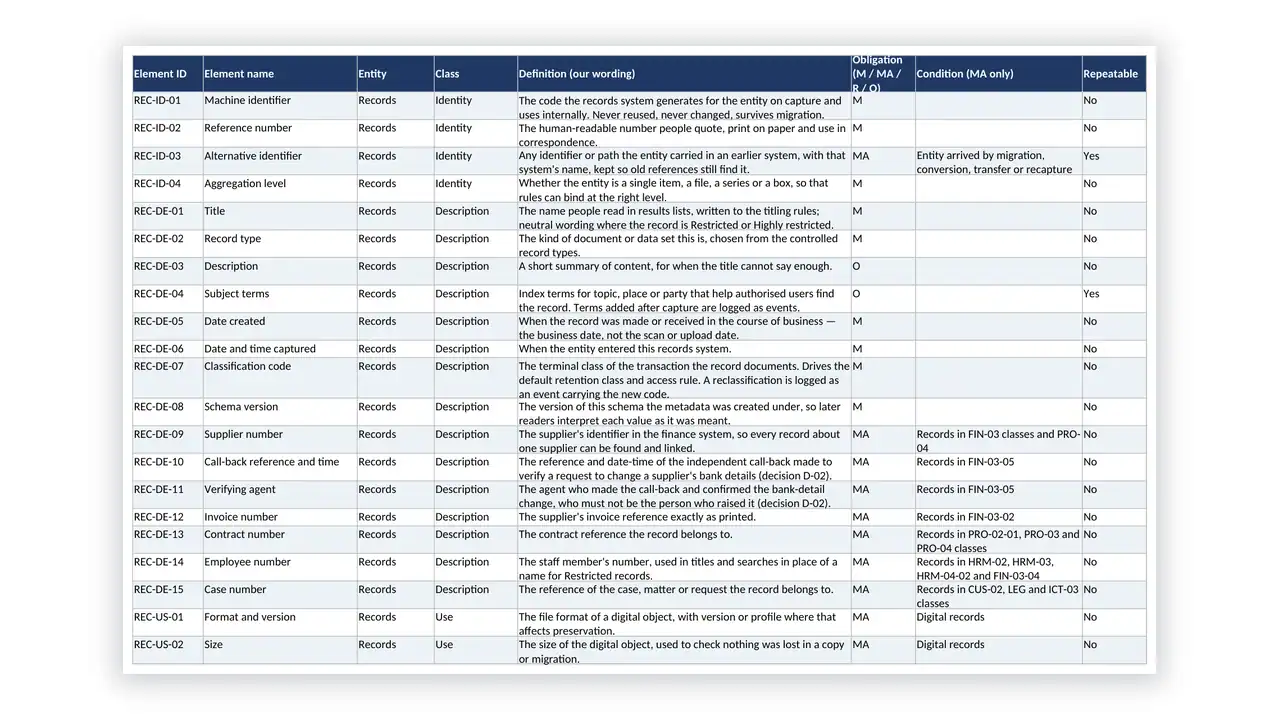
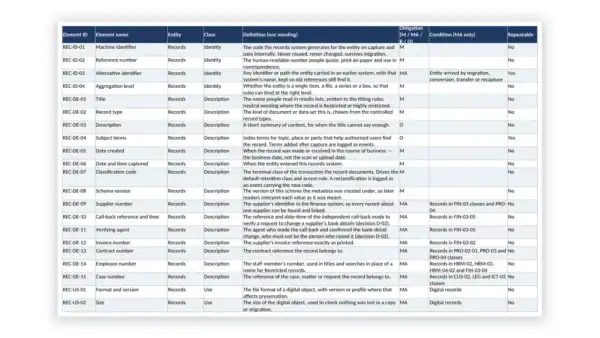
| Metadata schema | 66 metadata elements across the five entities and six classes, each with obligation, source, capture point and the control it references |
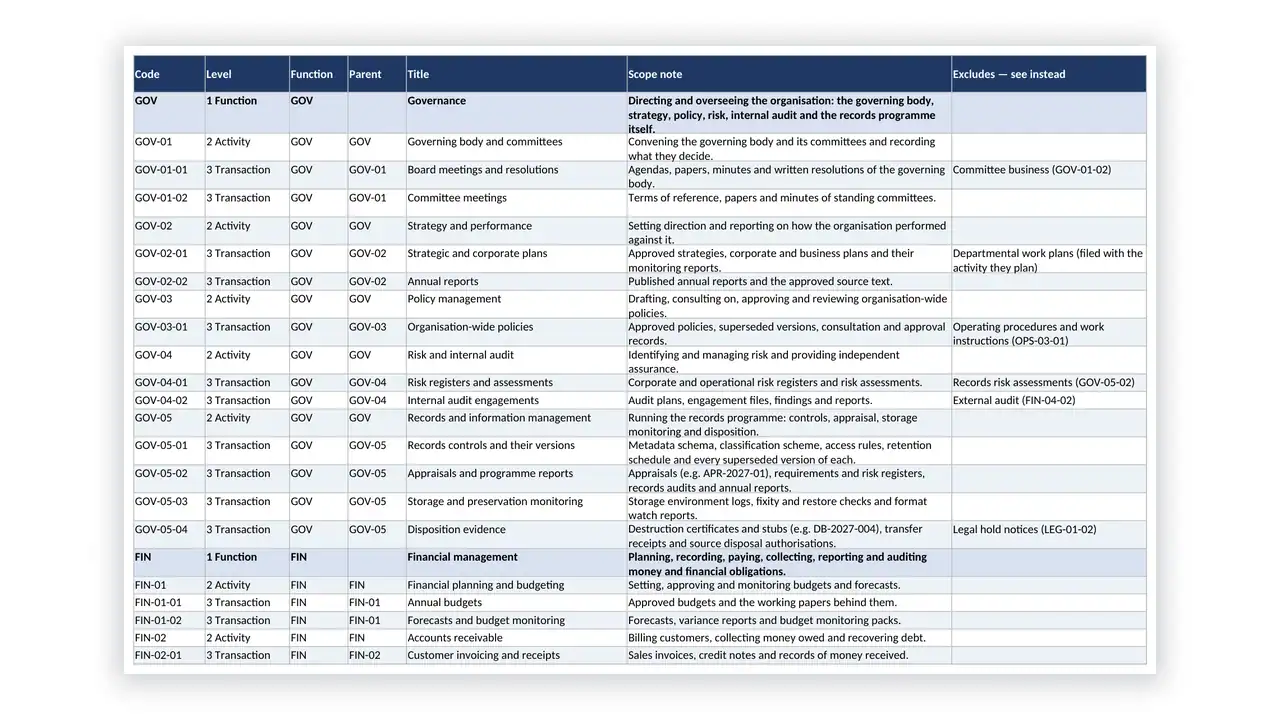
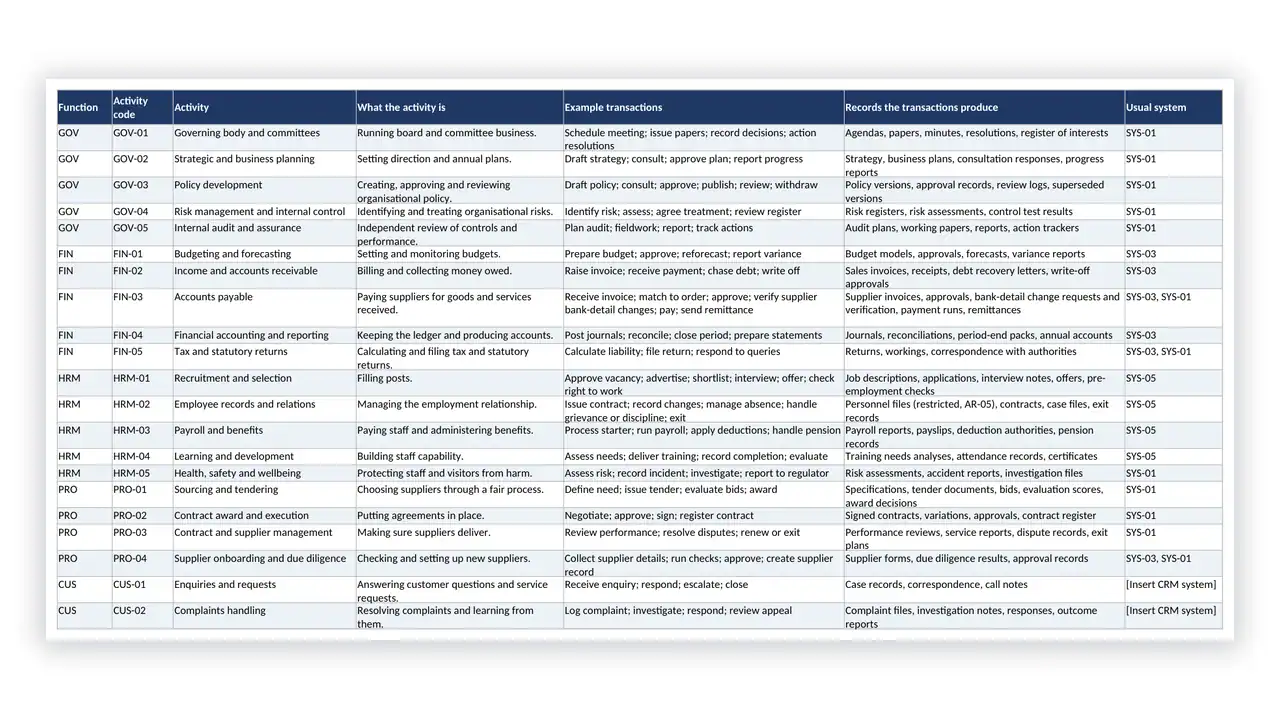
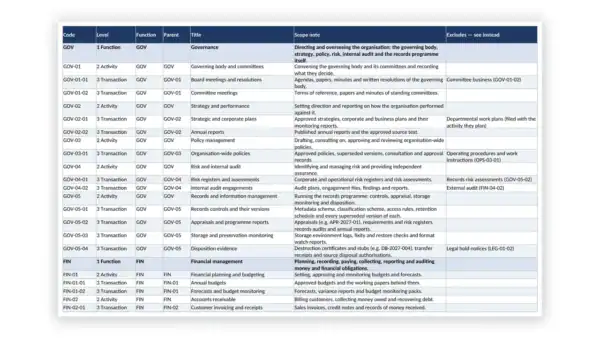
| Business classification scheme | 74 transaction-level classes under 40 activities and ten functions, function-based so it survives restructuring |
| Access and permissions rules | Security categories by agent group, with a rule register and review dates |
| Disposition authority | The 44-class retention and disposition schedule above |
The schema references the classification scheme, the access rules and the disposition authority, as clause 8.2 recommends, so a record captured with its metadata picks up its access and retention rules from the classification it is given.
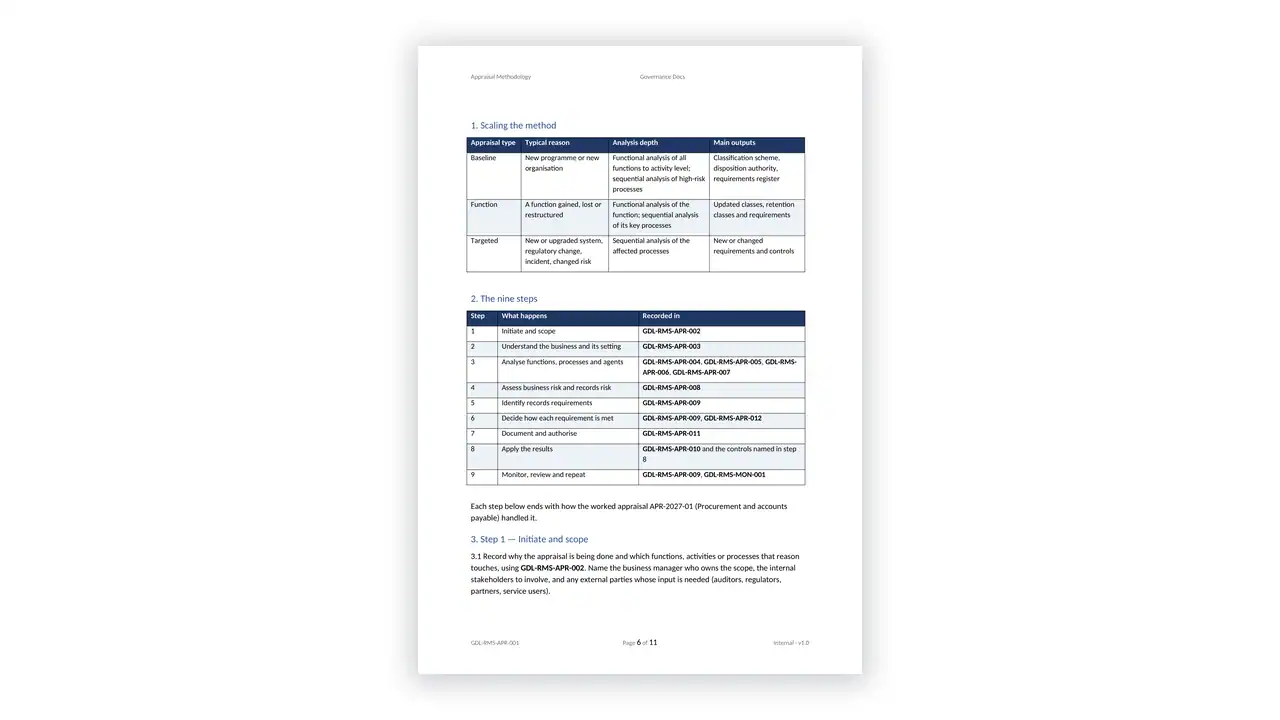
Clause 7 of ISO 15489-1 is appraisal: understanding the business, identifying records requirements from business needs, law and the expectations of the people you serve, and using risk to decide what to create, what to keep and for how long. It is the reasoning the retention schedule and every other control should rest on, and the part generic packs skip.
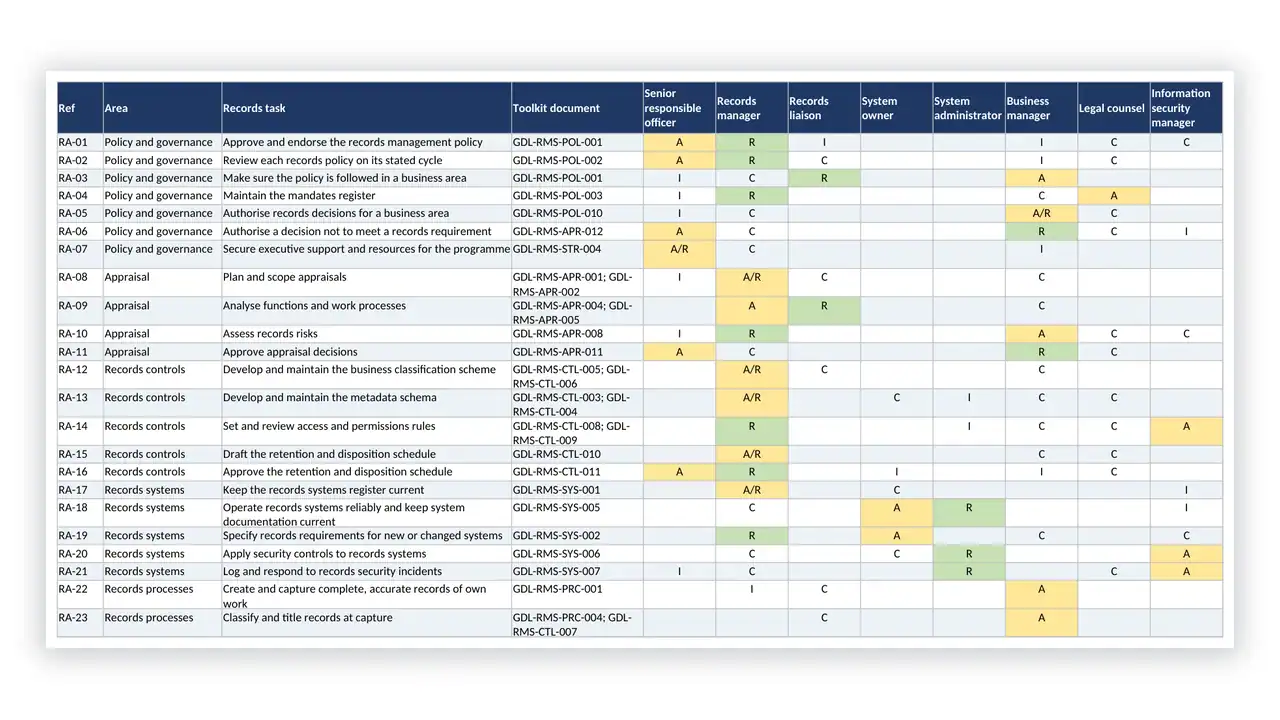
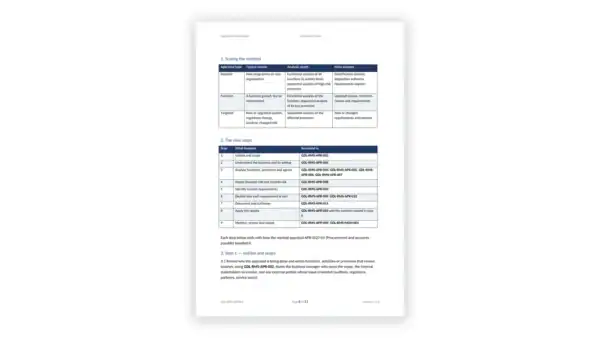
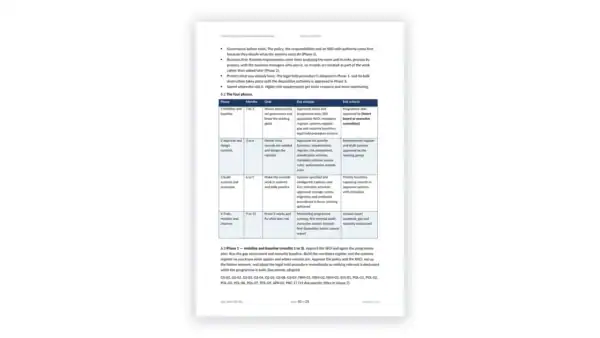
The toolkit’s appraisal section has a step-by-step methodology, a scoping statement, a business context analysis, functional and work process analysis worksheets, an agents and stakeholders register, a sources and interview log, a records risk assessment, a records requirements register, an implementation plan, and the decision record a senior manager signs.
| Workbook | What it holds on arrival |
|---|---|
| Recommendation Register and Conformance Matrix | All 180 recommendation items, each with its clause and the toolkit document that answers it |
| Gap Assessment | All 180 items ready to assess, with gap rating, priority and a live summary by clause |
| Maturity Self-Assessment | All 38 clauses and sub-clauses of clauses 4 to 9 on a five-level scale, with live averages |
| Records Standards Family Crosswalk | The 9 standards it cites, mapped to current editions |
| Retention and Disposition Schedule | 44 illustrative record classes |
| Metadata Schema | 66 metadata elements |
| Business Classification Scheme | 74 transaction-level classes in a three-level, function-based scheme |
Summaries use live formulas, so they are right the moment the data is. Worked example rows are shown in grey and never counted.
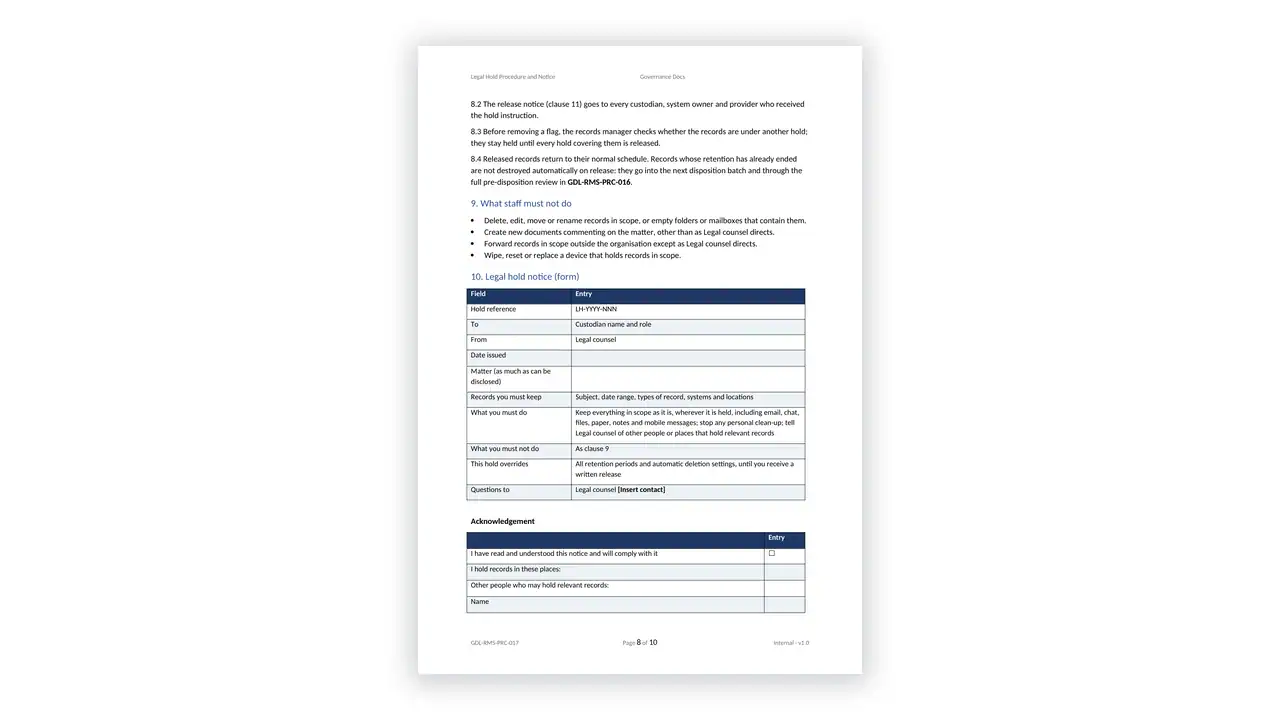
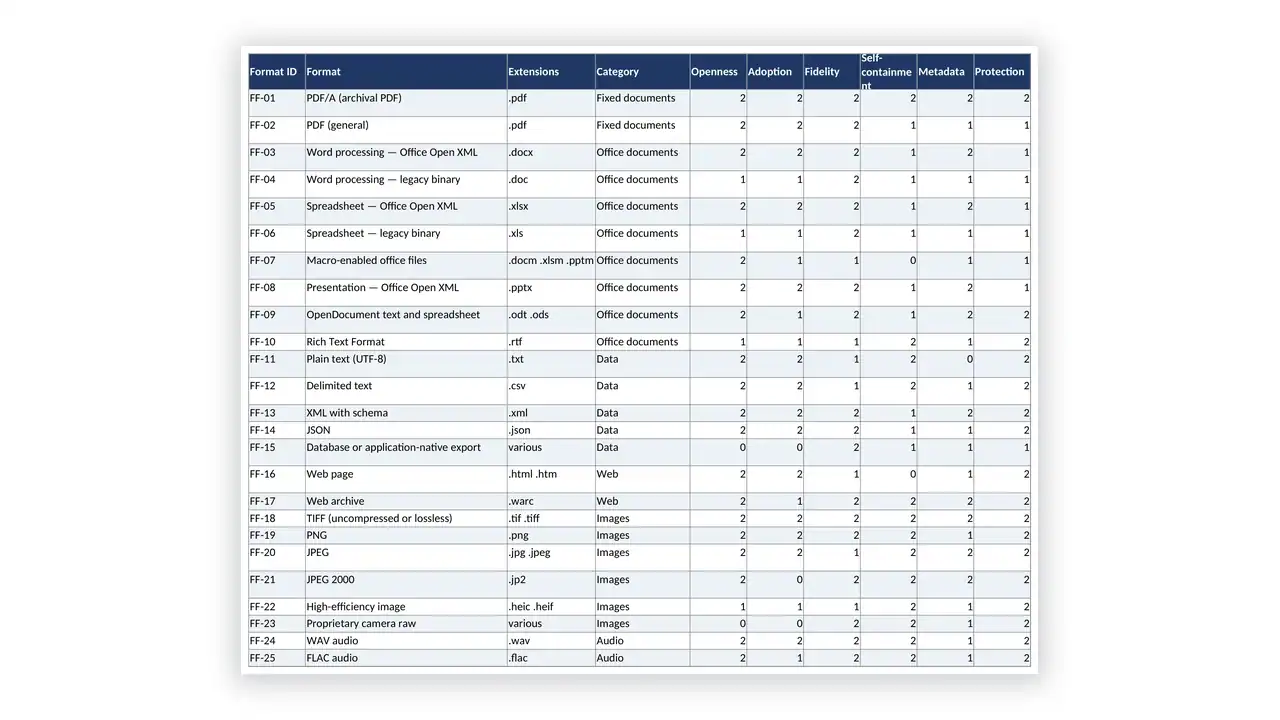
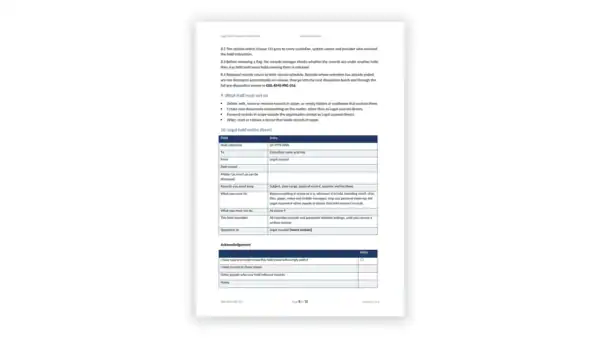
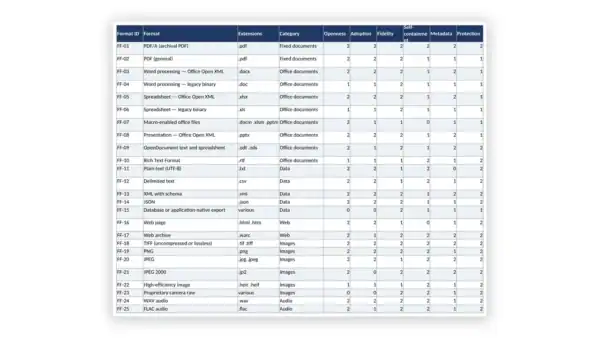
Section 09 runs the records processes of clause 9 end to end: creation and capture with a capture rules matrix, a unique identifier standard, classification and indexing, access control and redaction, storage, disaster preparedness, vital records, digital continuity and a file format register, migration and conversion with a validation and source-disposal sign-off, digitisation, disposition and destruction, a legal hold procedure and notice, and a disposition register for destruction certificates, transfers and holds.
One worked example runs through the pack, from the accounts payable class in the classification scheme to its retention class, a destruction batch and a legal hold, so you can see how the documents connect.
Records management sits underneath most of the other frameworks we cover. The ISO 9001 Toolkit and ISO 27001 Toolkit both depend on controlled documented information. The GDPR Toolkit and UK GDPR Toolkit need retention periods you can justify. The ISO 22301 Toolkit relies on vital records surviving a disruption, and the Data Governance Toolkit covers the structured data your records systems hold.
The ISO 15489 Toolkit is 49 Word documents and 43 Excel workbooks.
| # | Section | Documents |
|---|---|---|
| 00 | Start Here | 7 |
| 01 | Principles and Framework | 4 |
| 02 | Authoritative Records and Metadata | 7 |
| 03 | Records Systems | 9 |
| 04 | Policies and Responsibilities | 11 |
| 05 | Monitoring and Evaluation | 7 |
| 06 | Competence and Training | 5 |
| 07 | Appraisal | 12 |
| 08 | Records Controls | 12 |
| 09 | Records Processes | 18 |
00 Start Here
01 Principles and Framework
02 Authoritative Records and Metadata
03 Records Systems
04 Policies and Responsibilities
05 Monitoring and Evaluation
06 Competence and Training
07 Appraisal
08 Records Controls
09 Records Processes
The ISO 15489 Toolkit is a set of 92 editable Microsoft Word and Excel templates for running a records management programme aligned with ISO 15489-1:2016. It covers every recommendation in clauses 4 to 9 of the standard, from the records management policy and appraisal to the metadata schema, classification scheme, access rules, retention schedule, legal hold and destruction.
No. ISO 15489-1 is a guidance standard: it recommends practice and contains no certifiable requirements. You can describe your programme as aligned with it. The certifiable standard for a management system for records is ISO 30301.
Yes. The toolkit cites clause numbers and describes each recommendation in our own words, but it does not reproduce ISO’s text. ISO 15489-1:2016 is sold by ISO and by national standards bodies.
ISO 15489-1:2016, the second edition, which replaced the 2001 edition. ISO reviewed and confirmed it in 2021 and it is the current edition. The crosswalk workbook maps the standards it cites to their current editions.
No, and no template’s periods should be. The schedule gives 44 record classes with example periods so you are not starting from a blank page, but every period has to be confirmed against the laws, regulations and contracts that apply to your organisation, recorded in the mandates register, and approved before use.
Yes. Where a document assumes separate people for separate duties, it says how a small organisation can combine roles while keeping a second person involved in the decisions that matter most: authorising destruction, changing access rules and signing off migrations.
Microsoft Word (.docx) and Microsoft Excel (.xlsx), 49 and 43 respectively. Every file is editable and unprotected. Workbooks carry drop-down validation, frozen headers, filters, live summary formulas and worked example rows flagged for deletion.
Free articles that explain the requirements this toolkit covers.
 ISO 15489 Toolkit – 92 Records Management Templates$99.00



Reviews
There are no reviews yet