CART
ISO 39001 vs ISO 45001 is the question every fleet operator, logistics firm and public-sector transport department asks once it has an occupational health and safety management system and someone points out that most of its serious injuries happen on public roads. ISO 45001:2018 covers work-related road risk in principle — driving is work, a collision is a work-related injury, the hazard identification in clause 6.1.2 has to include it — but it gives no model for it.
ISO 39001:2012 is written for exactly that gap: a road traffic safety (RTS) management system built on the Safe System approach, with a clause 6.3 that names the performance factors an organisation can influence and a clause 6.4 that turns them into objectives. Both are harmonized-structure standards, both are certifiable, and for a fleet the sensible answer is rarely one or the other. This guide compares the two clause by clause, sets out the five differences that decide the choice, explains the edition position of each — ISO 45001 stable, ISO 39001 at working-draft revision — and shows how to run ISO 39001 inside an ISO 45001 system as one certification.
Free gap assessment
Could you prove workers take part in safety decisions?
Score every clause of ISO 45001, free, including the consultation and participation evidence that fails more audits than any other requirement.
Run the free ISO 45001 gap assessment → or View premium report sample
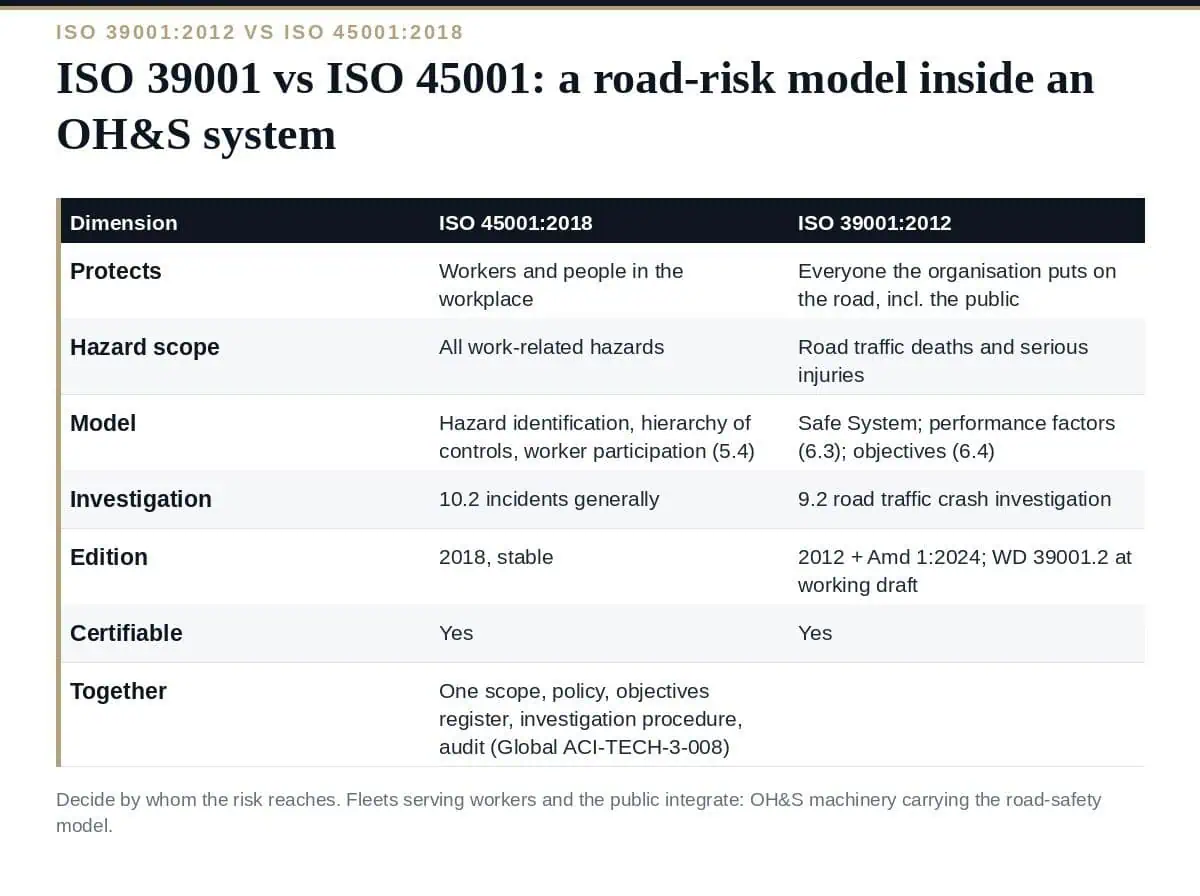
| Dimension | ISO 45001:2018 | ISO 39001:2012 |
|---|---|---|
| Title | Occupational health and safety management systems — Requirements with guidance for use | Road traffic safety (RTS) management systems — Requirements with guidance for use |
| Edition and status | First edition, March 2018; ISO/TC 283; stable | First edition, October 2012, 37 pages; ISO/TC 241; Amd 1:2024 (climate change, free); stage 90.92 with ISO/WD 39001.2 at working draft |
| Who it protects | Workers — employees, contractors, agency staff — and others in the workplace | Everyone affected by the organisation’s road traffic activity: workers, contractors, customers, other road users |
| Scope of hazard | All work-related hazards | Road traffic deaths and serious injuries |
| Model | Hazard identification, risk assessment, hierarchy of controls, worker participation | Safe System approach; exposure, intermediate and final safety outcome factors |
| Distinctive clauses | 5.4 Consultation and participation of workers; 6.1.2 hazard identification; 8.1.2 hierarchy of controls; 8.1.3 management of change; 8.1.4 procurement including contractors | 6.3 RTS performance factors; 6.4 RTS objectives; 7.1 Coordination; 8.2 Emergency preparedness; 9.2 Road traffic crash and other incident investigation |
| Certifiable | Yes | Yes |
On ISO 39001 vs ISO 45001 the shared ground is most of the text. Clauses 4, 5, 6.1, 7, 8.1, 9.1, 9.3 or 9.4 and 10 are harmonized text in both, with OH&S or RTS wording: context, interested parties, scope, leadership, policy, roles, risks and opportunities, resources, competence, awareness, communication, documented information, operational planning, monitoring, internal audit, management review, nonconformity and improvement. An organisation certified to ISO 45001 has the machinery; ISO 39001 adds the factor analysis, the objectives, the road-specific controls and the crash investigation. The reverse is also true, and the integration is the reason most fleets end up with both. Our guide to ISO 45001 implementation covers the OH&S side.
| Situation | Recommendation | Why |
|---|---|---|
| Transport, logistics or passenger operator; road is the main serious-injury risk | Both, integrated; ISO 39001 leads on road risk | ISO 45001 covers the depot and the workforce; ISO 39001 supplies the road model and reaches other road users |
| Manufacturer or service company with a large grey fleet | ISO 45001 with ISO 39001 factors and objectives inside it; certify ISO 39001 if customers or insurers value it | The OH&S system exists; road risk is its largest gap |
| Organisation that generates traffic without owning vehicles — sites, events, schools | ISO 39001 | In scope through influence; ISO 45001’s worker focus misses the public |
| Customer or tender names ISO 39001 | ISO 39001 | Meet the requirement; integrate later |
| No management system yet; small fleet | ISO 45001 first, with road risk as a named hazard and ISO 39001 factors as the method | Broader legal duty; the road model can be adopted without certifying it |
| Public authority responsible for roads | ISO 39001 | The standard was written with road authorities in mind; ISO 45001 does not reach road design or the travelling public |
Does ISO 45001 cover driving for work?
Yes, in principle: driving is work and work-related road risk must be identified and controlled under clause 6.1.2. It gives no road-specific model, which is what ISO 39001 adds — the Safe System approach, the performance factors and road crash investigation.
Can we certify to ISO 39001 without ISO 45001?
Yes. ISO 39001 is a stand-alone certifiable standard. Organisations that generate road traffic without a workforce exposure — or whose road risk dwarfs everything else — sometimes hold it alone.
Is ISO 39001 being revised?
Yes. ISO 39001:2012 sits at stage 90.92 and ISO/WD 39001.2 is at working-draft stage, years from publication. The 2012 edition with its free 2024 amendment is the certifiable text; a system built on the Safe System approach will carry forward.
Which one do insurers and customers ask for?
Fleet customers and insurers increasingly name ISO 39001 for transport contracts; general employers, regulators and most tenders name ISO 45001. Fleets serving both audiences integrate.
Do we need worker participation for road safety?
ISO 45001 requires it (5.4) for the whole OH&S system, drivers included; ISO 39001 does not have the clause but expects coordination and communication. Driver participation in rosters, vehicles and near-miss reporting is the practical way to satisfy both.
Decide ISO 39001 vs ISO 45001 by asking whom the risk reaches. Workers in a workplace: ISO 45001. Everyone the organisation puts on the road, including the public: ISO 39001. A fleet with both: one system, the OH&S machinery carrying the road-safety model, one policy, one objectives register, one investigation procedure and one audit — with the road factors doing the work that the hierarchy of controls alone cannot.
The RTS policy, the performance-factor and exposure analysis, the objectives register, the journey management and fatigue procedures and the crash investigation form — written to integrate with an ISO 45001 system — are in the ISO 39001 Road Traffic Safety Toolkit, or start with the free templates.

October 12, 2026

October 12, 2026

October 12, 2026

October 12, 2026

October 12, 2026

