CART
A fleet safety policy is the document that turns an organisation’s duty of care for people on the road into rules a driver, a scheduler and a manager can each be held to — and under ISO 39001:2012 it is also the road traffic safety (RTS) policy clause 5.2 requires top management to establish, so it has to do two jobs at once. The management system job is to state commitments, provide the framework for the objectives in clause 6.4 and be communicated and available; the operational job is to say, in plain language, who may drive what, how vehicles are kept, how journeys are planned, what happens when a driver is tired, distracted or over a limit, and what the organisation does after a crash. Most fleet safety policies do the second job and forget the first, or do the first in language nobody in a cab will read. This guide sets out what ISO 39001 requires of the policy, the seven sections a working fleet safety policy contains, the rules that belong in each, how far it reaches — grey fleet, contractors and visitors included — how it is communicated and evidenced, and the five faults that make a policy fail an audit or a court.
Free gap assessment
Could you prove workers take part in safety decisions?
Score every clause of ISO 45001, free, including the consultation and participation evidence that fails more audits than any other requirement.
Run the free ISO 45001 gap assessment → or View premium report sample
| Requirement (clause 5.2 and the harmonized structure) | Applied to a fleet safety policy | Evidence |
|---|---|---|
| Appropriate to the purpose of the organisation | Written for this operation — HGVs, vans, passenger transport, grey fleet — not a generic template | Policy reads against the exposure analysis |
| Framework for setting RTS objectives | Every objective under 6.4 traces to a policy commitment | Objectives register cross-referenced |
| Commitment to comply with legal and other requirements | Hours rules, licensing, vehicle standards, roadworthiness, insurance, local road law | Requirements register |
| Commitment to continual improvement of RTS performance | Improvement measured on the performance factors of 6.3, not only on crashes | Trend data; management review |
| Documented, communicated, available to interested parties | Read and signed by drivers; briefed to schedulers and managers; available to contractors and customers | Signed acknowledgements; briefing records; contractor packs |
| Reviewed for continuing suitability | Annually and after significant change or a serious incident | Version history; review minutes |
Our guide to ISO 39001 covers the standard the policy sits in; the sections below are the operational half.
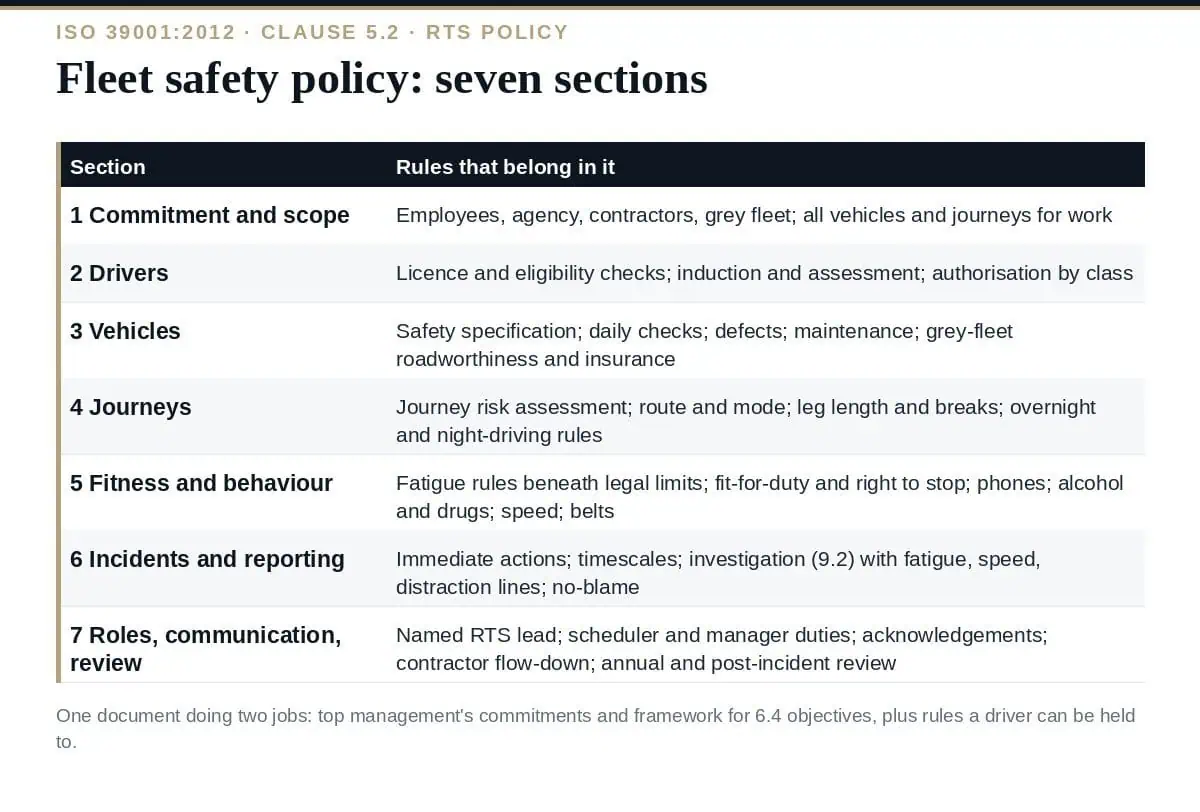
| Section | What it states | Rules that belong in it |
|---|---|---|
| 1 Commitment and scope | Top management’s commitment; who and what the policy covers | Applies to all who drive for work — employees, agency drivers, contractors and grey fleet; all vehicles used for work; all journeys including commuting where the organisation influences it |
| 2 Drivers | Who may drive and on what conditions | Licence and eligibility checks at start and periodically; driving history; induction and assessment; authorisation by vehicle class; agency and contractor driver requirements |
| 3 Vehicles | How vehicles are specified, inspected and maintained | Safety specification at procurement (restraints, ADAS, lighting); daily walk-round checks; defect reporting; maintenance and inspection schedules; grey-fleet roadworthiness and insurance checks |
| 4 Journeys | How journeys are planned and managed | Journey risk assessment; route and mode choice; maximum leg length and breaks; overnight rules; weather and night-driving rules; loading and securing |
| 5 Driver fitness and behaviour | The rules on fatigue, distraction, impairment and speed | Hours and rest rules beneath the legal limits; fit-for-duty declaration and the right to stop; mobile phone rule (no hand-held; policy on hands-free); alcohol and drugs; speed limits and telematics monitoring; seat belts; eyesight |
| 6 Incidents and reporting | What happens after a crash, a near miss or a concern | Immediate actions; reporting timescales; investigation under 9.2 with fatigue, speed and distraction as standing lines of enquiry; no-blame reporting; support for drivers |
| 7 Roles, communication and review | Who owns what; how the policy is communicated; how it is reviewed | Named RTS lead; manager and scheduler responsibilities; driver acknowledgement; contractor flow-down; annual review and post-incident review; consequences for breaches |
Our guide to the journey risk assessment covers section 4; our guide to driver fatigue covers the fitness rules in section 5.
| Audience | How it is communicated | Evidence |
|---|---|---|
| Drivers (employed and agency) | Induction; signed acknowledgement; toolbox talks; cab card with the key rules | Signatures; briefing records; cab card issue log |
| Schedulers and transport managers | Training on the rostering and journey rules they apply | Training records; scheduling system rules configured |
| Line managers of grey-fleet drivers | Briefing on checks and journey limits; approval role for long journeys | Approval records; check records |
| Contractors | Contract schedule; onboarding pack; periodic review | Contract clauses; monitoring records |
| Top management and the board | The policy is theirs; annual review with the RTS data | Review minutes |
Is a fleet safety policy the same as the ISO 39001 RTS policy?
It can and should be the same document. Clause 5.2 requires top management to establish an RTS policy with commitments, a framework for objectives and communication; a fleet safety policy that carries those elements and the operational rules satisfies the clause and is the document drivers actually read.
How long should it be?
Short enough to be read: a two- to four-page policy with the commitments and the rules by section, supported by procedures — journey management, fatigue, vehicle checks, incident investigation — that carry the detail.
Does it apply to staff who drive their own cars?
Yes, wherever they drive for work. Grey-fleet drivers are in scope of the duty of care and of ISO 39001 where the organisation influences their road use; the policy sets the checks and journey rules that apply to them.
What must drivers sign?
An acknowledgement that they have read and understood the policy and the rules that apply to them, renewed when the policy changes. It is the communication evidence clause 5.2 and 7.4 expect.
How often should it be reviewed?
Annually as part of management review, and after significant change — new vehicle types, new operations, new technology — or a serious incident.
Write one fleet safety policy that does both jobs: top management’s commitments and the framework for objectives in the first section, the rules for drivers, vehicles, journeys, fitness and incidents in the middle, and roles, communication and review at the end. Reach it into grey fleet and contractors, get it signed and briefed, enforce it consistently, and review it with the data — because a policy is evidence of a managed fleet only when the people on the road can say what it requires of them.
The Fleet Safety (RTS) Policy with the seven sections drafted, the driver acknowledgement form, the journey management and fatigue procedures, the vehicle check and defect forms and the incident investigation form are in the ISO 39001 Road Traffic Safety Toolkit, or start with the free templates.


October 11, 2026

October 11, 2026

October 11, 2026
October 11, 2026

October 11, 2026

