

Changing Certification Body: The Complete 2026 Transfer Guide
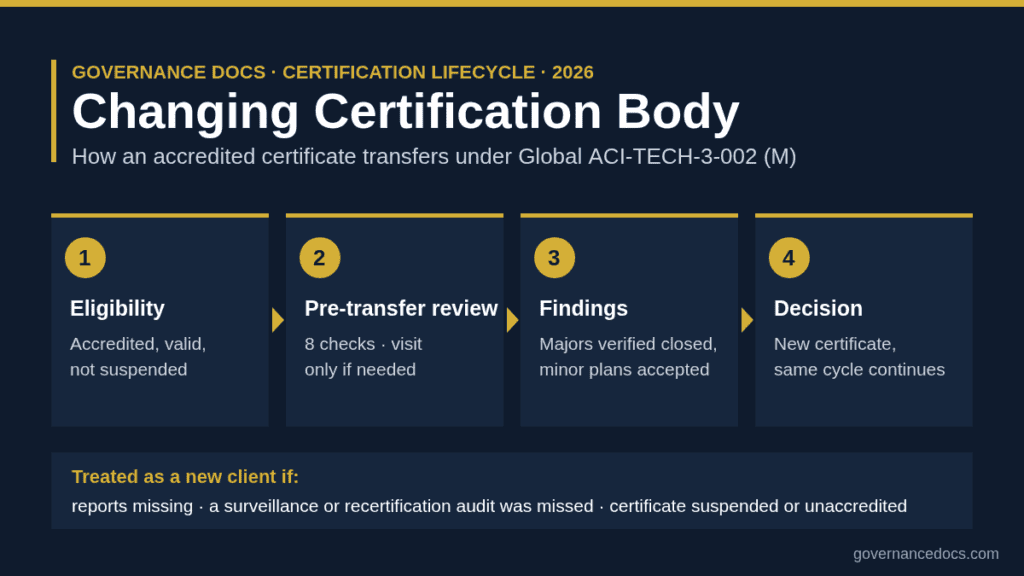
Changing certification body is something most certified companies consider at least once, usually after a fee rise, a poor audit or a change of auditor, and most hold off because they assume switching means starting the whole certification over. It does not. A written international rule sets out how an accredited certificate moves from one certification body to another, what the new body must check, and the narrow cases where it has to treat you as a brand-new client. If you know that rule, you can switch partway through a cycle and keep your certificate, your original certification date and your audit schedule.
This guide works for any accredited management system certificate: ISO 9001, ISO 14001, ISO 45001, ISO 22301, ISO 42001 and the rest. If you hold ISO 27001 specifically, our ISO 27001 certification transfer guide covers the sector detail for an ISMS.
What changing certification body actually means
In the accreditation rules the formal term is a transfer of certification. It means another accredited body recognizes your existing, valid certification, which was issued by an accredited body, so that it can issue its own certificate. The old body is the “issuing” certification body and the new one is the “accepting” certification body.
That definition has three practical consequences:
- The certificate must be valid when it moves. A transfer recognizes a current certificate. It does not revive one that has expired or been suspended.
- You end up with a new certificate. The accepting body issues its own document, and the old certificate is retired. Your old certificate is not simply restamped.
- Two certificates at once is not a transfer. Being certified by two bodies at the same time is outside the definition and is explicitly discouraged. If you want a second opinion, you are buying a second certification with its own audit programme.
The 2026 rule for changing certification body: Global ACI-TECH-3-002
For years, transfers were governed by IAF MD 2, the International Accreditation Forum’s mandatory document on transferring accredited management system certification (latest edition IAF MD 2:2023). The IAF stopped operating on 1 January 2026, and its role passed to the Global Accreditation Cooperation Incorporated (Global ACI).
The transfer rules were reissued as Global ACI-TECH-3-002 (M), version 1.0, issued 10 July 2026 and in force from 28 August 2026. The document says it is based on IAF MD 2:2023 and was reformatted “without any substantive change to the text.” The requirements have not changed, only the document number and the name of the forum behind it. If a certification body’s proposal still cites IAF MD 2, it is quoting the same rules under the old number.
The document sits on top of ISO/IEC 17021-1:2015, the standard every management system certification body is accredited against. Clause 9.1.3.4 of ISO/IEC 17021-1 requires a body taking on a client to take account of certification and audits already carried out by another body, and to obtain and keep sufficient evidence about any nonconformities. TECH-3-002 turns that clause into a step-by-step procedure.
Which certificates can be transferred
Before you start changing certification body, check that your certificate is eligible to move. TECH-3-002 section 2.1 sets three conditions:
- It must be accredited. Only certification covered by an accreditation body that has signed the Global ACI Arrangement or a regional MLA can transfer. A certificate from an unaccredited body cannot move, so you start again as a new client.
- It must be valid. A certificate that is known to be suspended cannot be accepted for transfer.
- Special timing applies if your body has failed. If the issuing body has stopped trading, or its accreditation has expired, been suspended or been withdrawn, the transfer must be completed within six months or by the certificate’s expiry date, whichever comes first. The accepting body must also notify its own accreditation body before the transfer.
The last condition is the one that catches people out. If your certification body loses its accreditation, changing certification body is no longer optional, and you cannot wait until the next surveillance audit to decide what to do. The six-month clock is already running.
The pre-transfer review: what the new body checks
When you are changing certification body, the accepting body has to review your certification before it can issue anything. Usually this is a desk review of your documents. If that review turns up a reason, such as unresolved major nonconformities, the body adds a pre-transfer visit to confirm the certification is valid. The document is explicit that this visit is not an audit. Whoever makes the visit must have the competence required of an audit team for your scope.
Section 2.2.4 lists the minimum checks. The review and its findings must be fully documented.
| Check (TECH-3-002 clause) | What you need to have ready |
|---|---|
| Scope within both bodies’ accreditation (2.2.4.1) | Your certificate scope and the sector codes it covers |
| Issuing body’s scope within its accreditation body’s MLA scope (2.2.4.2) | The accreditation mark and number on your certificate |
| Reasons for the transfer (2.2.4.3) | A short, honest explanation |
| Every transferring site holds valid accredited certification (2.2.4.4) | The current certificate and any site appendix |
| Audit reports and nonconformity status (2.2.4.5) | The initial or latest recertification report, the latest surveillance report and the status of every open finding |
| Complaints and actions taken (2.2.4.6) | Your complaint log and what you did about each complaint |
| Audit plan and programme inputs (2.2.4.7) | The issuing body’s audit programme, if you have it |
| Regulatory engagement (2.2.4.8) | Any current dealings with regulators that relate to your scope |
Clause 2.2.4.5 is the one that matters most. If the audit reports are not available, or if a surveillance or recertification audit was not completed as your current body’s programme required, you must be treated as a new client. A missed surveillance audit can therefore turn changing certification body from a simple transfer into a full initial certification.
Transfer or new client: what changing certification body costs you
The difference between the two outcomes is large, and it depends almost entirely on how well your records are kept.
| Item | Clean transfer | Treated as a new client |
|---|---|---|
| Audit route | Pre-transfer review (document review, plus a visit only if needed) | Full initial certification: stage 1 and stage 2 |
| Certification cycle | Continues from your previous cycle (2.3.4) | A new three-year cycle starts from the new certification decision |
| Original certification date | Can be quoted, with a note that a different body certified you before a stated date | Not carried over |
| Next audit | The next surveillance or recertification audit in the remaining programme | Surveillance within 12 months of the new decision (ISO/IEC 17021-1 clause 9.1.3.3) |
| Typical trigger | Valid certificate, reports available, findings under control | Missing reports, a missed audit, suspension, an unaccredited certificate or problems found in review |
Before the accepting body can issue its certificate, two things must be true (clause 2.3.1). It must have verified the corrections and corrective actions for every outstanding major nonconformity, and it must have accepted your correction and corrective action plans for every outstanding minor one. The normal certification decision process applies, and the person who makes the decision must be different from the person who carried out the pre-transfer review. The decision must be made before any surveillance or recertification audit begins under the new body (2.3.5).
If the review finds problems that block the transfer, the accepting body must explain why it is treating you as a new client and keep a record of that reasoning (2.3.2). You are entitled to that explanation, so ask for it in writing.
When changing certification body makes sense
The rules make switching easy. Whether it is worth doing depends on your reasons. The common ones include:
- Price. Audit time for ISO 9001, ISO 14001 and ISO 45001 comes from the same accreditation tables (Global ACI-TECH-3-004, formerly IAF MD 5) whichever body you use, so savings come mostly from day rates, travel and how the body handles the integration of several standards. Compare quotes on audit days and day rate, not on the total alone.
- Audit quality. You may have had a run of auditors with no experience in your sector, frequent auditor changes, or findings that do not stand up. That is a legitimate reason to move, and you can state it in the review.
- Consolidation. If you hold ISO 9001 with one body and ISO 14001 or ISO 45001 with another, changing certification body for one of them so both sit with one body allows a combined audit and usually fewer total days.
- Customer or market requirements. Some customers want a particular accreditation body’s mark, or a body with offices in a particular country.
- Your body has lost accreditation. In that case you have to move, and the six-month rule above applies.
Changing certification body is a poor answer to an audit you expect to fail. Your open nonconformities move with you, the new body must verify that majors are closed before it issues a certificate, and the reason you give for transferring becomes part of the documented review.
The best time in the cycle for changing certification body
Changing certification body is possible at any point while your certificate is valid. Some points cause less disruption than others.
| Point in the cycle | How easy it is | Why |
|---|---|---|
| Just after a surveillance audit with all findings closed | Easiest | You have a fresh report, no open majors and almost a year before the next audit |
| Before the recertification audit (year 3) | Good | The new body runs the recertification audit itself, which gives it a full view of your system |
| With major nonconformities still open | Harder | A pre-transfer visit is likely, and the certificate cannot be issued until the majors are verified as closed |
| After your certificate has expired | Not a transfer | There is no valid certificate to recognize, so you start as a new client |
For ISO 9001 there is an extra timing point in 2026. Under Global ACI’s transition requirements for ISO 9001:2026, new and initial certifications must be to the 2026 edition from 31 March 2028, and ISO 9001:2015 certificates stop being valid on 30 September 2029. The transition audit can be combined with a surveillance or recertification audit, or held as a separate special audit. Many organizations will decide to switch bodies and plan the transition at the same time, so that the new body runs the transition audit. Our ISO 9001:2026 transition guide sets out the milestones.
Integrated systems and sector schemes
If you hold several certificates, changing certification body means each one is reviewed against its own accredited scope. The accepting body must be accredited for every standard and every sector code you want to move. One that is accredited for ISO 9001 in your sector but not for ISO 45001 cannot take the whole set. Check each body’s accreditation scope on its accreditation body’s register before you ask for quotes.
Sector schemes built on ISO/IEC 17021-1 can add their own conditions. IATF 16949 certificates move under the IATF Rules (6th edition, in force since 1 January 2025), which set an automotive-specific transfer process that includes a transfer audit and a check against the IATF database. Aerospace and food-safety schemes also publish their own scheme rules. If you hold one of these certificates, read your scheme’s rules alongside TECH-3-002.
A step-by-step plan for changing certification body
- Read your current contract. Find the notice period, any cancellation fees and what happens to audits that are already scheduled.
- Collect your records. You need your current certificate, the initial or latest recertification report, the latest surveillance report and the status of every nonconformity.
- Close or plan your findings. Majors must be closed and verified before the new certificate can be issued. Minors need an accepted plan.
- Shortlist accredited bodies. Confirm on the accreditation body’s register that each one covers your standards and sector codes.
- Compare like-for-like quotes. Ask for audit days by year, day rate, travel and the transfer review fee as separate lines.
- Authorize the information request. You must allow your current body to release your records. TECH-3-002 clause 2.4.2 prohibits it from suspending or withdrawing your certificate because you announced a transfer, provided you still meet the certification requirements.
- Escalate if your current body stalls. If your current body does not hand over the information, or suspends you without cause, you or the new body should contact the accreditation body that accredits it (2.4.3).
- Confirm the outcome in writing. Get the new certificate, the remaining audit programme, and the original certification date if you want it quoted. The accepting body informs your old body once the certificate is issued.
Most of the work in changing certification body is in your records. If your corrective action log, complaint records and management review outputs are complete and easy to find, the review goes quickly. If they are scattered, it is slow. For ISO 9001 those records come from the system you already run. Our guides to the ISO 9001 surveillance audit and ISO 9001 certificate validity explain what each audit expects to see.
Changing certification body: frequently asked questions
Will I lose my certificate while changing certification body?
No, as long as your certificate is valid and the review raises no blocking issues. Your current body may not suspend or withdraw your certificate just because you told it you are leaving. The new certificate continues your existing cycle.
Do I need a new stage 1 and stage 2 audit?
Not for a clean transfer. A clean transfer goes through a pre-transfer review, which is a document review plus a visit only if the review shows one is needed. You only go through stage 1 and stage 2 if you are treated as a new client, for example because reports are missing or an audit was missed.
Can I keep my original certification date?
Yes. The accepting body can quote your initial certification date, with a note that a different certification body certified you before a stated date.
Can I switch with open nonconformities?
Yes, but they come with you. The new body must verify that every major is closed and accept your plans for the minors before it issues its certificate.
Is IAF MD 2 still valid?
Its content is. Since 28 August 2026 the same requirements apply as Global ACI-TECH-3-002 (M), with no substantive change to the text.
For the full certification journey, start with our complete guide to ISO 9001. If you are planning a move and want your records in order before the new body reviews them, our ISO 9001 Toolkit provides 84 templates for ISO 9001:2026, including procedures, registers and the corrective action and management review records a pre-transfer review looks for. It is $89, delivered instantly.

Governance Docs
Governance Docs LLC
Recent Posts
November 21, 2026
November 20, 2026
November 19, 2026
November 18, 2026

November 18, 2026