CART
RTS performance factors are what make ISO 39001 a road traffic safety standard rather than a generic management system with vehicles in it. Clause 6.3 requires the organization to identify the factors it can influence, and those factors — not accident counts alone — are what the objectives, the controls and the measurement are built on.
This guide explains the three kinds of factor the standard works with, how to choose the ones you can actually affect, and why a system measured only on crashes cannot show improvement.
Free gap assessment
Could you prove workers take part in safety decisions?
Score every clause of ISO 45001, free, including the consultation and participation evidence that fails more audits than any other requirement.
Run the free ISO 45001 gap assessment → or View premium report sample
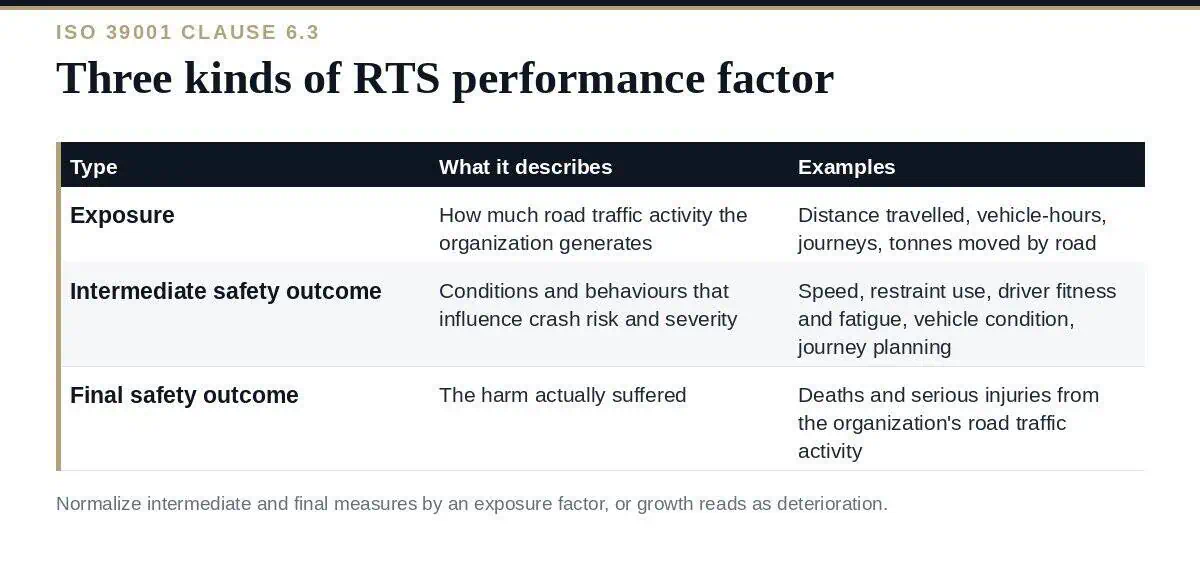
| Type | What it describes | Examples |
|---|---|---|
| Exposure | How much road traffic activity the organization generates or is subject to | Distance travelled, vehicle-hours, journeys made, tonnes moved by road |
| Intermediate safety outcome | Conditions and behaviours known to influence crash risk and severity | Speed, seat-belt and restraint use, driver fitness and fatigue, vehicle condition and safety features, route and journey planning |
| Final safety outcome | The harm actually suffered | Deaths and serious injuries arising from the organization’s road traffic activity |
The three RTS performance factors are structured this way because final outcomes are rare, lagging and largely outside anyone’s short-term control. An organization can go a year without a serious injury and be getting more dangerous the whole time. Intermediate factors move first, can be measured continuously, and are the ones an organization can genuinely influence — which is why ISO 39001 asks you to work on them rather than only counting crashes.
Recording exposure matters for a reason people miss: it is what makes any other number comparable. Ten incidents against a fleet that doubled its mileage is not the same as ten against a static fleet. Normalize the intermediate and final measures by an exposure factor — per million kilometres, per thousand journeys — or a growing business will look like a deteriorating one, and a shrinking one will look like a success.
Exposure is also a legitimate control. The safest kilometre is the one not driven, and route consolidation, modal shift and journey elimination are RTS interventions in their own right.
ISO 39001 asks for the RTS performance factors relevant to the organization — those it can influence and those it can affect through others. That second half matters for organizations that do not own vehicles: a company that contracts logistics still influences speed, scheduling pressure and driver hours through the way it buys, plans and pays for transport.
A workable selection method:
Two examples of the shift the framing produces. A distribution business measuring only incidents will invest in driver training after a bad quarter; the same business measuring intermediate factors will notice that late-afternoon speeding correlates with a scheduling change made three months earlier, and fix the schedule. A construction firm counting collisions on site will find nothing to act on until one happens; measuring reversing manoeuvres per delivery gives it something to reduce this month.
Fleet safety is where most organizations start, and the standard reaches further — anyone whose operations put vehicles on public roads is in scope, including through contractors. Our guide to ISO 39001 and what it requires covers the wider management system, and the road safety programme sits naturally alongside occupational health and safety obligations for driving at work.
Where are RTS performance factors required?
Clause 6.3 of ISO 39001:2012, inside planning — which places them before objectives and before the operational controls that follow from them.
Do we need all three types?
You need exposure factors to make anything comparable, intermediate factors to have something to manage, and final outcome factors because harm is what the system exists to reduce. Most organizations under-invest in the middle group.
We do not own vehicles — does this apply?
Very likely, if your activity generates road traffic. The standard covers factors you can influence through others, which reaches contracted transport and deliveries.
How do we normalize?
Choose one exposure denominator and keep it — per million kilometres or per thousand journeys are the common choices. Changing denominators breaks the trend line.
Is ISO 39001 certifiable?
Yes, it is a requirements standard and organizations certify to it, most commonly transport, logistics and public-sector fleets.
Build the RTS management system on factors rather than incidents. Record exposure so every other number can be compared, choose intermediate factors with a real evidential link to harm, and set an objective and an owner against each. Keep the final outcome measures — they are the point of the exercise — but do not manage from them, because by the time they move, the decisions that caused them were made months earlier.
Factor registers, objectives and the measurement records are in the ISO 39001 Road Traffic Safety Toolkit, or start with the free ISO templates.


October 13, 2026
October 12, 2026

October 12, 2026

October 12, 2026

October 12, 2026

