

AS9100 Certification Body: The Essential 2026 Selection Guide
Choosing an AS9100 certification body is not the same exercise as picking an ISO 9001 registrar. Aerospace certification runs inside a closed, industry-controlled scheme, so the body you hire has to clear checks that a general quality registrar never faces, and your certificate only counts with your customers if it appears in the IAQG OASIS database. This guide explains what those checks are, how to verify them yourself in an afternoon, and which questions separate a good aerospace registrar from a merely accredited one.
If you are still working out whether aerospace certification fits your business at all, start with our overview of aerospace quality management and the 9100 family, then come back here when you are ready to request quotes.
Free gap assessment
Are you ready for the 2026 edition of ISO 9001?
Score yourself against the new edition, free, including the risk and opportunity split and the clause 10 renumbering that breaks converted checklists.
Run the free ISO 9001 gap assessment → or View premium report sample
How the AS9100 certification body scheme works
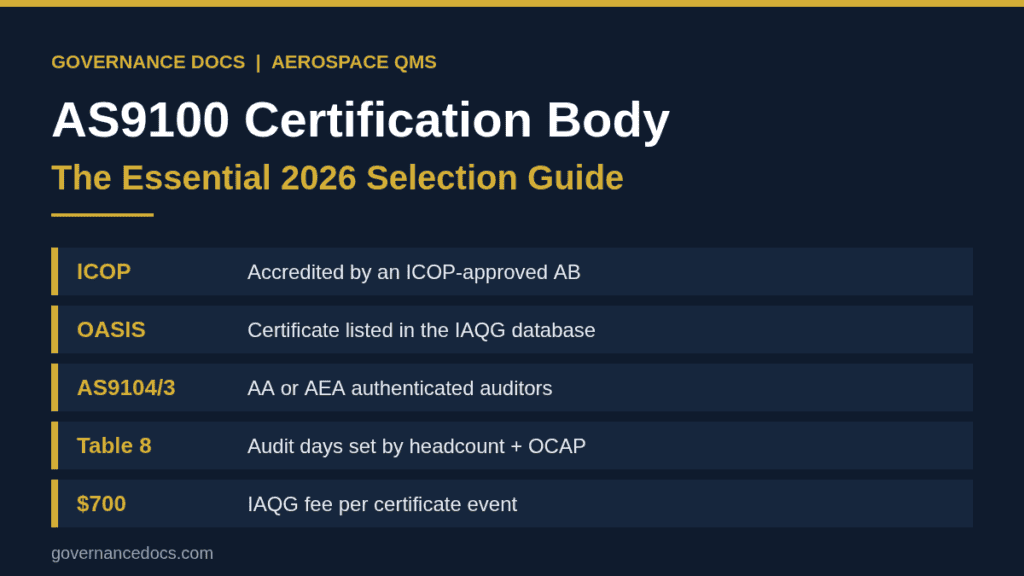
AS9100, AS9110 (maintenance organizations) and AS9120 (distributors) are certified under the Industry Controlled Other Party (ICOP) scheme run by the International Aerospace Quality Group (IAQG). Three standards, often called the “trilogy”, govern it:
- AS9104/1 sets the requirements for certification programs and the bodies that run them (current revision AS9104/1A, January 2022).
- AS9104/2 covers the oversight of those programs by the IAQG sector structure and accreditation bodies.
- AS9104/3 sets auditor training, competence and authentication rules (current revision AS9104/3A).
A fourth standard, AS9101, tells auditors how to conduct and report the audit itself, including the Process Effectiveness Assessment Report (PEAR) and the objective evidence records your customers can later review.
Every AS9100 certification body also works to ISO/IEC 17021-1, the general standard for management system certifiers. The aerospace rules sit on top. The practical consequence is that the field of eligible bodies is much smaller than for ISO 9001, and each one is watched more closely: accreditation bodies witness aerospace audits, and the IAQG can see every certificate and audit record in OASIS.
The five checks every AS9100 certification body must pass
Before you compare day rates, confirm these five points. Any body that fails one is not a real option, however cheap the quote.
| Check | What good looks like | Where to verify it |
|---|---|---|
| ICOP-recognized accreditation | Accredited for aerospace QMS by an ICOP-approved accreditation body (for example ANAB in the US or UKAS in the UK) | The accreditation body’s directory and the body’s OASIS listing |
| Correct standard on its scope | Accreditation covers the exact standard you need: 9100, 9110 or 9120 | Accreditation certificate and OASIS certification body record |
| Authenticated auditors | Auditors authenticated under AS9104/3 as Aerospace Auditor (AA) or Aerospace Experienced Auditor (AEA) for your standard | Ask for auditor names and grades; confirm in the auditor authentication system |
| Industry code coverage | Auditors who have worked on products and processes like yours (machining, composites, avionics, special processes) | Ask for the auditor’s sector history in writing |
| Accreditation in good standing | No current suspension of the body’s aerospace accreditation | Accreditation body notices; ask the body directly |
The last check matters more than buyers expect. Under the IAS aerospace accreditation policy, for example, a body whose aerospace accreditation is suspended must stop stage 1 audits for new clients, stop scope extensions and stop accepting certificate transfers, and must tell its clients within 15 days. A suspended registrar can strand you mid-cycle.
Why the OASIS database decides whether your certificate counts
An aerospace certificate that is not in OASIS is, for practical purposes, invisible. Prime contractors and many tier-one suppliers check supplier certificates in the database rather than trusting a PDF. Our guide to the OASIS database walks through searching and reading a record; here is what it means for your choice of AS9100 certification body.
The body uploads two tiers of data. Tier 1 is public: the certificate, its scope, sites and status. Tier 2 is private: audit reports, PEARs, nonconformity reports, scoring and any suspension history. You control who sees Tier 2, but aerospace customers and authorities can ask for it, and AS9104/1 expects you to grant access unless you have a valid reason such as competition or confidentiality.
Two practical obligations follow, as BSI sets out in its January 2026 aerospace scheme rules:
- You must appoint an OASIS administrator before the initial audit is complete. Without one, the body cannot publish your certificate.
- OASIS accounts go inactive after 18 months without activity, so the role has to be handed over when people leave. A lapsed administrator can delay a recertification certificate.
Because Tier 2 records follow you, the quality of your AS9100 certification body’s reports also matters. Vague nonconformity write-ups and thin PEARs are visible to your customers for years.
What an AS9100 certification body charges for
Audit time in aerospace is set by a table, not by negotiation. AS9104/1 Table 8 gives a baseline audit duration per site by number of employees, which the body then adjusts using the Organization Certification Analysis Process (OCAP). As a guide, the table reproduced in DEKRA and ANAB’s 2023 client briefing gives:
| Employees at the site | Initial audit (stage 1 + stage 2), days | Surveillance, days | Recertification, days |
|---|---|---|---|
| 1 to 5 | 2 | 1 | 2 |
| 26 to 45 | 5 | 2 | 4 |
| 86 to 100 | 8 | 3 | 6 |
| 276 to 425 | 12 | 5 | 9 |
Treat these as baselines before adjustments, not quotes. OCAP risk scoring can move the time down or up by about 10 percent, permitted reductions apply only where whole processes such as design are absent, and the body adds time for planning and reporting. BSI’s scheme rules estimate that completing the AS9101 documentation adds roughly 0.5 to 1.5 days per auditor, confirmed at stage 1.
On top of auditor days, the IAQG charges for every certificate it publishes. Its OASIS fee schedule (updated 25 November 2024) lists:
| OASIS event | IAQG fee (USD) |
|---|---|
| Initial certificate | $700 per certified standard |
| Recertification certificate | $700 per certified standard |
| Certificate transfer to a new body | $700 per transfer per certificate |
| Certificate modification (new site, scope or address change) | $300 |
The IAQG invoices the certification body, and most bodies pass the cost on. BSI, for instance, states that it passes these disbursements through with a $50 processing fee included in the rate it quotes. A certificate covering both AS9100 and AS9120 is billed as two standards. For the full budget, including consultant and internal time, see our AS9100 certification cost breakdown.
Questions to ask an AS9100 certification body before you sign
Every accredited AS9100 certification body follows the same scheme rules, so the real differences show up in how it staffs and runs your audits. Put these questions in writing and compare the answers side by side.
- Who will audit us, and what are their grades? Ask for named auditors, their AA or AEA status for your standard, and their product and process background. An auditor who has never seen a special process line will spend your audit days learning it.
- How do you handle auditor changes? Aerospace scheme rules expect auditor rotation, and bodies limit client requests to change auditors. BSI’s rules say substitution requests will be denied without substantiated evidence of improper activity, except for export control, nationality, confidentiality or conflict-of-interest reasons. Know the policy before a dispute, not during one.
- Can you staff ITAR or classified work? If your scope involves export-controlled data, the body must provide auditors who can lawfully see it. Processes an auditor cannot access cannot be certified.
- What OCAP data do you need, and when? The OCAP submission covers your sites, size, design responsibility, nonconformance escapes, on-time delivery and customer satisfaction. NASA’s summary of the AS9104/1 changes notes it must reach the body 90 days before the audit and be updated before every surveillance and recertification audit.
- How will you quote OASIS fees and modifications? Ask whether the quote includes IAQG fees, any processing markup, and what a site addition or scope change will cost later.
- How much of the audit can be remote? AS9104/1A limits remote auditing; get the body’s policy in writing if you run multiple sites.
- What is your plan for IA9100? The IAQG has announced that the next revision of AS9100 will be renamed IA9100. As of November 2026 the IAQG had not announced a publication date or transition deadline, so ask how the body will schedule your transition audit once the rules are out. Our IA9100 guide covers what is known so far.
One rule applies across all management system certification. ISO/IEC 17021-1 clause 5.2.5 bars a certification body from providing management system consultancy. Your auditor can explain a requirement, but cannot write your procedures. A registrar that offers to “get you ready” through the same entity is a warning sign.
AS9100 certification body vs ISO 9001 registrar: what changes
Many aerospace suppliers already hold ISO 9001 and assume they can stay with the same registrar. That works only if the body is also accredited under the ICOP scheme. The differences are worth knowing before you ask.
| Factor | ISO 9001 registrar | AS9100 certification body |
|---|---|---|
| Governing rules | ISO/IEC 17021-1 and accreditation mandatory documents | ISO/IEC 17021-1 plus AS9104/1, AS9104/2, AS9104/3 and AS9101 |
| Auditor qualification | Body’s own competence criteria | Industry authentication as AA or AEA under AS9104/3 |
| Audit time | Duration tables in the accreditation mandatory documents | AS9104/1 Table 8, adjusted by OCAP risk scoring |
| Certificate register | Optional public databases | OASIS listing required, with private audit data |
| Outsourcing | Allowed within limits | Not allowed for AS9104/1 activities; IAF “critical locations” not recognized |
| Observers at audits | Accreditation body witnesses | Accreditation body, IAQG oversight, OEM and regulator observers may attend |
If your current ISO 9001 registrar is not ICOP-accredited, you will need a second body or a move. Our guide on changing certification body explains the transfer review, and in aerospace the new body will also inspect your OASIS history for open nonconformities, past suspensions and trends before it accepts the transfer.
Red flags when shortlisting an AS9100 certification body
- The body cannot show you its OASIS record or its aerospace accreditation certificate.
- The quote shows fewer audit days than Table 8 allows for your headcount, with no OCAP explanation.
- The body offers implementation help, document writing or a “guaranteed pass”.
- Auditor names and grades are “to be confirmed” right up to the audit week.
- The body proposes to run your audit from an overseas office that is not its accredited location.
- Nobody can explain how they will handle your move to IA9100.
Any one of these can turn a cheap certificate into one your customers reject. An unaccredited “AS9100 certificate” will not appear in OASIS, and most aerospace primes will not accept it.
Be audit-ready whichever body you choose
An AS9100 certification body audits what you have; it cannot build it for you. Audit days are fixed by headcount, so the cheapest way to keep a certification body’s time productive is to walk in with a complete, current system: configuration management, risk, supplier control, product safety, counterfeit parts prevention and the records that prove each one works. The AS 9100/9110/9120 Aerospace QMS Toolkit gives you 57 editable templates covering the procedures, forms and registers auditors sample, so stage 1 confirms readiness instead of listing gaps.
Frequently asked questions
Is an AS9100 registrar the same as an AS9100 certification body?
Yes. “Registrar” is the common US term; “certification body” is the term used in ISO/IEC 17021-1 and the AS9104 series. Both mean the accredited organization that audits your quality management system and issues the certificate.
How do I check that an AS9100 certification body is legitimate?
Confirm its aerospace accreditation with an ICOP-approved accreditation body, check that it appears in the IAQG OASIS database, and ask for the AS9104/3 authentication grades of the auditors it will assign. A legitimate body will issue a certificate that you can find in OASIS.
Can I switch my AS9100 certification body mid-cycle?
Yes, through a certificate transfer. The new body reviews your OASIS records, previous audit reports and nonconformities before accepting you, and the IAQG charges $700 per transferred certificate. Plan the move well before a surveillance or recertification audit is due.
Does the AS9100 certification body set the audit length?
Only within limits. The baseline comes from AS9104/1 Table 8 by employee count, and the body adjusts it using your OCAP data and permitted reductions. Large discounts below the table are a warning sign rather than a bargain.

Governance Docs
Governance Docs LLC
Recent Posts

November 22, 2026
November 21, 2026
November 20, 2026
November 19, 2026
November 18, 2026