

ISO 42001 Certificate Validity: The Complete 2026 Guide
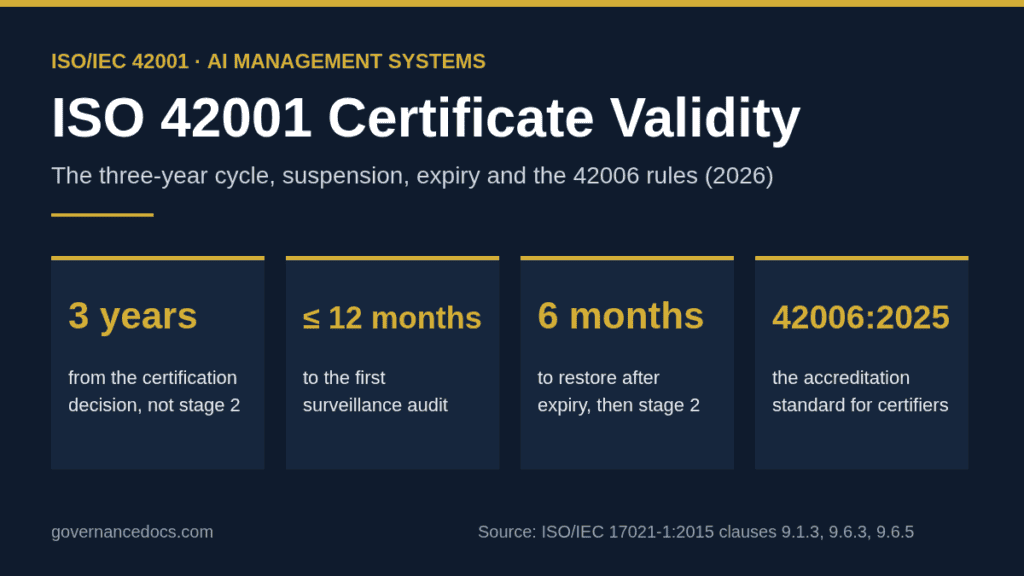
ISO 42001 certificate validity is three years, counted from the certification body’s decision to certify you, and those three years only hold if both surveillance audits happen on time. ISO/IEC 42001 was published in December 2023, so the first certificates issued in 2024 reach their expiry dates during 2027. Many AI governance leads are about to live through their first full cycle without a precedent from their own organization.
This guide explains how the cycle runs, what keeps an ISO 42001 certificate valid between audits, what suspension and withdrawal mean, what happens at the expiry date, and how ISO/IEC 42006:2025 changed the rules for the bodies that issue these certificates. It is written for the person who owns the certificate, and for the buyer who has to decide whether a vendor’s certificate can be trusted. If you are still working toward certification, start with our step-by-step ISO 42001 certification guide.
Free gap assessment
How much of ISO 42001 could you evidence today?
Score every clause and Annex A control of the AI management standard, free, and see where the programme really sits.
Run the free ISO 42001 gap assessment → or View premium report sample
How ISO 42001 Certificate Validity Works: The Three-Year Cycle
ISO/IEC 42001 itself says nothing about certificates. The rules come from two standards that bind the certification body, not you. ISO/IEC 17021-1:2015 sets the general requirements for every body that certifies management systems. ISO/IEC 42006:2025 adds the requirements specific to bodies that audit and certify AI management systems against ISO/IEC 42001.
Clause 9.1.3.2 of 17021-1 sets the shape of the cycle: a two-stage initial audit, surveillance audits in the first and second years after the certification decision, and a recertification audit in the third year, before the certificate expires. The first three-year cycle begins with the certification decision. Every later cycle begins with the recertification decision.
Two timing rules in clause 9.1.3.3 decide whether ISO 42001 certificate validity survives the cycle:
- Surveillance audits must happen at least once a calendar year, except in recertification years.
- The first surveillance audit must take place no more than 12 months after the certification decision date. Not the stage 2 date. If you plan the first surveillance from the stage 2 anniversary, you will usually be late by the weeks it took the certification body to make its decision.
| Point in the cycle | What happens | ISO/IEC 17021-1 clause |
|---|---|---|
| Stage 1 and stage 2 | Initial certification audit | 9.3.1 |
| Certification decision | Cycle starts; certificate issued with an expiry date about three years out | 9.1.3.2 |
| Year 1 | First surveillance audit, no later than 12 months after the decision | 9.1.3.3 |
| Year 2 | Second surveillance audit, in the next calendar year | 9.1.3.3 |
| Year 3 | Recertification audit, completed before the expiry date | 9.6.3 |
| Recertification decision | New three-year cycle starts | 9.1.3.2, 9.6.3.2.3 |
A major nonconformity at the initial audit can delay the start of validity. Under clause 9.5.3.2, if the certification body cannot verify the correction and corrective action for a major nonconformity within six months of the last day of stage 2, it has to run another stage 2 before it can recommend certification. Our ISO 42001 stage 1 audit guide covers how to avoid that at the start.
What an ISO 42001 Certificate Must Show
Clause 8.2.2 of 17021-1 lists what every accredited certificate has to carry. These are the fields to read when you check ISO 42001 certificate validity, whether the certificate is yours or a vendor’s.
| Required field | What to look for |
|---|---|
| Name and location of the certified client | The legal entity you contract with, and every site covered if it is a multi-site certificate |
| Effective date | Not earlier than the certification decision it relates to |
| Expiry or recertification due date | Consistent with a three-year cycle; for a 2024 certificate, a date in 2027 |
| Unique identification code | The number you quote when you ask the certification body to confirm status |
| Standard and issue status | ISO/IEC 42001:2023, the only edition that exists |
| Scope | The activities, products and services covered at each site, without ambiguity. For AI, check whether the AI systems you buy are inside it |
| Certification body name, address and mark | An accreditation symbol may appear alongside, but must not mislead |
| Any other information the normative documents require | Clause 8.2.2 h) is where scheme-specific content such as ISO/IEC 42006 requirements lands |
| Means to tell revisions apart | Reissued certificates must be distinguishable from obsolete versions |
The scope line deserves the most attention. An organization can certify an AI management system that covers one product line, one business unit, or only its role as an AI user rather than a developer. A valid certificate whose scope leaves out the AI service you are buying tells you very little about that service. A note in the same clause also allows the certification body to keep the original certification date on a certificate after a lapse, as long as the current cycle dates and the last cycle’s expiry date are shown. An “originally certified” date does not prove continuous certification on its own. Read the current cycle dates.
Why the Certifier’s Accreditation Matters for ISO 42001 Certificate Validity
This is where ISO 42001 differs from older standards such as ISO 9001. When the first ISO 42001 certificates were issued in 2024, ISO/IEC 42006 had not been published. It came out in July 2025 as a 31-page first edition. Accreditation bodies that accredited AI management system certifiers before then worked from 17021-1 and draft criteria.
Accreditation has caught up since. At its 59th General Assembly in November 2025, the European co-operation for Accreditation adopted EA Resolution 2025 (59) 06, which endorses the mandatory application of ISO/IEC 42006:2025 as the standard to be used for accrediting bodies that certify AI management systems. In the United States, ANAB states that it accredits ISO 42001 certification bodies against ISO/IEC 17021-1 and ISO/IEC 42006:2025. On 10 March 2026, BSI announced ANAB accreditation for ISO/IEC 42001 on top of its existing UKAS and RvA accreditations.
Two practical points follow:
- Accreditation is not the same as validity. A certificate from a non-accredited body can be within its dates and still carry little weight with a buyer or a regulator. ISO 42001 certificate validity in the buyer’s sense means valid dates, a relevant scope and a certifier that is accredited for ISO 42001 specifically, not just for ISO 27001.
- Recertification is the natural point to check your certifier. If your 2024 certificate came from a body that is not yet accredited for ISO 42001 under ISO/IEC 42006, the 2027 renewal is the cleanest moment to move. Our guide to choosing an ISO 42001 certification body covers how to verify an accreditation scope.
ISO 42001 Certificate Validity Between Audits: Surveillance
Between issue and expiry, ISO 42001 certificate validity depends on surveillance. Under clause 9.6.2.2 of 17021-1, surveillance audits are on-site audits but not necessarily full system audits. Each one covers internal audits and management review, action on earlier nonconformities, complaints handling, progress toward objectives, continuing operational control, changes, and use of marks and references to certification.
For an AI management system, “changes” is the area that moves fastest. New models, new AI use cases, new third-party AI services and changes to how you use AI all feed your AI risk assessment, AI system impact assessment and Statement of Applicability. Clause 8.5.3 of 17021-1 requires the certification body to have enforceable arrangements for you to tell it, without delay, about changes such as a change of ownership, key staff, sites, scope of operations, or major changes to the management system and processes. A significant change that you do not report can come to light at surveillance as a nonconformity. Clause 9.6.4.2 also lets a certification body run a short-notice audit in response to changes or complaints.
Free AI risk assessment
Which of your AI systems could harm people, or you?
List your AI systems, models and data, pick from 54 AI risk scenarios, including the attacks on AI described in ISO 27090, rate them for the people affected and for you, and plan treatment with ISO 42001 Annex A controls. You get a heat map, a process score and the findings an auditor would raise, free.
Run the free AI risk assessment → or View premium report sample
One trap for teams that also hold ISO 9001 or ISO 14001: the audit-time tables in Global ACI-TECH-3-004 (formerly IAF MD 5) cover quality, environmental and occupational health and safety systems. They are not the method for ISO 42001. AI management system audit time comes from ISO/IEC 42006:2025. Our ISO 42001 surveillance audit guide covers what auditors sample at each visit.
When ISO 42001 Certificate Validity Ends Early: Suspension and Withdrawal
ISO 42001 certificate validity can end before the printed expiry date. Clause 9.6.5.2 says the certification body shall suspend certification when, for example, the client fails to meet certification requirements, does not allow surveillance or recertification audits at the required frequencies, or asks for suspension itself.
Clause 9.6.5.3 is the one buyers should know: under suspension, the management system certification is temporarily invalid. The certificate still exists and still shows a future expiry date, but it is not valid while suspended. Under 9.6.5.4 the certification body restores certification once the issue is resolved. If it is not resolved, the result is withdrawal or a reduction of scope. A note to that clause says suspension would in most cases not exceed six months.
A common myth is that 17021-1 gives you 90 days to close a nonconformity. It does not. The standard requires each certification body to have documented procedures for suspension and withdrawal, and the closure deadlines you work to come from those procedures and your contract. The only fixed deadline in the cycle is at recertification, covered below. Read your certification body’s rules, not a generic article.
ISO 42001 Certificate Validity at the Expiry Date
The expiry date is where most ISO 42001 certificate validity problems surface. Recertification has to be planned so the certificate can be renewed before it expires (9.6.3.1.1). The recertification audit includes an on-site audit (9.6.3.2.1), and for any major nonconformity the time limits for correction and corrective action must be defined and met before expiry (9.6.3.2.2).
| Situation at expiry | Result | 17021-1 clause |
|---|---|---|
| Recertification completed and decided before expiry | New certificate; the new expiry date can be based on the old one, so no days are lost | 9.6.3.2.3 |
| Recertification not completed, or a major nonconformity not resolved, by expiry | Recertification not recommended; certification not extended | 9.6.3.2.4 |
| Outstanding recertification activities completed within 6 months after expiry | Certification body can restore certification; the gap stays visible on the certificate | 9.6.3.2.5 |
| More than 6 months after expiry | At least a new stage 2 audit is required | 9.6.3.2.5 |
Restoring within six months does not hide the lapse. Under 9.6.3.2.5 the effective date of the restored certificate is on or after the recertification decision, so there is a period with no valid certificate. If a customer contract requires continuous ISO 42001 certification, that gap is the risk. Book the recertification audit early enough that a major nonconformity can still be closed before expiry. Our ISO 42001 recertification audit guide covers planning and what the auditor checks.
Does a Revision or the EU AI Act Affect ISO 42001 Certificate Validity?
Edition changes are a big validity issue for ISO 9001 and ISO 14001 in 2026, because both have new editions with transition deadlines. ISO 42001 has no such deadline. ISO’s page for ISO/IEC 42001:2023 still shows edition 1, published December 2023, at stage 60.60 (published), with no replacement listed as of November 2026. A certificate issued to the 2023 edition stays valid for its full cycle unless that changes, and any future transition would be announced with its own timetable.
The EU AI Act is a separate question. An ISO 42001 certificate is evidence of a working AI management system. It is not a CE marking, and by itself it does not give presumption of conformity with the AI Act, which comes from harmonised standards cited in the Official Journal. The certificate’s validity and your AI Act obligations need to be tracked separately. Our comparison of ISO 42001 and the EU AI Act explains how the two fit together.
How to Check a Vendor’s ISO 42001 Certificate Validity
AI vendor questionnaires increasingly ask for an ISO 42001 certificate. A PDF attached to a questionnaire proves nothing about current status. Use this five-step check:
- Read the dates. The expiry date should be no more than about three years after the effective date. A certificate dated 2024 should show a 2027 expiry.
- Read the scope. Confirm the AI system or service you are buying, and the vendor’s AI role in it, sit inside the scope.
- Confirm status with the certification body. Use the body’s online register or ask it directly, quoting the certificate number. This is the only way to catch a suspension.
- Check the certifier’s accreditation scope. Look up the certification body in the accreditation body’s directory and confirm ISO/IEC 42001 is listed, not only ISO/IEC 27001.
- Diary the renewal. Ask for the renewed certificate after the expiry date. A missing renewal is the most common way a supplier certificate quietly lapses.
Keep Your Evidence Ready for Every Audit
Every audit in the cycle samples the same records: the AI policy, AI risk assessment and treatment, AI system impact assessments, the Statement of Applicability against the 38 Annex A controls, internal audit results and management review minutes. Keeping ISO 42001 certificate validity is mostly a matter of keeping those records current between visits. If you are building or refreshing that documentation, the ISO 42001 Toolkit ($199) gives you editable policy, procedure and record templates aligned to ISO/IEC 42001:2023, so the evidence is in place before the auditor asks.
Frequently Asked Questions
How long is an ISO 42001 certificate valid for?
Three years from the certification decision, provided the two annual surveillance audits take place on time and no suspension occurs. The certificate is renewed through a recertification audit in the third year, before expiry.
Is my ISO 42001 certificate valid while it is suspended?
No. ISO/IEC 17021-1 clause 9.6.5.3 says that under suspension the certification is temporarily invalid, even though the certificate still shows a future expiry date.
What happens if our ISO 42001 certificate expires before recertification is finished?
The certification is not extended. The certification body can restore it if the outstanding recertification work is completed within six months of expiry. After six months, at least a new stage 2 audit is required, and either way there is a gap in validity.
Do we need to transition to a new edition of ISO 42001?
Not as of November 2026. ISO/IEC 42001:2023 is the only edition, and ISO lists no replacement. Certificates issued to it remain valid for their full cycle.
Is an ISO 42001 certificate from a non-accredited body valid?
It can be within its dates, but it is not an accredited certification and many buyers will not accept it. Check that the certification body is accredited for ISO/IEC 42001 by a recognized accreditation body.

Governance Docs
Governance Docs LLC
Recent Posts
November 19, 2026
November 18, 2026
November 18, 2026

November 18, 2026

November 18, 2026