CART
ISO 39001 is the road traffic safety management system standard, and it applies to far more organisations than the ones that own lorries.
Its scope is any organisation that interacts with the road system. That includes employers whose staff drive to meetings, companies whose deliveries are subcontracted, and organisations whose sites generate traffic they do not control. If people are on the road because of what your organisation does, the standard is aimed at you.
Free gap assessment
Could you prove workers take part in safety decisions?
Score every clause of ISO 45001, free, including the consultation and participation evidence that fails more audits than any other requirement.
Run the free ISO 45001 gap assessment → or View premium report sample
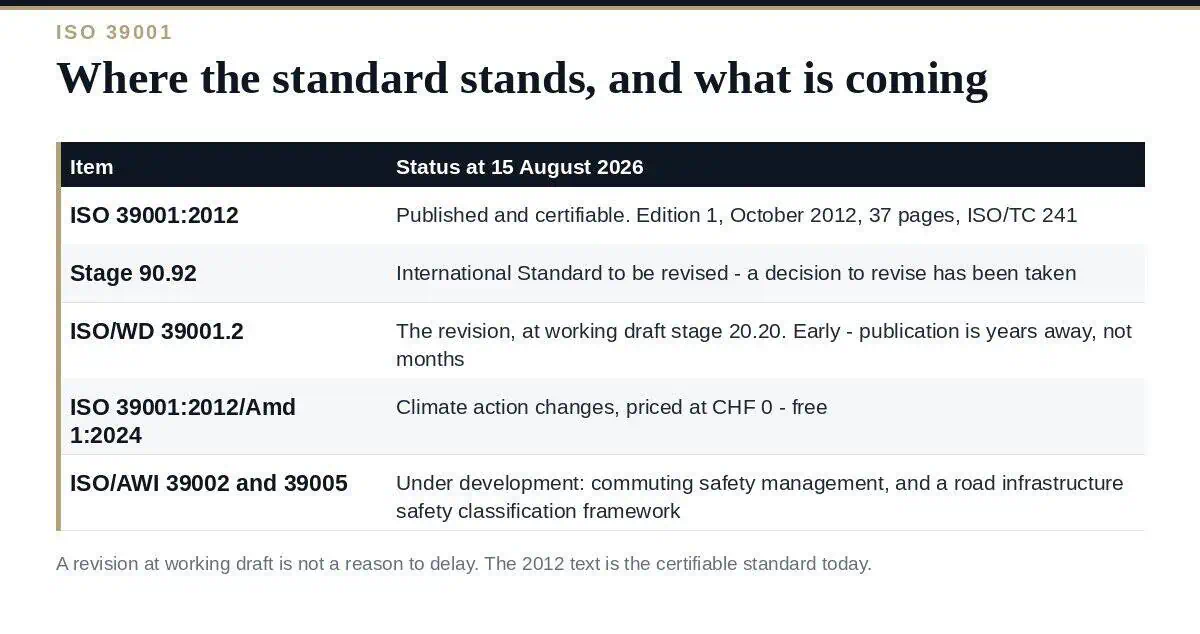
ISO 39001:2012 — Road traffic safety (RTS) management systems — Requirements with guidance for use — is a requirements standard, so it is certifiable. It runs to 37 pages and is maintained by ISO/TC 241.
Structurally it is a management system like any other: context, leadership, planning, support, operation, performance evaluation, improvement. What makes it distinctive is the model underneath.
The Safe System approach. The standard rests on the principle that people make mistakes and are physically vulnerable, so the road system should be designed to keep the consequences of those mistakes survivable. That is a different starting point from blaming driver error, and it drives everything the standard asks for.
The practical consequence is the performance factors an organisation must identify and manage, which fall into three groups:
Final outcomes are the point but useless as a management signal for most organisations, because the numbers are small and lagging. The intermediate factors are what you actually manage, and being explicit about that distinction is one of the more useful things ISO 39001 does.
Most organisations that adopt ISO 39001 find their exposure is larger than assumed, because grey fleet — staff driving their own vehicles for work — never appeared in any register.
Those journeys generate the same duty of care as a company vehicle and usually none of the controls: no checks on insurance, roadworthiness, licence status, or hours driven before a long return trip. A structured exposure assessment is often the first time an organisation sees the whole picture.
Two facts from the ISO record are worth knowing before you plan.
A revision has been decided. ISO 39001:2012 sits at stage 90.92 — International Standard to be revised — and ISO/WD 39001.2 is under development at stage 20.20.
Stage 20.20 is a working draft. It has to pass committee draft, DIS and FDIS stages before publication, which is measured in years. This is not a reason to delay certification. The 2012 text is the certifiable standard today, and a management system built on the Safe System approach will carry forward.
There is a free amendment. ISO 39001:2012/Amd 1:2024 covers climate action changes and is listed at CHF 0.
Two related projects are also in development at ISO/TC 241: ISO/AWI 39002 on commuting safety management, and ISO/AWI 39005 on road infrastructure safety level classification. Commuting is the gap most organisations argue about, so 39002 is worth watching.
| Standard | Relationship |
|---|---|
| ISO 45001 | The closest neighbour. Occupational health and safety covers work-related road risk in principle; ISO 39001 gives it a method, performance factors and a model. Organisations with real road exposure usually need both |
| ISO 31000 | Supplies one risk method, so road risk is scored on the same scale as everything else the board sees |
| ISO 14001 | Shares the management system backbone, and journey data serves both — the same distance figures drive emissions reporting and exposure assessment |
| ESG reporting | Road safety outcomes are social disclosures. A certified system produces defensible numbers rather than estimates |
This guide reflects the ISO 39001 record and the ISO/TC 241 catalogue at 15 August 2026.
The ISO 39001 Road Traffic Safety Toolkit provides 10 editable templates covering the RTS policy, the exposure and performance factor assessment, the objectives and targets, and the audit and management review records.


October 15, 2026

October 15, 2026
October 14, 2026
October 14, 2026
October 14, 2026

