

If your organization runs several information security frameworks at once, the trouble starts when nobody has decided which ones are legal duties, which are customer demands and which are just good practice. This guide sorts 30 of them into six areas so you can choose, sequence and reuse the work.
One rule first: documents support compliance, but they never make you compliant or certified. Certification is decided by an accredited body after an audit, and laws are enforced by regulators.
How to choose among information security frameworks
Ask four questions, in this order.
- Is it a law or contract? DORA, NIS2, the EU Cyber Resilience Act, HIPAA and the FTC Safeguards Rule are legal duties if you fall in scope. NERC CIP is mandatory for registered grid entities. PCI DSS binds you through your card agreements.
- Who is asking? A buyer asking for a SOC 2 report or a TISAX label is a commercial reason, and it usually has a deadline attached.
- Where do you operate? Region and sector narrow the field quickly: Saudi regulators, UK tenders, German cloud buyers, US defense primes.
- What do you want to prove? A certificate, an attestation report, or simply a defensible program.
A workable pattern for information security frameworks is one backbone plus the two or three obligations that apply on top. The comparison below is grouped by area, so find your sector first.
The 30 information security frameworks compared
| Framework and what it is | Who it applies to | Type | Our toolkit |
|---|---|---|---|
| Core management and risk | |||
| ISO/IEC 27001: ISMS standard with 93 Annex A controls in 4 themes | Any organization; often a customer demand | Certifiable | ISO/IEC 27001 Information Security |
| NIST CSF 2.0: Six functions, outcome-based | Voluntary; common US baseline | Guidance, not certifiable | NIST Cybersecurity Framework 2.0 |
| NIST SP 800-30: Risk assessment method | Anyone who needs a defensible risk process | Guidance, not certifiable | NIST Cyber Risk Management (SP 800-30) |
| CIS Controls v8.1: 18 prioritized controls, each broken into safeguards | Smaller teams wanting a practical starting list | Guidance, not certifiable | CIS Controls v8.1 |
| NIST SP 800-61: Incident handling guidance | Any organization; feeds many legal reporting duties | Guidance, not certifiable | Incident Response (NIST SP 800-61) |
| KPI set: Metrics to measure program performance | Anyone reporting to management or auditors | Measurement aid, not a framework | IT & Cybersecurity KPI Set |
| Payments and financial | |||
| PCI DSS: Card data security standard | Merchants and providers handling card data; set by card brands and acquirers | Validated by assessor or self-assessment | PCI DSS |
| PCI PIN: PIN handling requirements | Organizations that process or protect PINs | Assessed against the standard | PCI PIN Security (PIN v3.1) |
| SWIFT CSP: Annual customer security controls | SWIFT users | Annual attestation | SWIFT CSP |
| DORA: EU ICT resilience regulation | EU financial entities and their ICT providers | Law | DORA |
| Cloud and service providers | |||
| SOC 2: Controls report on trust criteria | Service providers answering customer due diligence | Attestation report | SOC 2 |
| ISO 27017/27018: Cloud and cloud-privacy controls | Cloud providers and customers with an ISMS | Guidance on top of 27001 | ISO/IEC 27017 & 27018 Cloud |
| CSA STAR: Public cloud assurance registry | Cloud providers selling to cautious buyers | Self-assessment or third-party tiers | CSA STAR Cloud Security |
| BSI C5:2026: German cloud criteria catalog | Cloud providers selling into Germany | Auditor attestation | BSI C5:2026 Cloud Security |
| US government and defense | |||
| CMMC: DoD contractor program | Defense contractors; Phase 2 suspended July 2026 | Self or third-party assessment | CMMC |
| NIST SP 800-171: CUI protection requirements | Contractors holding CUI | Contract requirement | NIST SP 800-171 (CUI) |
| NIST SP 800-53: Federal control catalog | Federal systems and their suppliers | Catalog, not certifiable | NIST SP 800-53 |
| FedRAMP: Federal cloud program | Cloud providers selling to US agencies | Federal certification | FedRAMP |
| GovRAMP and TX-RAMP: State cloud programs | Cloud providers selling to state agencies | Program authorization | GovRAMP (StateRAMP) & TX-RAMP |
| OT and critical infrastructure | |||
| IEC 62443: Industrial control system series | Asset owners and service providers | Standards series, maturity scored | IEC 62443 IACS / OT Cybersecurity |
| NERC CIP: Bulk electric system standards | North American grid operators | Mandatory, audited | NERC CIP Critical Infrastructure Protection |
| NIS2: EU cybersecurity directive | Essential and important entities in the EU | Law | NIS2 |
| EU CRA: Product security regulation | Makers of products with digital elements | Law | EU Cyber Resilience Act |
| Regional and sector | |||
| Saudi NCA ECC: National baseline controls | Saudi government and critical infrastructure bodies | Regulatory | Saudi NCA Essential Cybersecurity Controls |
| SAMA CSF: Saudi financial sector framework | SAMA-regulated financial institutions | Regulatory | SAMA Cyber Security Framework |
| Cyber Essentials: Baseline UK scheme | UK suppliers; often a tender condition | Certification | Cyber Essentials (UK) |
| TISAX: Automotive assessment model | Automotive suppliers | Assessment labels | TISAX / VDA ISA |
| HITRUST CSF v11: Certifiable control framework | Healthcare and its vendors | Certifiable | HITRUST CSF v11 |
| HIPAA: US health privacy and security law | Covered entities and business associates | Law | HIPAA |
| WISP / FTC Safeguards: Written security program | Non-bank financial firms under FTC rules | Law | WISP / FTC Safeguards Rule |
Type matters. NIST frameworks and the CIS Controls are guidance. SOC 2 is an attestation report, not a certification. HIPAA, DORA, NIS2 and the CRA are laws.
Core frameworks: build the backbone once
Pick one backbone and let everything else map to it. The usual candidates are ISO/IEC 27001 (93 Annex A controls in four themes) or NIST CSF 2.0. CSF 2.0 was released on 26 February 2024, has six functions and is not certifiable. See the primary source at NIST’s Cybersecurity Framework page.
The choice is usually about your customers. Buyers outside the US tend to ask for an ISO certificate. US buyers more often accept a CSF-aligned program plus a SOC 2 report. For a deeper look at the standard, see our ISO 27001:2022 guide.
Three supporting pieces pay off under every framework. A risk method such as NIST SP 800-30 gives you one risk register that every framework reads. An incident response plan feeds the reporting clocks in NIS2, DORA and the CRA. The KPI set gives management reviews something to measure.
Free ISO 27001 risk assessment
Which of your risks sit above your appetite line?
Set your own risk criteria, pick from 61 information security risk scenarios, rate likelihood and impact, and decide how to treat each one. You get a heat map, a process score and the findings an auditor would raise, free.
Run the free risk assessment → or View premium report sample
Regulated sectors and customer-driven frameworks
Payments, finance and cloud sales are where information security frameworks become contractual.
In payments, PCI DSS applies if you store, process or transmit card data. PCI PIN is a separate standard for PIN handling, and SWIFT users attest annually against the Customer Security Controls Framework. SWIFT publishes a new version each July, effective the following January, so check which version you are attesting to.
In the EU, DORA is a regulation for financial entities and their ICT providers. NIS2 is a directive, so national law applies. If you sit in both, read DORA vs NIS2 before you duplicate effort. NIS2 sets three reporting clocks: early warning within 24 hours, notification within 72 hours, and a final report one month after the notification.
In cloud, a SOC 2 report is the usual answer to US due diligence. A SOC 1 report covers controls relevant to customers’ financial reporting, which is a different question (see SOC 1 vs SOC 2). ISO/IEC 27017:2026 replaced the 2015 edition in July 2026, so check which edition a buyer expects.
Government, defense and critical infrastructure
US federal work brings its own stack. Contractors handling controlled unclassified information work from NIST SP 800-171, and CMMC assesses against Revision 2, even though Revision 3 is final at NIST. The CMMC Phase 2 requirements were suspended in July 2026, while Phase 1 self-assessment and DFARS 252.204-7012 still apply. Our CMMC Phase 2 guide tracks what remains.
FedRAMP’s consolidated rules took effect on 4 July 2026 and use the term FedRAMP Certification. Plan for the dates on the program’s own deadlines page, since the final grace periods end on 1 February 2028.
For operational technology, IEC 62443 is a standards series, and our pack targets asset owners and service providers. NERC CIP is mandatory for North American bulk electric system entities, and the enforceable standards change in stages, so use NERC’s own registers for dates. The EU CRA reporting duty applies from 11 September 2026, and the remaining obligations from 11 December 2027.
Which information security frameworks come first
Sequence by deadline, then by reuse.
- Legal duties with dates. Anything in force now, such as NIS2 or DORA, goes first.
- Customer-blocking items. A missing SOC 2 report or TISAX label stalls deals, so start these early because audit windows take time.
- The backbone. Build the ISMS or CSF profile so every later framework reuses its policies, risk register and evidence.
- Annual cycles. Cyber Essentials, SWIFT and TISAX move every year. TISAX assessments ordered from 1 January 2027 use ISA2027, and Cyber Essentials moved to the Danzell question set for certifications purchased from 27 April 2026.
Overlap is your friend across information security frameworks. Access control, logging, supplier management and incident handling appear in almost every framework above. Write them once, then map.
Regional and health frameworks
Saudi organizations deal with NCA controls, and financial institutions add SAMA. UK suppliers meet Cyber Essentials in tenders. Automotive suppliers need TISAX.
In health, HIPAA is law, while HITRUST is a certifiable framework that many buyers request. A proposed HIPAA Security Rule update was published on 6 January 2025 and remains a proposal, so do not plan around it as final. Non-bank financial firms in the US should check the WISP and FTC Safeguards Rule pack: below 5,000 consumers, four elements are lifted from the writing requirement, but the practice still has to be done.
Buy the set or one toolkit
If you need one framework, buy that toolkit. If you will meet three or more, the package is cheaper and gives you a consistent document set to map across. Consultants serving clients need the Consultant Package, since our licenses cover internal use by one organization.
For wider governance planning, see our guides to GRC frameworks and privacy compliance programs.
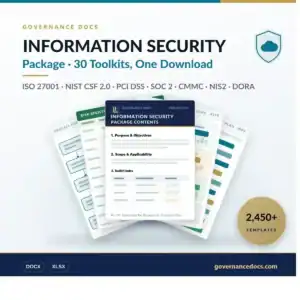
The Information Security Package includes all 30 toolkits for $699. It is one purchase with a separate download per toolkit.
Information security frameworks FAQ
Do I need all 30 information security frameworks?
No. You need a backbone plus the few that a law, regulator or customer demands. Use the table to find your area and ignore the rest.
Which framework should I start with?
Start with any legal duty that is already in force. If none applies, start with ISO/IEC 27001 or NIST CSF 2.0, depending on where your customers are.
Is SOC 2 a certification?
No. It is an attestation report issued by an independent auditor. ISO/IEC 27001, Cyber Essentials and HITRUST are certifications.
Can one set of documents cover several frameworks?
Largely, yes. Policies, the risk register, access, logging and incident procedures overlap heavily. You still need framework-specific evidence and each body’s own assessment.
Does a toolkit make me compliant?
No. It gives you editable documents that support your program. Compliance depends on how you implement them, and certification is decided by an accredited body.

Recent Posts
November 18, 2026
November 18, 2026
November 18, 2026
November 18, 2026

November 18, 2026