

A GRC framework is the set of connected programs that lets an organization govern its objectives, manage its risks and meet its obligations without running three separate bureaucracies. Many organizations build one by accident, adding a framework every time a customer or regulator asks. This guide shows how to assemble a GRC framework on purpose, from four layers and in a sensible order.
The four layers are risk, resilience, assurance and compliance. Financial firms add a fifth block of sector rules on top. Each layer has frameworks that are voluntary and frameworks that are law, and mixing them up is the fastest way to waste a year.
What a GRC framework is made of
There is no single standard called “the GRC framework.” You are choosing and connecting several. A workable GRC framework answers four questions:
- Risk: what could stop us reaching our objectives, and how much of it will we accept?
- Resilience: if it happens anyway, how do we keep critical services running?
- Assurance: who checks that the controls work, and who tells the board?
- Compliance: which laws and commitments bind us, and how do we prove we meet them?
The table below maps the 15 frameworks we cover, what kind of thing each one is, and who actually needs it. “Law” means a regulator can enforce it. “Certifiable” means an accredited body can audit you against it. Guidance means neither.
| Framework | What it is | Who it applies to | Type | Our toolkit |
|---|---|---|---|---|
| ISO 31000 Risk Management | Guidance on a risk management process and framework | Any organization; the shared risk language for everything below | Guidance, not certifiable | ISO 31000 Risk Management toolkit |
| COSO ERM & Internal Control | COSO Internal Control (2013) and Enterprise Risk Management (2017) frameworks | Organizations that need an internal control or ERM structure; the usual basis for SOX | Voluntary frameworks, not certifiable | COSO ERM & Internal Control toolkit |
| Third-Party Risk Management (TPRM) | A lifecycle for vetting, contracting, monitoring and exiting vendors | Any organization that outsources; essential in financial services | Practice and supervisory expectation, not certifiable | Third-Party Risk Management toolkit |
| ISO 22301 Business Continuity | Requirements for a business continuity management system | Organizations that must prove they can keep critical services running | Certifiable | ISO 22301 Business Continuity toolkit |
| ISO 28000 Supply Chain Security | Requirements for a security management system covering the supply chain | Logistics, manufacturing and other supply-chain-dependent organizations | Certifiable | ISO 28000 Supply Chain Security toolkit |
| DORA | EU regulation on digital operational resilience for financial entities | Financial entities in the EU and their ICT providers (in scope by law) | Law, not certifiable | DORA toolkit |
| Internal Audit (IIA Global Internal Audit Standards) | The 2024 professional standards for internal audit: 5 domains, 15 principles | Internal audit functions; expected by boards and audit committees | Professional standards, not a certificate | Internal Audit toolkit |
| SOX / ICFR | US securities law requirements for internal control over financial reporting | US-listed companies (Sections 302 and 404) | Law, not certifiable | SOX / ICFR toolkit |
| SOC 1 (ICFR) | Report on a service provider’s controls relevant to customers’ financial reporting | Service organizations whose customers’ auditors ask for it | Attestation report, not a certification | SOC 1 toolkit |
| ISO 37301 Compliance Management | Requirements for a compliance management system | Any organization with obligations to manage; the compliance backbone | Certifiable | ISO 37301 Compliance Management toolkit |
| ISO 37001 Anti-Bribery | Requirements for an anti-bribery management system | Organizations with bribery exposure, public-sector customers or third-party intermediaries | Certifiable | ISO 37001 Anti-Bribery toolkit |
| Basel III Prudential Risk | International prudential standards on bank capital, liquidity and risk | Banks, applied through national and regional rules | International standard, implemented by law | Basel III Prudential Risk toolkit |
| EU AMLR Anti-Money-Laundering | EU anti-money-laundering regulation, applies from 10 July 2027 | Obliged entities such as credit and financial institutions | Law, not certifiable | EU AMLR Anti-Money-Laundering toolkit |
| MiCA Crypto-Asset Regulation | EU regulation on crypto-asset issuers and service providers | Crypto-asset issuers and service providers serving the EU | Law, not certifiable | MiCA Crypto-Asset Regulation toolkit |
| GENIUS Act Stablecoin Compliance | US federal law on payment stablecoins (Pub. L. 119-27) | Payment stablecoin issuers and related service providers in the US | Law, not certifiable | GENIUS Act Stablecoin Compliance toolkit |
Layer 1: risk comes first in any GRC framework
Every other layer needs a common way to describe risk. Without one, your continuity plan, your audit plan and your compliance register will each score risk differently and nobody can compare them.
Start with ISO 31000 Risk Management. It is guidance, so there is nothing to certify, but it gives you the process: context, criteria, assessment, treatment, monitoring. Set your risk criteria and appetite early. Our guide to risk appetite, tolerance and capacity covers the three terms people confuse.
Add COSO ERM & Internal Control if you report financially in the US or want a control structure auditors recognize. COSO publishes two frameworks, the 2013 Internal Control framework and the 2017 ERM framework, and they do different jobs (see COSO: two frameworks). ISO 31000 and COSO ERM are compatible, so you do not have to choose one.
Then address third parties with Third-Party Risk Management (TPRM). Vendors are where risk, resilience and compliance collide, and regulators increasingly ask about them. If the topic is new to your team, start with what TPRM is.
Layer 2: resilience, from continuity to DORA
Risk assessment tells you what matters. Resilience programs keep it running when something fails.
ISO 22301 Business Continuity is the core: business impact analysis, recovery strategies, exercised plans. It is certifiable, which helps when customers ask for evidence. ISO 28000 Supply Chain Security extends the idea to the physical and logistical chain, and only matters if you move or depend on goods.
Free business impact analysis
How long can each activity really be down?
Rate the impact of an outage over time, set RTOs and maximum tolerable periods of disruption, map the people, systems and suppliers behind each activity, and get a recovery sequence back, free.
Run the free business impact analysis → or View premium report sample
DORA is different in kind. It is an EU regulation on digital operational resilience for financial entities, and it has applied since January 2025. If you are an in-scope financial entity, it is not optional, and much of your ISO 22301 and TPRM work will feed it (ICT risk, incident reporting, third-party registers).
Layer 3: assurance, the layer that tests the others
Assurance should come after the controls exist, but the function itself should be set up early so it can grow with the program.
Internal audit under the IIA Global Internal Audit Standards gives you the independent function. The 2024 Standards are organized into five domains and 15 principles; the IIA’s page for the Standards sets out the structure.
SOX / ICFR applies by law to US-listed companies, and its Section 404 work depends on a documented control framework, which is why COSO usually sits underneath it. SOC 1 (ICFR) is the other side of the same coin: if you are a service provider whose work affects your customers’ financial statements, a SOC 1 report lets their auditors rely on your controls. It is an attestation report, not a certification. If you are unsure whether you need SOC 1 or SOC 2, read SOC 1 vs SOC 2.
Layer 4: compliance management and anti-bribery
ISO 37301 Compliance Management is the certifiable backbone. It turns “we try to follow the rules” into an obligations register, a compliance risk assessment, a named function, and a way to handle breaches. Everything in the sector block below plugs into it.
ISO 37001 Anti-Bribery is narrower. It fits when you use agents and intermediaries, sell to governments, or operate in high-risk markets. It reuses the same management-system structure as ISO 37301, so implementing both together costs far less than doing them a year apart.
The financial-sector block
If you are a bank, payments firm, crypto-asset business or stablecoin issuer, your GRC framework needs the rules that regulators enforce directly. Check each one for applicability before you spend a day on it.
- Basel III Prudential Risk: international prudential standards for banks. They reach you through national or regional rules, not directly.
- EU AMLR Anti-Money-Laundering: the EU anti-money-laundering regulation, which applies from 10 July 2027. Build from the regulation’s own text, because some detailed technical standards were still in draft at our last check.
- MiCA Crypto-Asset Regulation: EU rules for crypto-asset issuers and service providers.
- GENIUS Act Stablecoin Compliance: a US federal statute on payment stablecoins, signed 18 July 2025. Its effective date is set by a formula in the statute and falls no later than 18 January 2027.
These four are law, not certifications. A management-system standard such as ISO 37301 cannot replace them, but it gives them a home: one obligations register, one owner, one breach process.
We have written more on a few of them if you need detail: Basel III and the AMLR are both covered on the site.
The order to build your GRC framework
Order matters because each layer feeds the next. This sequence works for most multi-framework organizations:
- List your legal obligations first. Anything that is law and applies to you (DORA, SOX, AMLR, MiCA, the GENIUS Act, Basel rules) sets the hard dates. Everything else is a choice.
- Agree the risk language. ISO 31000 criteria, appetite and a single risk register. COSO if you report financially in the US.
- Stand up the compliance system. ISO 37301 gives you the obligations register that step 1 produced a first draft of. Add ISO 37001 where bribery exposure is real.
- Add resilience. ISO 22301, then DORA mapping if in scope, then ISO 28000 for supply chains.
- Bring in third parties. TPRM touches risk, resilience and compliance, so it is easier once all three exist.
- Turn on assurance. Internal audit plans, SOX testing and, if you serve customers’ financial reporting, SOC 1.
Treat internal audit as an exception: appoint the function and agree its charter in step 2 or 3, so it can audit the program as it grows rather than arriving at the end. The IT governance documents and information security frameworks guides cover the technology layers.
Where the frameworks overlap
The same evidence serves several frameworks. A risk register supports ISO 31000, COSO ERM, DORA and the internal audit plan. An obligations register supports ISO 37301 and every regulation in the financial block. A vendor inventory supports TPRM, DORA and SOC 1 subservice questions. Build each artifact once, tag it to every framework it serves, and your GRC framework gets lighter as it grows.
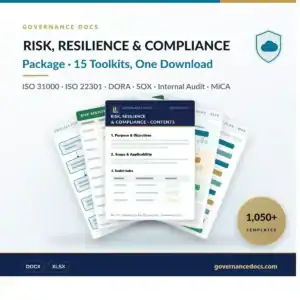
The Risk, Resilience & Compliance Package includes all 15 toolkits above for $499. It is one purchase with a separate download per toolkit, licensed for internal use by one organization. Consultants working for clients need the Consultant Package. Documents support your program, but certification or regulatory approval is never a result of buying templates.

GRC framework FAQ
Do I need all 15 frameworks in a GRC framework?
No. You will likely need a handful. Start with the ones that are law for your sector, then add voluntary frameworks that customers or auditors ask for. The financial-sector block applies only if you are in that sector.
Is a GRC framework certifiable?
No, as a whole it is not. Some components are certifiable (ISO 22301, ISO 28000, ISO 37301, ISO 37001), some are attestation reports (SOC 1) and some are laws (DORA, SOX, AMLR, MiCA, the GENIUS Act).
Should I implement ISO 31000 or COSO ERM?
They are compatible and often used together. ISO 31000 gives the risk process, and COSO ERM and Internal Control give an enterprise and control structure that suits financial reporting. Both are guidance, not certifiable.
What is the difference between SOX and SOC 1?
SOX is a US law that applies to listed companies. SOC 1 is an attestation report a service provider commissions so its customers’ auditors can rely on its controls over financial reporting.
Where should a small organization start?
With a risk register, an obligations register and a documented business impact analysis. Those three artifacts feed nearly every other framework in this guide.

Recent Posts
November 18, 2026
November 18, 2026
November 18, 2026
November 18, 2026

November 18, 2026