CART
Basel III has a deadline that already passed, and an implementation picture that is still incomplete. Both things are true, and the gap between them is the single most useful thing to understand about it.
The finalised reforms were set to be in effect from 1 January 2023. More than three years later, the Basel Committee is still tracking which of its 27 member jurisdictions have brought which elements into force.
Basel III is a set of internationally agreed standards for bank capital, liquidity and risk management, issued by the Basel Committee on Banking Supervision. The final post-crisis reforms were published between 2017 and 2019.
It is not law anywhere. That is the point most guides skip, and it changes everything about how you should plan.
The Committee has no legal authority over any bank. Its standards bind you only once your own jurisdiction transposes them into domestic regulation — and jurisdictions transpose at different speeds, in different orders, with deviations. Your obligations come from your national regulator’s rulebook, not from Basel.
So the useful question is never “what does Basel III require?” It is “which elements has my regulator brought into force, and from when?”
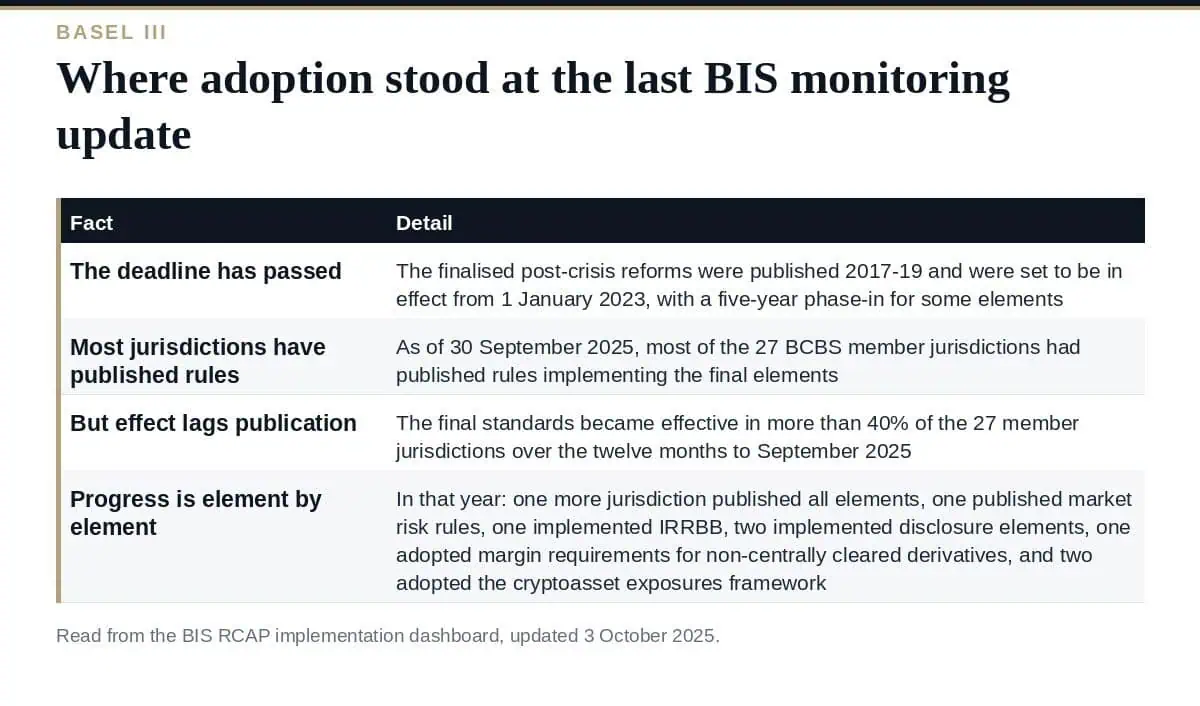
The Committee monitors this through its Regulatory Consistency Assessment Programme (RCAP), established in 2012. Its implementation dashboard was last updated on 3 October 2025, reporting adoption status as at 30 September 2025.
The headline: most member jurisdictions have now published their rules implementing the final elements of Basel III — those with an implementation date of 1 January 2023. But published is not the same as effective, and the final standards became effective in more than 40% of the 27 member jurisdictions over the twelve months to September 2025 alone.
Progress runs element by element rather than as a single switch. In that same year, one further jurisdiction published all elements, another published its market risk rules, one implemented the interest rate risk in the banking book standard, two implemented parts of the disclosure framework, one adopted the margin requirements for non-centrally cleared derivatives, and two adopted the framework for banks’ exposures to cryptoassets.
If you operate across borders, that fragmentation is your compliance problem. The same group can face different Basel III requirements, on different timetables, in each jurisdiction it books business in.
RCAP runs two distinct workstreams, and the distinction is worth knowing because they ask different questions.
Monitoring covers timeliness — has the jurisdiction transposed the standard into domestic regulation, and when. This is the dashboard.
Assessment covers consistency, and splits again:
That second one has a direct consequence for banks: your capital ratio is not only a number you report, it is a number the Committee wants comparable with a bank in another country. Calculation choices that look defensible internally can show up as an outlier in a thematic review.
Separately, the Committee runs an evaluation programme, established in mid-2020, assessing whether the implemented reforms actually increased resilience. Three evaluation reports were published in 2021–22, and evaluation continues under the 2025–26 work programme.
| Framework | Relationship |
|---|---|
| DORA | Basel III governs prudential resilience; DORA governs operational and ICT resilience for EU financial entities. Both land on the same institutions and neither substitutes for the other |
| ISO 31000 | Supplies a consistent risk method underneath the risk management expectations, so credit, market, operational and non-financial risk are graded on one scale |
| ISO 27001 | The information security management system behind risk data aggregation and reporting integrity |
| ISO 22301 | Business continuity, which supervisors increasingly examine alongside capital and liquidity |
This guide reflects the BIS RCAP implementation dashboard at 15 August 2026, which reported adoption status as at 30 September 2025. Confirm your own jurisdiction’s position with its regulator before acting on a date.
The Basel III Prudential Risk Toolkit provides 25 editable templates covering capital adequacy, liquidity monitoring, the ICAAP, risk governance and the Pillar 3 disclosure artefacts.


October 15, 2026

October 15, 2026
October 14, 2026

October 14, 2026

October 14, 2026

