CART
Risk appetite is one of three terms that get used as though they were synonyms — appetite, tolerance and capacity — and the confusion is expensive, because each one answers a different question and only one of them is a hard limit. Worth knowing before you start: ISO 31000 itself does not use the term.
This guide separates the three, shows what a usable appetite statement looks like, and covers where these statements stop working.
Free gap assessment
Is risk management actually changing decisions?
A maturity assessment against all eight principles, the framework and the process, free. Nobody can certify you to ISO 31000, so this scores distance from good practice instead.
Run the free ISO 31000 maturity assessment → or View premium report sample
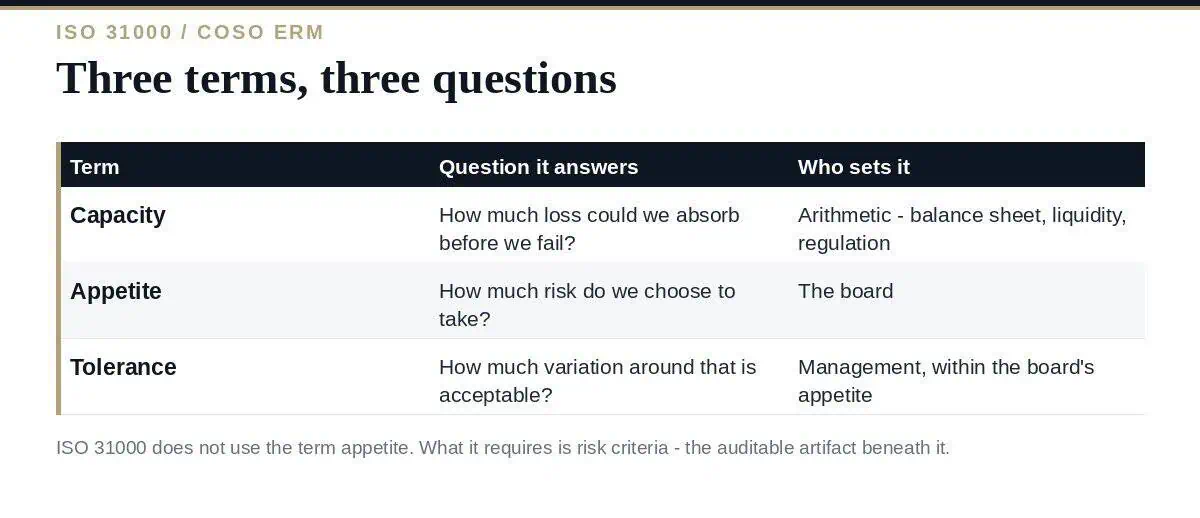
| Term | Question it answers | Who sets it |
|---|---|---|
| Capacity | How much loss could we absorb before we fail? | Arithmetic — balance sheet, liquidity, regulation |
| Appetite | How much risk do we choose to take in pursuit of objectives? | The board |
| Tolerance | How much variation around that is acceptable in practice? | Management, within the board’s appetite |
Capacity is a fact you discover. Risk appetite is a decision you make, and it should sit below capacity with room to spare. Tolerance is the operating band around a specific objective — the point at which management escalates rather than absorbs.
Free ISO 27001 risk assessment
Which of your risks sit above your appetite line?
Set your own risk criteria, pick from 61 information security risk scenarios, rate likelihood and impact, and decide how to treat each one. You get a heat map, a process score and the findings an auditor would raise, free.
Run the free risk assessment → or View premium report sample
ISO 31000 does not require a risk appetite statement, and does not use the phrase in its requirements. What it requires is risk criteria: the terms of reference against which the significance of risk is evaluated, defined when the process is designed and reviewed as things change. Risk appetite, as most organizations use it, is the board-level expression of those criteria, and the vocabulary came into general use mainly through enterprise risk management frameworks rather than through ISO.
That matters practically. If you are being audited against ISO 31000 or a management system standard, the auditable artifact is the criteria — the scales, the thresholds, the escalation rules. An appetite statement with no criteria beneath it satisfies nobody.
The failure mode is universal and recognisable: “We have a low appetite for operational risk and a moderate appetite for strategic risk.” Nobody has ever made a decision with that sentence. A statement earns its place when it does four things:
The link is the scoring scale. If risks are scored on a five-by-five matrix, the risk appetite has to be expressed in the same units, so that “above appetite” is a fact about the register rather than a judgement call. Without that, every escalation becomes a negotiation. Our guide to the cybersecurity risk register covers the register side of the same join.
Written once, for the board pack. An appetite statement that is not revisited when strategy changes describes a company that no longer exists.
No connection to authority. If exceeding appetite does not change who may approve a decision, the statement has no teeth. The mechanism is delegated authority: within appetite, the manager decides; above it, somebody more senior does.
Aggregation ignored. Ten individually acceptable risks can breach appetite collectively. Portfolio-level review is the only place that shows up.
Appetite set by the risk function. Risk teams draft; boards own. An appetite the board did not genuinely debate will not survive the first time it is inconvenient.
What is risk appetite?
The amount and type of risk an organization is willing to pursue or retain in pursuit of its objectives — a board-level choice, sitting below the organization’s capacity to bear loss.
How is it different from risk tolerance?
Appetite is the overall willingness; tolerance is the acceptable variation around a specific objective, set by management within appetite and usually expressed as a threshold that triggers escalation.
Does ISO 31000 require a risk appetite statement?
No. ISO 31000 requires risk criteria. Most organizations express the board’s position as an appetite statement and derive the criteria from it, which satisfies both.
Who approves it?
The board or equivalent governing body, on advice. Delegating approval to a risk committee is common; delegating it to the risk function is not.
How often should it be reviewed?
At least annually and whenever the strategy, business model or external environment changes materially — the same trigger that should prompt a review of the criteria beneath it.
Work out capacity first, because it bounds everything else. Set risk appetite per category with a measure attached, tie it to the same scale your risk register uses, and write the escalation rule that says what happens when a risk sits above it. Then push it into delegated authority — an appetite that changes who can approve what is a control, and one that lives only in a board paper is a paragraph.
Appetite statements, criteria scales and the register template are in the ISO 31000 Risk Management Toolkit, or start with the free ISO templates.


October 13, 2026
October 12, 2026
October 12, 2026

October 12, 2026

October 12, 2026

