CART
Road traffic safety objectives are where ISO 39001 stops describing risk and starts committing to change it. Clause 6.4 — RTS objectives and planning to achieve them — follows directly from clause 6.3, the RTS performance factors, and the sequence is the point: the organisation identifies the exposure, intermediate and final outcome factors it can influence, and then sets objectives against those factors with plans, resources, owners, timescales and measures. An objective set only on crashes fails the sequence, because final outcomes are rare, lagging and largely outside short-term control; an objective set on the intermediate factors — speed, vehicle safety, driver fitness, restraint use, journey planning — moves first and can be managed monthly. This guide sets out what clause 6.4 requires, how to derive road traffic safety objectives from the factor analysis, worked objectives for each factor type with measures and targets, how to build the plan behind each objective, how to monitor and report them, and the five faults that make objectives unauditable.
| Requirement | What it means | Evidence |
|---|---|---|
| Objectives at relevant functions and levels | Organisation-wide objectives plus depot, route or business-unit objectives where exposure differs | Objectives register by level |
| Consistent with the RTS policy | Each objective traces to a commitment in clause 5.2 | Cross-reference to the policy |
| Based on the RTS performance factors | Derived from the 6.3 analysis — exposure, intermediate and final outcome factors the organisation can influence | Factor-to-objective map |
| Measurable where practicable | A measure, a baseline and a target with a date | Metric definitions; baseline data |
| Planned | What will be done, what resources are required, who is responsible, when it will be completed, how results will be evaluated | Plan per objective |
| Monitored and communicated | Progress tracked under 9.1 and reviewed under 9.4; communicated to those who affect them | Dashboards; review minutes; briefings |
| Updated | Revised as factors, exposure and results change | Version history |
Our guide to RTS performance factors covers the clause 6.3 analysis the objectives are derived from.
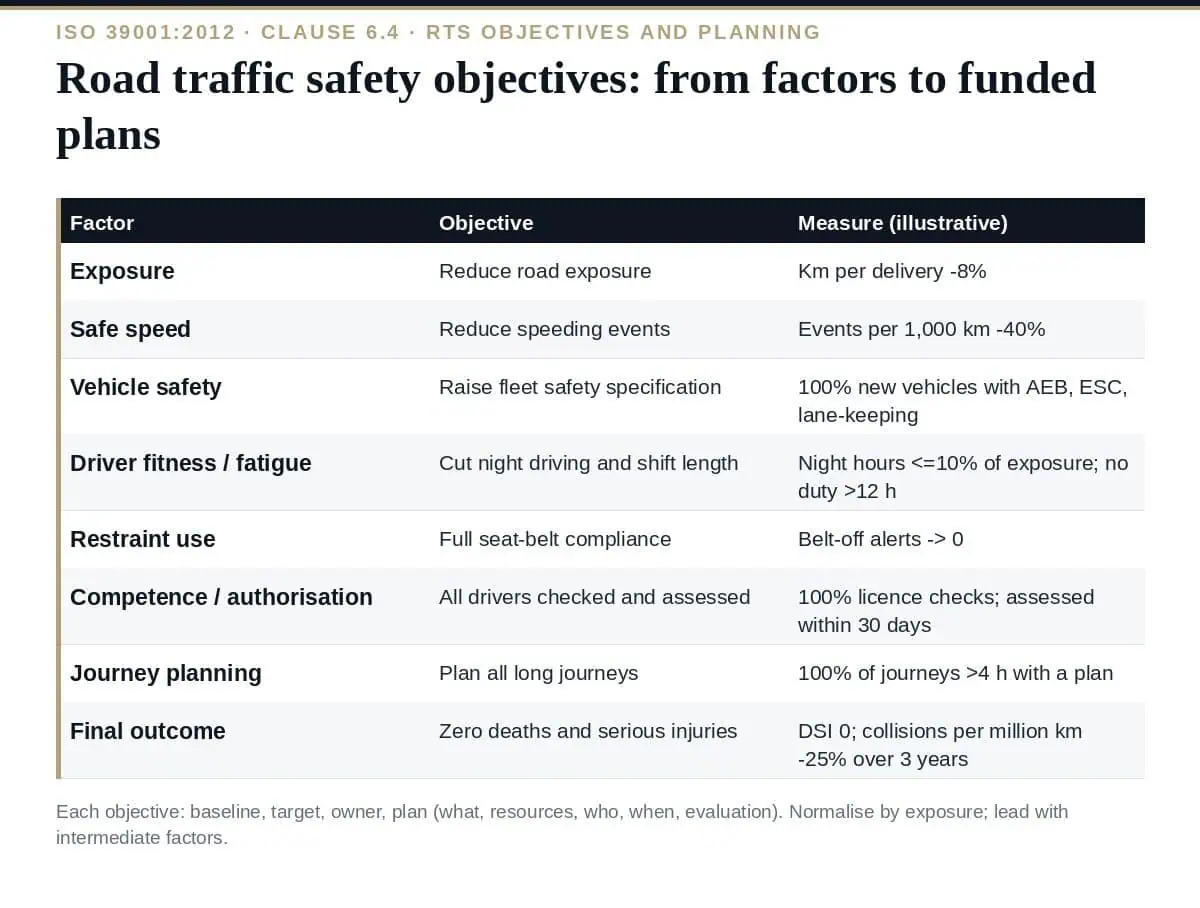
| Factor type | Factor | Objective | Measure and target | Plan elements |
|---|---|---|---|---|
| Exposure | Distance travelled | Reduce road exposure on the regional delivery network | Km per delivery −8% by year end | Route consolidation; drop density; modal shift for long legs |
| Intermediate | Safe speed | Reduce speeding events | Telematics speeding events per 1,000 km −40% in 12 months; zero events over limit +20% | Telematics on all vehicles; weekly driver feedback; escalation ladder; scheduling review |
| Intermediate | Vehicle safety | Raise the safety specification of the fleet | 100% of new vehicles with AEB, ESC and lane-keeping; fleet average age ≤4 years | Procurement specification; replacement plan; defect closure ≤48 h |
| Intermediate | Driver fitness and fatigue | Reduce driving at circadian low points and shift length | Night-driving hours ≤10% of exposure; no duty over 12 h; fatigue reports acknowledged within 24 h | Rostering rules; journey standards; fit-for-duty declaration; reporting route |
| Intermediate | Restraint use | Achieve full seat-belt compliance | Belt-off alerts per 1,000 km → 0; spot-check compliance 100% | Telematics belt sensors; cab briefings; consequences |
| Intermediate | Driver competence and authorisation | All drivers assessed and authorised by class | 100% licence checks current; 100% assessed within 30 days of start; refresher every 2 years | Licence-check service; assessment programme; authorisation register |
| Intermediate | Journey planning | Risk-assess and plan all long journeys | 100% of journeys over 4 h with a journey plan; overnight rule compliance 100% | Journey risk assessment procedure; planning tool; manager approval |
| Intermediate | Distraction | Eliminate hand-held phone use | Distraction events per 1,000 km −60%; zero hand-held detections | Policy; phone-blocking apps; dashcam review; consequences |
| Final | Deaths and serious injuries | Zero deaths and serious injuries; reduce collisions | DSI: 0; collisions per million km −25% over 3 years | The sum of the above; investigation of every collision under 9.2 |
Targets are illustrative; set them from the baseline. The final-outcome objective is the point of the exercise and the worst management signal, which is why it sits last and is reviewed over years rather than months. Our guide to driver fatigue covers the fitness objective in depth.
| Plan element (6.4) | What to record | Example (speeding events −40%) |
|---|---|---|
| What will be done | Actions in sequence | Install telematics on remaining 40 vehicles; weekly driver reports; three-step escalation; review delivery windows |
| Resources required | Money, people, systems | Telematics contract; 0.2 FTE analyst; manager time |
| Who is responsible | One owner; contributors | Transport manager; depot supervisors; HR for the escalation ladder |
| When it will be completed | Milestones and end date | Install by month 2; feedback live month 3; target by month 12 |
| How results will be evaluated | Measure, frequency, forum | Events per 1,000 km monthly; quarterly to management review |
What are road traffic safety objectives under ISO 39001?
The objectives clause 6.4 requires the organisation to set, at relevant functions and levels, based on the RTS performance factors identified under 6.3, consistent with the RTS policy, measurable where practicable, with plans stating what will be done, resources, responsibility, timescale and evaluation.
Should objectives be set on crashes?
Keep a final-outcome objective — zero deaths and serious injuries, fewer collisions — because harm is the point. But set the working objectives on intermediate factors such as speed, vehicle safety, driver fitness, restraint use and journey planning, which move first and can be managed monthly.
How many objectives should we have?
Enough to cover the significant factors the organisation can influence — typically five to nine — each with one owner and a plan. Twenty unowned objectives are worse than six owned ones.
Do we need telematics to set objectives?
No, but most intermediate factors are hard to measure without some data source. Licence checks, vehicle age, hours data and incident logs support several objectives without telematics; speed and distraction objectives usually need it.
How often should objectives be reviewed?
Progress monthly or quarterly; the set itself at management review, at least annually, and when exposure or the factor analysis changes.
Set road traffic safety objectives from the factor analysis, normalise them by exposure, give each a baseline, a target, an owner and a funded plan, monitor the leading measures monthly and keep the crash figures as the lagging check. That is the sequence clause 6.4 describes — and the difference between a fleet that reports its collisions and one that changes the conditions that cause them.
The RTS Objectives and Plans Register, the performance-factor analysis workbook, the monitoring dashboard template and the management review inputs are in the ISO 39001 Road Traffic Safety Toolkit, or start with the free templates.


September 20, 2026
September 19, 2026

September 19, 2026

September 19, 2026

September 19, 2026

