CART
Hard FM vs soft FM is the first distinction anyone learns in facility management and one that ISO’s vocabulary does not use at all. ISO 41011:2024 defines facility management as the “organizational function which integrates people, place and process within the built environment with the purpose of improving the quality of life of people and the productivity of the core business”, and defines facility services and support services — but not hard or soft. The split is industry shorthand: hard FM is the services attached to the fabric and systems of a building — mechanical, electrical, fire, lifts, fabric, statutory inspection — and soft FM is the services delivered to the people in it — cleaning, security, catering, reception, waste, grounds, mail. The distinction matters for how services are specified, sourced, measured and integrated under ISO 41001:2018, whose clause 8.3 is titled integration of services, and it matters for cost, risk and who is liable when something fails. This guide sets out what belongs in each, the six differences that change how you manage them, how ISO 41001 treats both, the sourcing models — single-service, bundled, total FM, integrated FM — and where the line blurs.
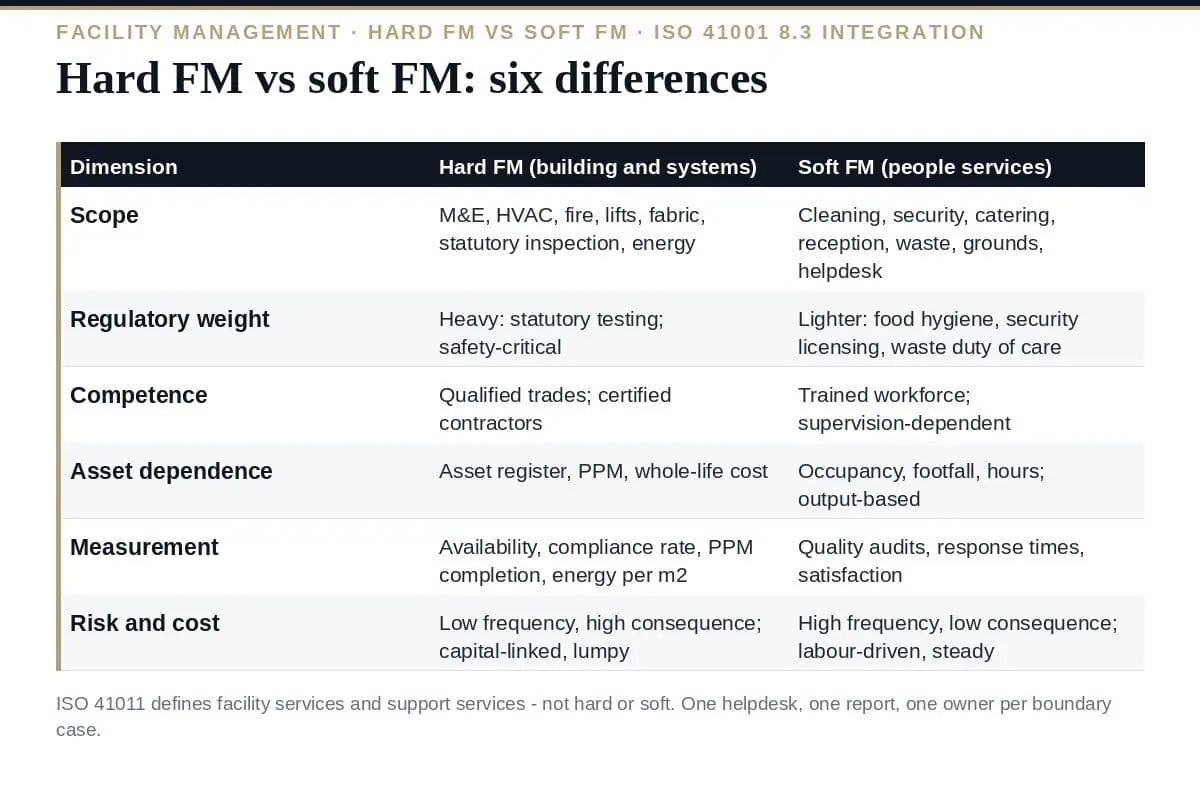
| Hard FM (the building and its systems) | Soft FM (the people in it) |
|---|---|
| Mechanical and electrical maintenance: HVAC, power, lighting, controls, BMS | Cleaning and hygiene, including specialist and periodic cleaning |
| Fire detection, suppression and life safety systems | Security: guarding, access control operation, CCTV monitoring, reception |
| Lifts, escalators and lifting equipment | Catering, vending and hospitality |
| Building fabric: roofs, envelope, glazing, internal finishes | Waste management and recycling |
| Plumbing, drainage, water hygiene and legionella control | Grounds maintenance, landscaping, winter services |
| Statutory inspection and testing: gas, electrical, pressure systems, fire, asbestos, water | Mailroom, porterage, reprographics, front-of-house |
| Energy management and metering; renewables and EV infrastructure | Helpdesk, space booking, moves and changes, workplace services |
| Minor works, repairs and projects | Pest control, laundry, uniform, plants |
| Dimension | Hard FM | Soft FM |
|---|---|---|
| Regulatory weight | Heavy: statutory inspection and testing regimes, fire safety, gas and electrical safety, pressure systems, asbestos, water hygiene — failure is a legal and safety event | Lighter but real: food hygiene, security licensing, waste duty of care, employment and safeguarding — failure is mostly a service and reputational event |
| Competence | Qualified trades and engineers; certified contractors for gas, electrical, lifts, fire | Trained but largely unlicensed workforce; high turnover; supervision-dependent |
| Asset dependence | Tied to the asset register and its condition; planned preventive maintenance schedules; whole-life cost | Tied to occupancy, footfall and hours of use; output-based |
| Measurement | Availability, statutory compliance rate, PPM completion, reactive ratio, energy per m² | Quality audits, response times, occupant satisfaction, cleanliness scores, incident counts |
| Risk profile | Low frequency, high consequence: a lift entrapment, a fire system failure, a legionella outbreak | High frequency, low consequence: a missed clean, a slow reception — with occasional high-consequence security or food-safety events |
| Cost behaviour | Capital-linked; lumpy; driven by asset age and condition; backlog accumulates silently | Labour-driven; steady; sensitive to wage rates, hours and specification creep |
The measurement row is where most FM contracts go wrong: hard services measured on inputs (visits made) and soft services on outputs (is it clean?), or the reverse. Our guide to facility management KPIs covers the measure set for both.
| ISO 41001:2018 clause | Applied to hard FM | Applied to soft FM |
|---|---|---|
| 4.2 Interested parties | Regulators, insurers, asset owners, engineers | Users, occupants, visitors, the workforce delivering it |
| 6.2 FM objectives | Statutory compliance 100%; availability; energy; backlog reduction | Satisfaction; response; quality scores; incident reduction |
| 7.2 Competence | Licences, certifications, contractor accreditation | Training, induction, supervision ratios, vetting for security |
| 8.1 Operational planning | PPM programmes, statutory schedules, permit-to-work | Rotas, specifications, quality audit regimes |
| 8.2 Coordination with interested parties | Shutdowns, access, engineering changes | Events, occupancy changes, service hours |
| 8.3 Integration of services | Where hard and soft meet: helpdesk routing, shared supervision, one performance report, one supplier interface | |
| 9.1 Monitoring | Compliance dashboards, condition data, energy | Quality audits, surveys, complaints |
Clause 8.3 is the reason the split should not become two management systems. ISO 41011 defines facility management as an integrating function, and the auditor looks for one helpdesk, one performance report and one view of the estate across both service types. Our guide to ISO 41001 covers the standard.
| Model | What it is | Fits when | Watch for |
|---|---|---|---|
| Single-service contracts | One contract per service, hard or soft | Small estates; specialist services; strong in-house management | Many interfaces; gaps between contracts; management overhead |
| Bundled hard or bundled soft | One provider for all hard services, another for all soft | Mid-size estates wanting fewer suppliers without losing specialism | The hard/soft boundary itself — who owns the blocked drain, the door that will not lock? |
| Total FM (TFM) | One provider for hard and soft | Large estates; demand organisations that want one throat to choke | Subcontracting depth; margin on margin; loss of specialist quality |
| Integrated FM (IFM) | One provider with integrated systems, helpdesk and reporting across services, often with self-delivery of core lines | Portfolios needing one data set and 8.3 integration by design | Lock-in; transition cost; the need to specify outputs precisely |
| In-house with specialist support | Own team for soft or hard, contracts for the licensed work | Sites where control and continuity matter more than cost | Competence maintenance; statutory coverage |
ISO 41012:2017 gives guidance on strategic sourcing and the development of agreements, with a revision at FDIS. Our guide to the facility management SLA covers the agreement that follows the sourcing decision.
The practical rule on hard FM vs soft FM boundaries: assign every case to one owner in the service specification, and route it through one helpdesk.
What is the difference between hard FM and soft FM?
Hard FM covers the services attached to a building’s fabric and systems — M&E, fire, lifts, fabric, statutory inspection, energy — and soft FM covers services delivered to the people in it — cleaning, security, catering, reception, waste, grounds, helpdesk. The split is industry vocabulary; ISO 41011 defines facility services and support services but not hard or soft.
Does ISO 41001 distinguish them?
No. It requires an FM system that integrates services (8.3) whatever their type. The distinction is useful for specification, competence, measurement and sourcing, and unhelpful if it becomes two systems.
Which is more expensive?
Soft FM usually dominates the operating budget because it is labour-driven; hard FM dominates capital and risk because it is asset-driven and its backlog accumulates silently. Whole-life cost is the comparison that matters.
Which should we outsource?
Licensed hard services are outsourced almost universally because of competence and statutory coverage; soft services depend on control, continuity and cost priorities. ISO 41012 gives sourcing guidance; the strategy should record the options considered.
Who owns the boundary cases?
Whoever the service specification says. Assign every blurred case — security systems, plant-room cleaning, waste, energy, moves — to one owner and one helpdesk route before the contract starts.
Use hard FM vs soft FM to specify, staff, measure and source services correctly — statutory and asset-driven on one side, people and output-driven on the other — and then integrate them the way ISO 41001 clause 8.3 expects: one helpdesk, one performance report, one owner for every boundary case. The split organises the work; the integration is the management system.
The service specification templates for hard and soft services, the service integration procedure, the helpdesk and boundary-ownership matrix and the supplier performance review are in the ISO 41001 Facility Management Toolkit, or start with the free templates.

September 20, 2026
September 19, 2026

September 19, 2026

September 19, 2026

September 19, 2026

