CART
Facility management KPIs are the difference between an FM function that can defend its budget and one that cannot. ISO 41001 requires the organization to determine what needs to be monitored and measured, and by what methods — and in facility management that requirement lands on a relationship most standards do not have to describe: the one between the demand organization that needs the services and the provider that delivers them.
This guide sets out the measures worth keeping, how to write one so two people report it the same way, and the trap of measuring activity instead of outcome.
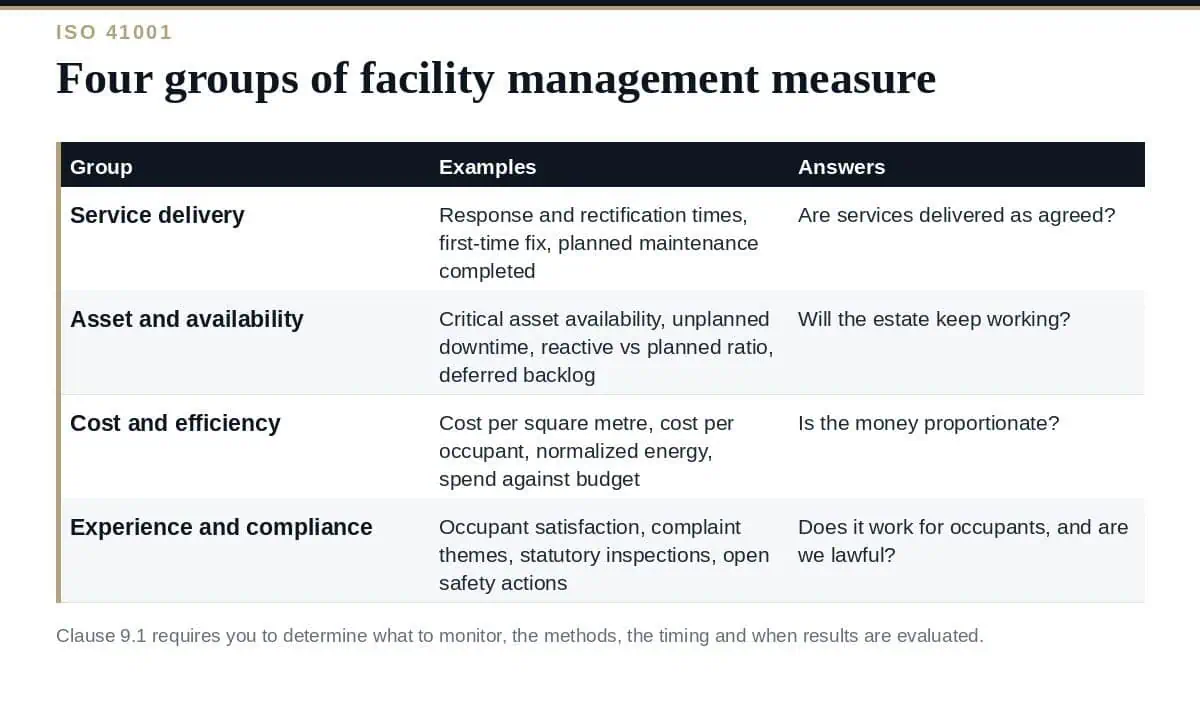
Clause 9.1 requires the organization to determine what needs monitoring and measurement, the methods for doing it, when it is performed, and when the results are analysed and evaluated. It does not hand you a list of measures, which is deliberate — an FM system in a hospital and one in a distribution centre share almost no numbers.
What it does supply is the framing. ISO 41001 is written around the demand organization — the entity that needs the facility services — and the provider that supplies them, whether that provider is in-house or contracted. Your KPIs exist to tell the demand organization whether it is getting what it needs, which is a different question from whether the FM team is busy.
| Group | Examples | Answers |
|---|---|---|
| Service delivery | Response and rectification times against target, first-time fix rate, planned maintenance completed on schedule | Are the services being delivered as agreed? |
| Asset and availability | Critical asset availability, unplanned downtime, reactive versus planned work ratio, backlog of deferred maintenance | Will the estate keep working? |
| Cost and efficiency | Cost per square metre, cost per occupant, energy consumption normalized for weather and occupancy, spend against budget | Is the money proportionate to what is delivered? |
| Experience and compliance | Occupant satisfaction, complaint volumes and themes, statutory inspections completed, open safety actions | Does it work for the people using it, and are we lawful? |
The reporting rule that follows: service delivery and asset measures are operational and belong in the monthly review; cost and experience measures are what the demand organization’s leadership actually needs. A board pack full of first-time fix rates tells an executive nothing they can act on.
The most common failure in facility management KPIs is counting work rather than results. Tickets closed, jobs raised and hours spent all rise when the estate is deteriorating — a rising volume of reactive work is a warning, not an achievement. Pair every activity measure with the outcome it is supposed to produce: jobs completed against asset availability, planned maintenance completed against unplanned downtime, spend against condition.
Where services are outsourced, the KPI is a contractual term and every ambiguity becomes a dispute. Four things have to be pinned down for each measure:
Keep the set small. A service specification with sixty measures gets reported on and acted on for about four of them, and the other fifty-six generate reporting effort that could have been maintenance.
Facility management KPIs pull in three directions worth wiring deliberately. Energy measures overlap with an energy management system, and if you run one, the normalization work is already done — see our guide to energy performance indicators. Statutory inspection and safety measures overlap with occupational health and safety obligations. And where FM is delivered under contract, the KPI set is also your supplier performance evidence.
One caution on the standard itself: ISO 41001:2018 is the current, certifiable edition, but its revision has been progressing through ISO’s stages, so clause numbering you cite today has a limited life. Cite what the clause requires rather than only its number, and check the edition before a re-certification cycle. Our guide to ISO 41001 and its revision covers where that stands.
Does ISO 41001 specify which KPIs to use?
No. It requires you to determine what to monitor and measure, the methods, the timing and when results are evaluated. The selection is yours and should follow the demand organization’s needs.
How many facility management KPIs should we report?
Few enough that each one has an owner and a consequence. Most organizations act on a handful; the rest are reporting overhead.
What is a demand organization?
The entity that needs and specifies the facility services, as distinct from the provider — in-house or external — that delivers them. The distinction is central to how ISO 41001 is written.
Should KPIs differ for in-house and outsourced FM?
The measures can be identical; the enforcement differs. Outsourced measures need contractual definitions, agreed data sources and stated exclusions because money turns on them.
How do we measure occupant satisfaction credibly?
A consistent instrument, a consistent population and a consistent period. A survey redesigned each year produces a trend line that means nothing.
Choose facility management KPIs from what the demand organization needs to know, not from what the CAFM system can export. Pair every activity count with the outcome it is meant to move, define each measure tightly enough that a contractor and a client compute it identically, and keep the set small enough to act on. Then report cost and experience upward, keep service delivery and asset measures in the operational review, and let the trend rather than the monthly number drive the conversation.
Performance frameworks, service specifications and review templates are in the ISO 41001 Facility Management Toolkit, or start with the free ISO templates.

October 13, 2026
October 12, 2026
October 12, 2026
October 12, 2026

October 12, 2026

