CART
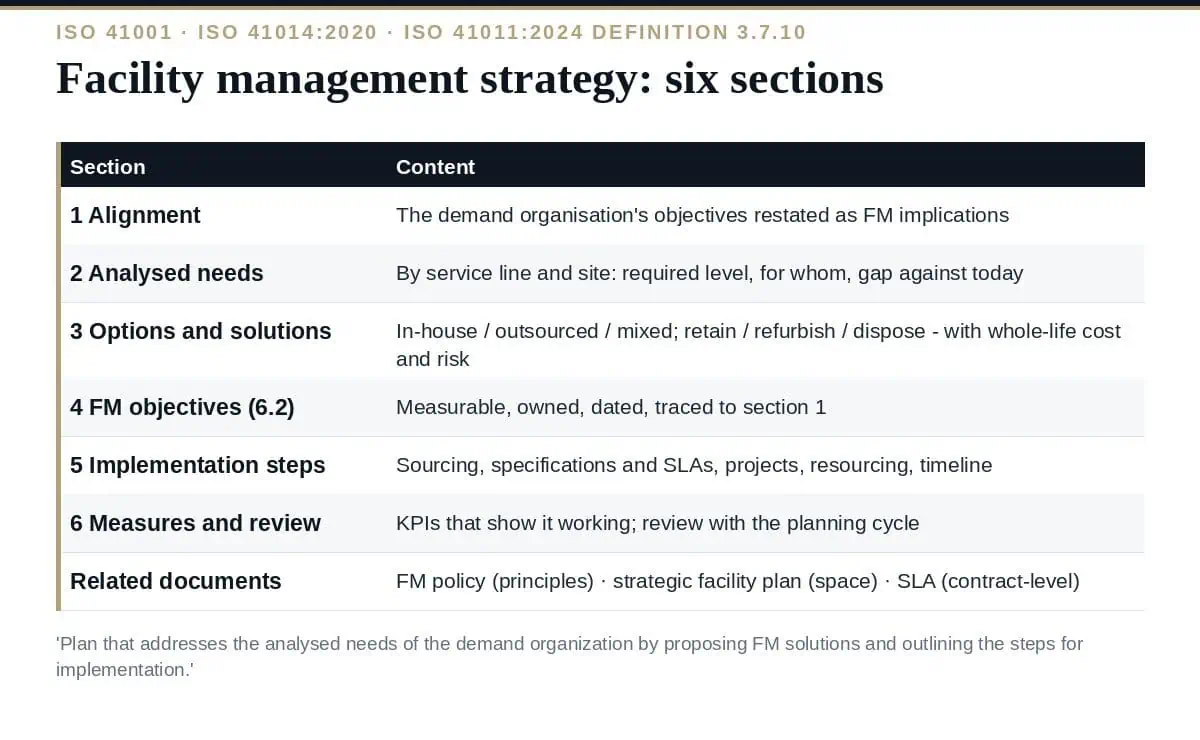
A facility management strategy is the document that makes ISO 41001 a management system rather than a maintenance regime. ISO 41011:2024 defines it as a “plan that addresses the analysed needs of the demand organization by proposing facility management solution(s) and outlining the steps for implementation” (3.7.10), and ISO 41014:2020 — Development of a facility management strategy — gives the method, for an FM organisation that “intends to ensure alignment between FM requirements and the objectives, needs and constraints of the demand organization’s core business”. That alignment is the whole point: ISO 41001’s FM objectives (6.2) have to trace to the organisation’s objectives, and the strategy is the trace. Without it, an FM function has a budget, a supplier list and a help desk, and no way to show an auditor — or a finance director — why any of it is the right size. This guide sets out what ISO 41001 expects the strategy to do, the inputs ISO 41014 works from, the six sections of a strategy that holds up, how it relates to the strategic facility plan, the FM policy and the service specifications, how to keep it alive across a planning cycle, and the five faults auditors and boards find.
| Clause (ISO 41001:2018) | Requirement | What the strategy supplies |
|---|---|---|
| 4.1, 4.2 | Context; needs and expectations of interested parties — the demand organisation, users, providers, regulators | The analysed needs the strategy starts from |
| 4.3, 4.4 | Scope of the FM system; the system itself | The services, sites and provider model the strategy covers |
| 5.1, 5.2 | Leadership; FM policy | Top management’s direction the strategy implements; the policy sets the principles, the strategy the plan |
| 6.1 | Actions to address risks and opportunities | The risks to delivering the strategy |
| 6.2 | FM objectives and planning to achieve them — traceable to organisational objectives | The objectives, with the trace |
| 7.1, 7.6 | Resources; organizational knowledge | The resourcing case; the knowledge the strategy depends on |
| 8.1–8.3 | Operational planning; coordination with interested parties; integration of services | Service specifications, SLAs, sourcing and integration decisions derived from the strategy |
| 9.1, 9.3 | Monitoring and measurement; management review | The measures that show the strategy is working; the review that updates it |
Our guide to ISO 41001 covers the standard; this post covers the document that makes clause 6.2 traceable.
| Input | Source | What to extract |
|---|---|---|
| Core business objectives and constraints | Corporate strategy; business plans; budgets | Growth, contraction, new locations, hybrid working, cost targets, sustainability commitments |
| Demand analysis | Interested-party engagement (4.2); occupancy and utilisation data | What the demand organisation — ISO 41011 3.3.4, the entity with the need and the authority to incur costs — actually requires, by service and site |
| Existing facilities | Condition assessments; asset registers; space data | Location, capability, utilisation and condition — the three ISO 41011 lists inside a strategic facility plan |
| Current services and performance | SLAs; KPIs; help-desk data; supplier reviews | Where service levels are met, exceeded or missed, and at what cost |
| Cost and whole-life data | Finance; maintenance history; energy | Operating cost per m², backlog, whole-life cost of options |
| Obligations | Compliance register | Statutory inspection, safety, environmental and accessibility duties |
| Market | Sourcing options; ISO 41012 guidance | In-house, outsourced or mixed; single or multi-service; contract terms |
| Document | ISO 41011:2024 definition (condensed) | Role | Typical owner |
|---|---|---|---|
| FM policy | Course or principle of action intended to achieve defined outcomes — e.g. net zero carbon operations, workplace well-being, zero incidents, minimal whole-life cost | Direction and principles (ISO 41001 5.2) | Top management |
| Strategic facility plan | Plan identifying the type, quantity and location of spaces required to support the demand organisation’s objectives, framed within its vision — culture and values, existing facilities analysis, facility cost plan | The estate plan: space and location | Demand organisation with FM |
| Facility management strategy | Plan addressing the analysed needs of the demand organisation by proposing FM solutions and the steps for implementation | The service and delivery plan: how needs are met | FM organisation |
| Service specification and SLA | SLA: document agreed between the demand organisation and a service provider on performance, measurement and conditions of service delivery | The contract-level expression of the strategy | FM organisation and provider |
Our guide to the facility management SLA covers the last row.
What is a facility management strategy?
Per ISO 41011:2024, a plan that addresses the analysed needs of the demand organisation by proposing FM solutions and outlining the steps for implementation. ISO 41014:2020 gives the method for developing one aligned with the core business.
Is it required by ISO 41001?
Not by name, but clause 6.2 requires FM objectives traceable to organisational objectives, and the strategy is how that trace is evidenced. Auditors sample it first.
How is it different from a strategic facility plan?
The strategic facility plan is about space — type, quantity and location of spaces the organisation needs. The FM strategy is about services and delivery — how the analysed needs are met. The plan feeds the strategy.
Who writes it?
The FM organisation, from the demand organisation’s objectives and an engagement with interested parties. Top management approves it; the strategy implements their FM policy.
How often should it be updated?
With the business planning cycle and on trigger — sites, headcount, providers, regulation, incidents — and reviewed at each management review.
Write the facility management strategy from the business’s objectives inward: analyse the needs, record the options with whole-life cost, choose the solutions, set FM objectives that trace, write the implementation steps and the measures, and refresh it with the planning cycle. That is the document ISO 41001 means when it asks for objectives traceable to the organisation’s — and the one a finance director reads before the budget.
The FM Strategy template with the six sections, the demand and stakeholder analysis, the options appraisal with whole-life cost, the FM objectives register and the service specification templates are in the ISO 41001 Facility Management Toolkit, or start with the free templates.

October 11, 2026
October 11, 2026

October 11, 2026

October 11, 2026

October 11, 2026

