CART
A facility condition assessment is the survey that turns an estate from a list of buildings into a set of decisions: what is in what state, what it will cost to put right, and in what order. ISO 41001:2018 does not name it, but three of its requirements cannot be met without one — organizational knowledge (7.6) has to include the condition of the assets the FM organisation manages, FM objectives (6.2) have to be set from the demand organisation’s needs against the facilities that exist, and preventive actions (10.3) have to come from somewhere. ISO 41011:2024 builds condition into the vocabulary: a strategic facility plan includes “an in-depth analysis of existing facilities, including location, capability, utilization and condition”, and whole-life cost is the “significant and relevant initial and future costs and benefits of an asset, throughout its life cycle”. The output most boards ask for is a single number — the facility condition index, or FCI, the ratio of the cost of deferred maintenance and repair to the current replacement value of the facility — and the number is only as good as the assessment behind it. This guide sets out what a facility condition assessment covers, how it is scoped and delivered, how the FCI is calculated and read, the two opposite conventions for it, how the result feeds ISO 41001, and the five faults that make an assessment expensive and useless.
| Element | What is assessed | Output |
|---|---|---|
| Site and external works | Roads, car parks, drainage, landscaping, boundaries, external lighting | Condition rating and deficiencies |
| Structure and envelope | Foundations, frame, roofs, walls, glazing, external doors | Remaining life; repair and replacement costs |
| Interiors | Partitions, ceilings, floors, finishes, fittings | Condition and refurbishment need |
| Mechanical systems | Heating, ventilation, air conditioning, plumbing, drainage, hot water, controls | Age against expected life; deficiencies; energy implications |
| Electrical systems | Supply, distribution, lighting, emergency lighting, power, low-voltage systems | Condition and compliance; capacity |
| Fire and life safety | Detection, alarm, suppression, escape, compartmentation | Compliance deficiencies flagged as priority |
| Vertical transport | Lifts, escalators, hoists | Condition; modernisation need |
| Accessibility and statutory | Access, asbestos, water hygiene, gas, pressure systems | Statutory deficiencies as a separate class |
| Cost | Each deficiency costed to repair or replace, with a priority and a year | The deferred maintenance total; the capital renewal forecast |
ASTM E2018 — the Standard Guide for Property Condition Assessments, current edition 2024 — describes the baseline process most commercial assessments follow: document review, interviews, a walk-through survey, and a report with opinions of probable costs. Deeper assessments add intrusive inspection, engineering testing and component-level life-cycle modelling. Our guide to ISO 41001 covers the management system the assessment feeds.
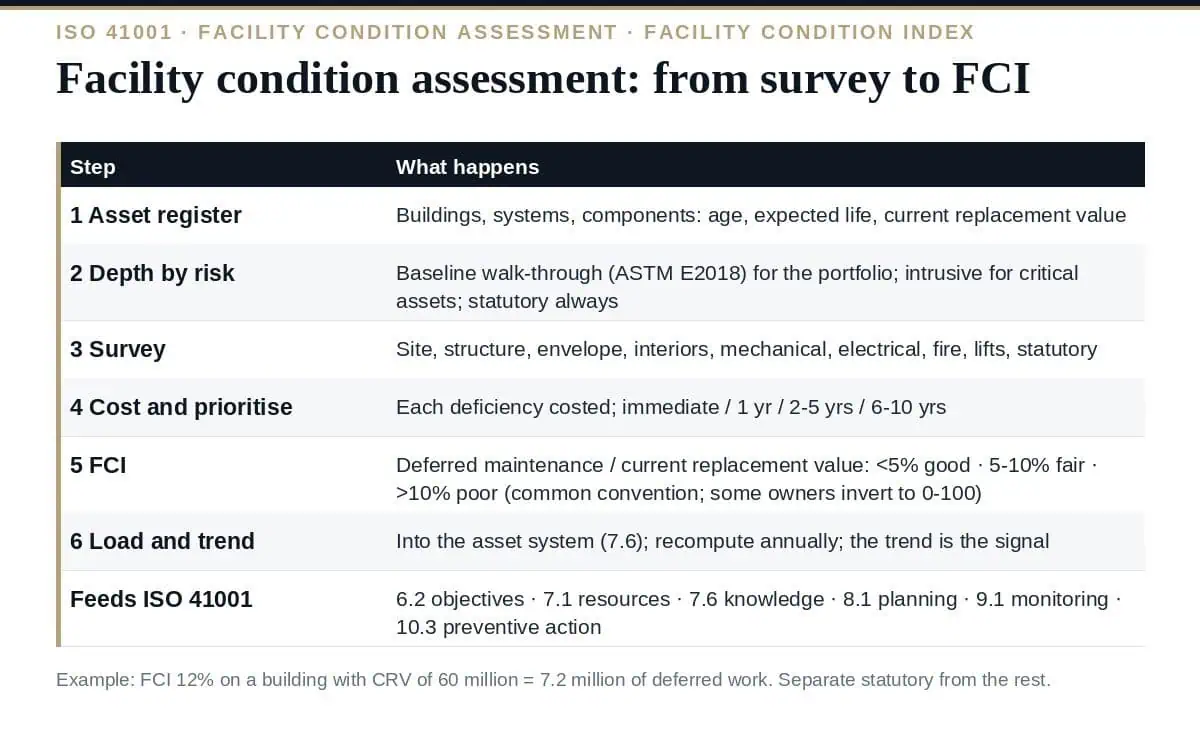
| Step | What to do | Note |
|---|---|---|
| 1 Deferred maintenance and repair (DM) | Sum the costed deficiencies that should have been addressed and have not — repairs, replacements past expected life, statutory items | Exclude improvements and upgrades; include only what restores the asset to its required function |
| 2 Current replacement value (CRV) | The cost to replace the facility today with one of the same size and function to current standards | Use a consistent basis across the estate — cost models, insurance values or benchmark rates per m² |
| 3 FCI | FCI = DM ÷ CRV, expressed as a percentage | The common convention: lower is better |
| 4 Read the bands | Under 5% — good; 5% to 10% — fair; over 10% — poor | The bands originate in the 1991 APPA/NACUBO study Managing the Facilities Portfolio and are used widely since; set your own thresholds if the estate’s risk profile warrants |
| 5 Watch the opposite convention | Some public-sector owners — U.S. Department of Defense reporting reviewed by the GAO, for example — use a condition index scored 0–100 where higher is better, in effect 100 × (1 − DM ÷ CRV) | State which convention a report uses before comparing numbers |
| 6 Trend it | Recompute annually; a rising FCI under the common convention means backlog is growing faster than it is being cleared | The trend is the management signal; the level is the starting point |
An FCI of 12% on a 20,000 m² building with a CRV of $60 million means $7.2 million of deferred work. That number is what a finance director can act on; the survey that produced it is what an auditor will ask to see behind the 7.6 knowledge and the 10.3 preventive actions.
| ISO 41001:2018 clause | What the assessment supplies |
|---|---|
| 4.1 Context | The condition of the estate as an internal issue |
| 6.1 Risks and opportunities | Failure risks from poor-condition and end-of-life assets; opportunities from consolidation |
| 6.2 FM objectives | Objectives on backlog reduction, statutory compliance, FCI by building — traceable to the business’s needs; see the facility management strategy |
| 7.1 Resources | The capital renewal forecast that sizes the budget |
| 7.6 Organizational knowledge | The condition data itself, held by the organisation |
| 8.1 Operational planning | PPM and replacement programmes prioritised by condition |
| 9.1 Monitoring | FCI trend; statutory compliance rate; backlog cleared versus added |
| 10.3 Preventive actions | Action on deteriorating components before failure |
Our guide to the facility management strategy covers the options appraisal the assessment informs; our guide to facility management KPIs covers where the FCI sits among the measures.
What is a facility condition assessment?
A structured survey of a facility’s site, structure, envelope, interiors, mechanical, electrical, fire and life safety, vertical transport and statutory elements, with each deficiency costed and prioritised, producing a deferred maintenance total, a capital renewal forecast and — divided by current replacement value — the facility condition index.
What is the FCI and what is a good score?
The facility condition index is deferred maintenance and repair cost divided by current replacement value, as a percentage. Under the common convention lower is better: under 5% good, 5–10% fair, over 10% poor, bands that originate in the 1991 APPA/NACUBO study. Some public-sector owners invert it to a 0–100 score where higher is better.
Does ISO 41001 require a condition assessment?
Not by name. It requires organizational knowledge (7.6), FM objectives set from the organisation’s needs (6.2), operational planning (8.1) and preventive actions (10.3), none of which an FM organisation can evidence for a built estate without condition data. ISO 41011 lists condition among the analyses inside a strategic facility plan.
How often should we assess?
A baseline every three to five years, critical systems annually, and an update after any major project or incident. The FCI trend, not the level, is the management signal.
What standard governs the assessment process?
ASTM E2018 (2024 edition) is the widely used baseline guide for property condition assessments; national and sector guides add depth. ISO 41001 governs what the organisation does with the result.
Run the facility condition assessment from the asset register, at a depth set by risk, with one rating scale and one cost basis, cost every deficiency with a priority and a year, compute the FCI per building and for the estate, and load it into the system the organisation owns. Then trend it — because the number that matters under ISO 41001 is not this year’s FCI but whether the backlog is being cleared faster than it grows.
The Asset and Condition Register, the condition assessment procedure and rating scale, the capital renewal forecast workbook with the FCI calculation, and the preventive action log are in the ISO 41001 Facility Management Toolkit, or start with the free templates.

October 11, 2026
October 11, 2026

October 11, 2026

October 11, 2026
October 11, 2026

