CART
ISO 41001 is the certifiable facility management standard — and unusually among ISO standards, its replacement is already close enough to change how you should plan.
The 2018 edition is recorded as International Standard to be revised, and the draft replacement has reached DIS stage. That is considerably further along than the revisions circling ISO 31000 or ISO 39001, and it means the clause numbering you document against today has a limited life.
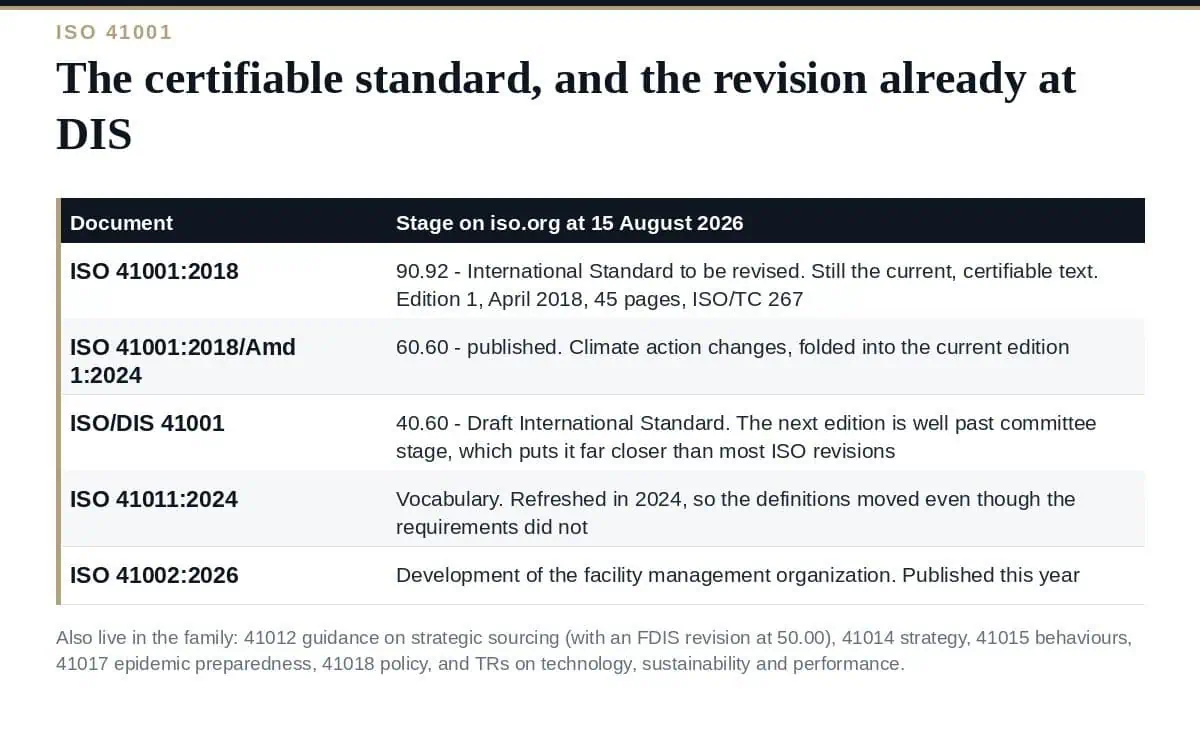
ISO 41001:2018 — Facility management — Management systems — Requirements with guidance for use — is the first edition, published April 2018, running to 45 pages under ISO/TC 267. It sits at stage 90.92.
Three things follow from the committee’s catalogue, and they matter in different ways.
There is a published amendment. ISO 41001:2018/Amd 1:2024 covers climate action changes and is at 60.60 — published. If your copy predates it, you are missing content that is part of the current standard.
ISO/DIS 41001 is at stage 40.60. A Draft International Standard that has been through enquiry is close to final. It still has to clear FDIS and publication, so no date is safe to plan around, but this is not a distant prospect.
The vocabulary already moved. ISO 41011:2024 replaced the earlier vocabulary standard, so definitions shifted while the requirements stayed put — a genuine source of confusion when an auditor and a consultant are working from different vintages.
Facility management is defined broadly here: the integration of people, place and process within the built environment to improve quality of life and the productivity of the core business. That framing does real work, because it puts the organisation’s objectives — not the building’s condition — at the centre.
The standard follows the harmonised management system structure, with facility-specific substance underneath:
The demand-organisation framing is what most implementations underuse. Writing down who is asking for the service, who provides it, and what “good” means between them resolves arguments that otherwise recur every contract cycle.
ISO 41001 is the only certifiable standard in a large and unusually active family. Several parts are worth knowing about because they answer questions the requirements standard deliberately does not:
Work is also under way on change management, a performance management framework and maintenance management guidance.
| Standard | Relationship |
|---|---|
| ISO 55001 and ISO 50001 | Asset management and energy management. Same estate, different questions — we compare all three directly in that guide |
| ISO 45001 | Occupational health and safety. FM controls much of what ISO 45001 governs physically, so the two integrate closely and the audit machinery is shared |
| ISO 9001 | Same harmonised structure. If you hold it, context, audit, review and improvement are reusable |
| ISO 22301 | Business continuity depends on the built environment continuing to function, and ISO 41017 covers the epidemic case specifically |
This guide reflects the ISO 41001 record and the ISO/TC 267 catalogue at 15 August 2026. Stages move; check before committing to a date.
The ISO 41001 Facility Management Toolkit provides 17 editable templates covering the FM policy and scope, the demand and service provider definitions, service specifications and levels, competence records, and the audit and management review artefacts.

October 15, 2026

October 15, 2026
October 14, 2026
October 14, 2026
October 14, 2026

