CART
A QHSE policy is one document doing the job that three standards assign to clause 5.2, and it works only if it satisfies each of them on its own terms.
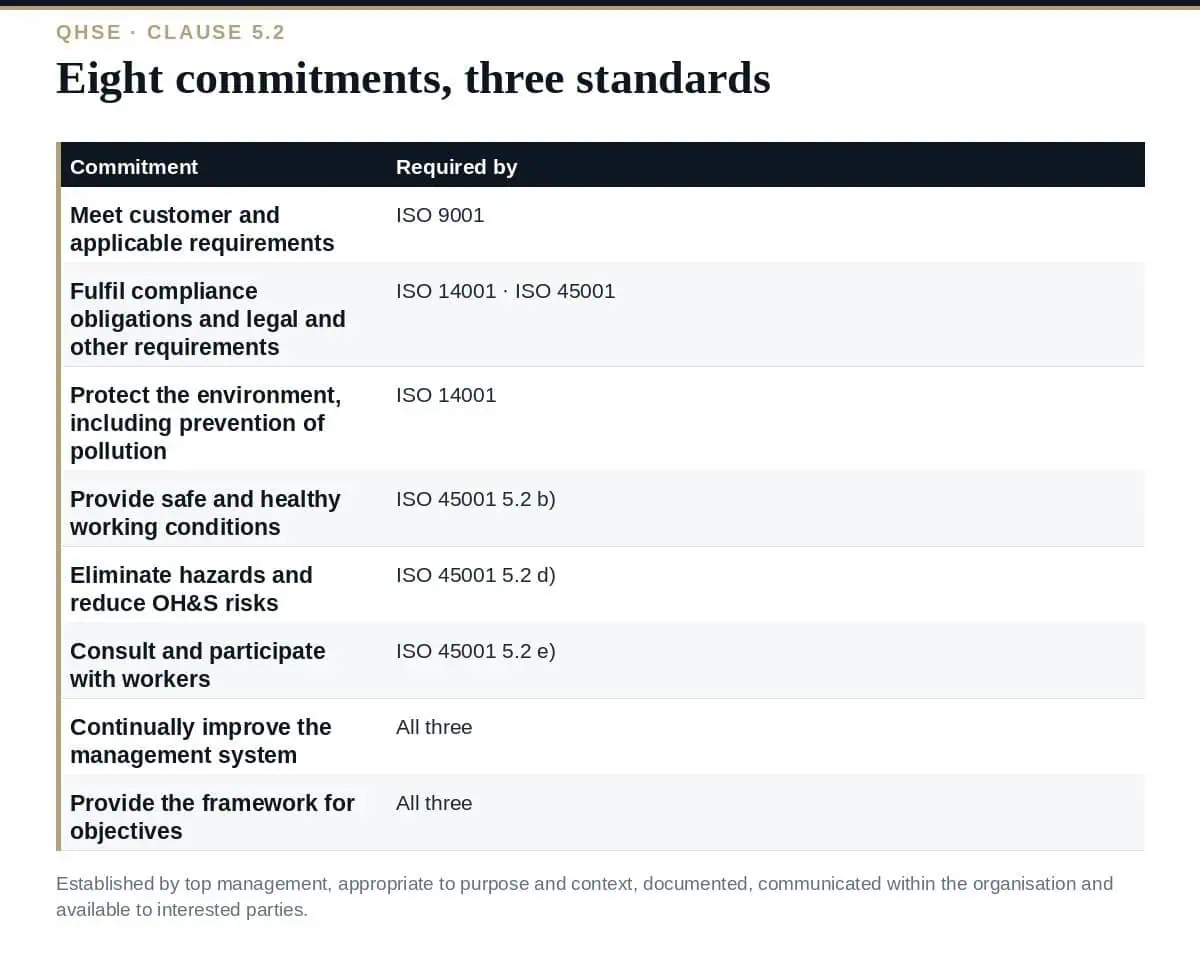
ISO 9001:2026, ISO 14001:2026 and ISO 45001:2018 all require top management to establish a policy that is appropriate to the organisation’s purpose and context, provides a framework for objectives, commits to satisfying applicable requirements and to continual improvement, and is documented, communicated and available — but each adds commitments of its own: quality to customer and applicable requirements; environment to the protection of the environment including prevention of pollution and to fulfilling compliance obligations; safety to providing safe and healthy workplaces, eliminating hazards and reducing OH&S risks, and consulting and participating with workers.
A combined policy that averages them fails all three audits. This guide sets out the eight commitments a QHSE policy has to carry to satisfy the three standards, the clause 5.2 mechanics they share, a structure and a worked example, the communication and review evidence an auditor asks for, and the errors that turn an integrated policy into a nonconformity in three management systems at once.
| Requirement | ISO 9001:2026 (quality) | ISO 14001:2026 (environment) | ISO 45001:2018 (OH&S) |
|---|---|---|---|
| Established by top management | Yes | Yes | Yes, with workers’ consultation in view |
| Appropriate to the purpose and context of the organisation | Yes — and supports its strategic direction | Yes — including the nature, scale and environmental impacts of its activities, products and services | Yes — including the nature and scale of its OH&S risks and opportunities |
| Framework for setting objectives | Quality objectives | Environmental objectives | OH&S objectives |
| Commitment to satisfy requirements | Applicable requirements | Fulfil compliance obligations | Fulfil legal requirements and other requirements |
| Commitment to continual improvement | Of the QMS | Of the EMS to enhance environmental performance | Of the OH&S management system |
| Standard-specific commitments | — | Protection of the environment, including prevention of pollution and other commitments relevant to context | Safe and healthy working conditions for the prevention of work-related injury and ill health; eliminate hazards and reduce OH&S risks; consultation and participation of workers and workers’ representatives |
| Documented information | Available and maintained | Maintained | Maintained |
| Communicated | Within the organisation; understood and applied | Within the organisation | Within the organisation |
| Available to interested parties | As appropriate | Available to interested parties | Available to interested parties, as appropriate |
The 2026 editions of ISO 9001 and ISO 14001 kept the clause 5.2 structure; what changed around it — climate change as a context issue in clause 4, quality culture and ethical behaviour among leadership’s commitments in ISO 9001:2026 5.1 — belongs in the policy’s context and tone rather than as new required sentences. Our guides to ISO 9001:2026 changes and ISO 14001:2026 transition cover the editions.
Two additions are optional but sensible: a commitment relevant to context under ISO 14001 (climate change mitigation or adaptation, resource use, life-cycle perspective), and a commitment to quality culture and ethical behaviour that ISO 9001:2026 now names among leadership’s responsibilities.
| Section | Content | Worked example (fabrication and installation contractor, 180 staff) |
|---|---|---|
| Scope and purpose | Who the policy binds, what the organisation does, the three systems it governs | ‘This policy applies to all activities of [Company] at its Leeds works and on customer sites: the design, fabrication and installation of structural steelwork, and the management of quality, environmental and occupational health and safety performance.’ |
| Context statement | The nature and scale of quality, environmental and OH&S issues | ‘Our significant environmental aspects are energy use in fabrication, steel waste and transport emissions; our significant hazards are work at height, lifting operations and hot work; our customers require conformity to their specifications and to the relevant execution class.’ |
| The eight commitments | One sentence each, in the standards’ own terms | ‘We will provide safe and healthy working conditions for the prevention of work-related injury and ill health, eliminate hazards and reduce OH&S risks, and consult and participate with our workers and their representatives in doing so.’ |
| Framework for objectives | How objectives are set and reviewed | ‘Quality, environmental and OH&S objectives are set annually at management review, assigned to named owners and measured through our KPIs.’ |
| Responsibilities | Top management’s accountability; everyone’s role | ‘The Managing Director is accountable for this policy; every employee and subcontractor is responsible for applying it.’ |
| Communication and availability | How it is communicated and to whom it is available | ‘Communicated at induction and annually; displayed at the works and on our website; available to customers, regulators and the public on request.’ |
| Approval and review | Signature, date, version, review interval | Signed by the Managing Director, dated, reviewed at each management review. |
| Evidence | Why the auditor asks | Practical form |
|---|---|---|
| Approval | Top management established it | Signature and date of the most senior person in scope; minutes of the meeting that approved it |
| Worker consultation (ISO 45001) | 5.2 e) and 5.4 require consultation on the policy | Safety committee minutes or a consultation record showing the policy was discussed before approval |
| Communication | ‘Communicated within the organisation’ and, for quality, ‘understood and applied’ | Induction records, briefing records, noticeboard photographs, intranet page; and the interviews — staff able to say what the policy commits to |
| Availability to interested parties | All three require it in some form | Website page; a customer or regulator request log |
| Link to objectives | Framework for objectives | The objectives register citing the policy commitment each objective serves |
| Review | Policy remains appropriate as context changes | Management review minutes covering the policy; version history |
Our guide to the QHSE management review covers where the policy is reviewed; QHSE KPIs covers the measures the objectives framework produces.
What must a QHSE policy contain?
The clause 5.2 requirements of ISO 9001, ISO 14001 and ISO 45001 together: appropriateness to purpose and context, a framework for objectives, commitments to satisfy applicable requirements and compliance obligations, to protect the environment including prevention of pollution, to provide safe and healthy working conditions, to eliminate hazards and reduce OH&S risks, to consult and participate with workers, and to continual improvement — documented, communicated and available to interested parties.
Can one policy cover all three standards?
Yes, and most integrated systems do it. The condition is that each standard’s specific commitments appear in terms its auditor recognises, not as a blended sentence. A single page is usually enough.
Who signs the QHSE policy?
Top management — the most senior person or body accountable for the organisation within the scope. A QHSE manager’s signature does not satisfy ‘established by top management’.
How often should it be reviewed?
At each management review at minimum, and whenever context changes: a new site, new activities, an edition change to the standards, or a significant incident. The 2026 editions of ISO 9001 and ISO 14001 are a reason to review it now.
Does the policy have to be public?
It has to be available to interested parties — as appropriate under ISO 9001 and ISO 45001, and without qualification under ISO 14001. A website page is the usual way; a request log is the fallback evidence.
Write the QHSE policy as eight commitments in the three standards’ own words, on a context statement that names your aspects, hazards and customers, signed by top management after consulting workers, communicated until people can repeat it, and reviewed at every management review. One page is enough; averaging is not.
The integrated QHSE policy template with the eight commitments, the separate quality, environmental and OH&S policy versions, the communication record and the policy review checklist are in the QHSE Documentation Bundles, or start with the free templates.

September 21, 2026
September 20, 2026
September 20, 2026
September 19, 2026

September 19, 2026

