CART
QHSE KPIs are the measures through which an integrated management system answers the question clause 9.1 of ISO 9001, ISO 14001 and ISO 45001 asks in almost identical words — what needs to be monitored and measured, by what methods, when, and when the results are analysed and evaluated — and the question the board asks in plainer ones: are we getting better? The difficulty is not finding indicators; every QHSE function has dozens.
It is choosing a set that covers all three disciplines, mixes lagging results with leading activity, connects to the objectives set under clause 6.2, and is defined precisely enough that the number means the same thing every month. This guide sets out twelve QHSE KPIs — four per discipline, each with its definition, formula, data source and the trap in it — explains the leading-versus-lagging balance, shows how the set feeds management review and the objectives cycle, and lists the KPI errors that make a dashboard decorative.
Free gap assessment
Are you ready for the 2026 edition of ISO 9001?
Score yourself against the new edition, free, including the risk and opportunity split and the clause 10 renumbering that breaks converted checklists.
Run the free ISO 9001 gap assessment → or View premium report sample
All three standards require the organisation to determine what to monitor and measure, the methods, the timing, and when to analyse and evaluate; to evaluate performance and the effectiveness of the management system; and to retain documented information as evidence. ISO 14001 and ISO 45001 add an evaluation of compliance (9.1.2) with its own retained evidence, and ISO 45001 requires monitoring of the extent to which the OH&S objectives are met and the effectiveness of operational controls.
ISO 9001:2026’s 9.1.3 lists eight items the analysis must cover, including the effectiveness of actions on risks and, separately, on opportunities. A KPI set is the practical form of the determination; the register that defines each indicator is the documented information. Our guide to the QHSE management system covers the clauses the KPIs sit in.
| KPI | Definition and formula | Type | Trap |
|---|---|---|---|
| First-pass yield (FPY) | Units passing final inspection without rework ÷ units started, per process or product line | Lagging (process) | Counting reworked units as passes; measure at the point of first inspection |
| Cost of poor quality (COPQ) | Internal failure (scrap, rework, downtime) + external failure (returns, warranty, credits) as % of revenue | Lagging (financial) | Omitting external costs because finance books them elsewhere |
| On-time-in-full (OTIF) | Orders delivered complete on the agreed date ÷ orders due | Lagging (customer) | Measuring against the revised date rather than the original promise |
| Customer complaints per 1,000 units or orders | Logged complaints ÷ units or orders shipped × 1,000 | Lagging (customer) | A complaints process nobody uses produces a flattering zero; pair with a leading survey or NPS |
| KPI | Definition and formula | Type | Trap |
|---|---|---|---|
| TRIR or LTIFR | Total recordable incident rate: recordable injuries × 200,000 ÷ hours worked (OSHA basis); lost-time injury frequency rate: lost-time injuries × 1,000,000 ÷ hours worked (ILO basis) | Lagging | Mixing the two bases; a small site’s rate swings wildly on one injury — report the count alongside |
| Near-miss and hazard reporting rate | Reports per 100 workers per month, with the ratio closed within target | Leading | A rising rate is good news early on; treat a falling rate as a reporting problem before a safety one |
| Critical-control verification | Scheduled verifications of critical controls (permits, isolations, lifting plans, guarding) completed and found effective ÷ scheduled | Leading | Verifying that the check was signed rather than that the control worked |
| Corrective action closure | Actions from incidents, audits and inspections closed on time ÷ actions due | Leading (system) | Closing on paper; sample effectiveness at the next audit |
| KPI | Definition and formula | Type | Trap |
|---|---|---|---|
| Energy intensity | kWh (or GJ) ÷ unit of output (tonne, unit, m², revenue) | Lagging (performance) | Absolute consumption falls when production falls; intensity is the honest number |
| Waste diversion rate | Waste recycled, reused or recovered ÷ total waste generated, by weight | Lagging (performance) | Contractor tonnages unverified; reconcile to waste transfer notes |
| Scope 1 and 2 emissions | tCO₂e from owned or controlled sources (fuel, refrigerants, process) plus purchased energy, using published factors, absolute and per unit | Lagging (performance) | Factor and boundary changes year to year; keep the methodology under change control |
| Compliance evaluation status | Compliance obligations evaluated on schedule ÷ obligations due, with the count of non-compliances open | Leading (system) | Evaluating the register rather than the operation — evidence of compliance, not of a tick |
Our guide to Scope 1, 2 and 3 emissions covers the emissions methodology; ISO 45001 evaluation of compliance covers the OH&S side of the compliance KPI.
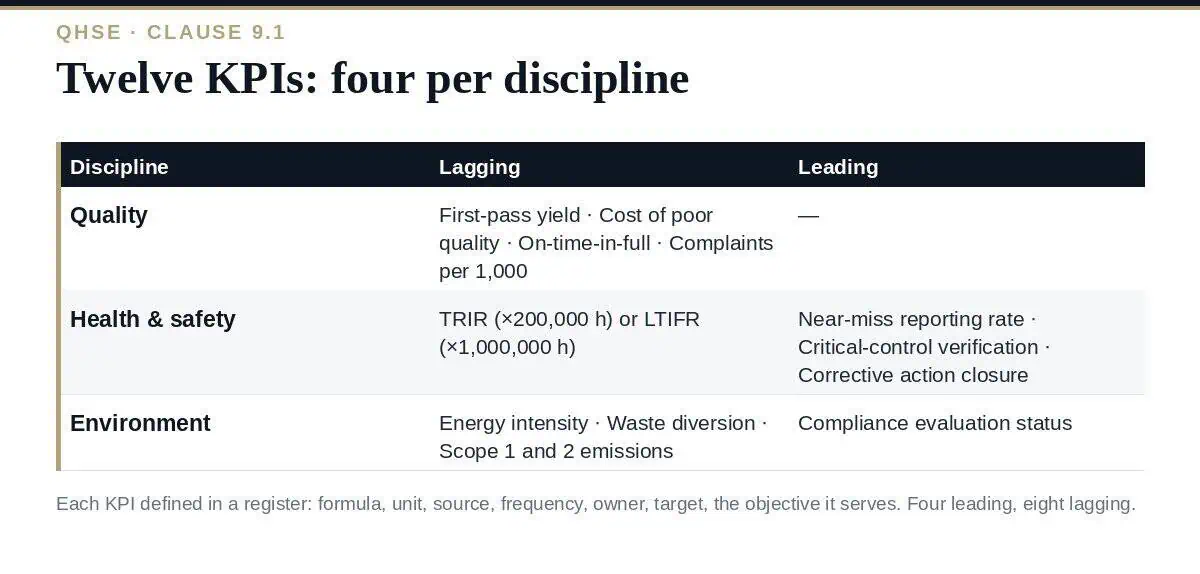
Lagging indicators measure outcomes — injuries, defects, emissions — after the fact; leading indicators measure the activities and conditions that produce them. A set of twelve that is all lagging tells the board what happened and nothing about what will; a set that is all leading tells it how busy the function was. The split above is deliberate: four leading (near-miss reporting, critical-control verification, corrective action closure, compliance evaluation status) and eight lagging, with each leading indicator chosen because it predicts a lagging one — reporting rate and control verification predict injury rates; closure and compliance status predict findings. The test of a leading indicator is whether anyone can name the lagging outcome it exists to move.
Our guide to ESG KPIs covers the reporting layer the environmental indicators increasingly feed.
What are the most important QHSE KPIs?
A balanced dozen: for quality, first-pass yield, cost of poor quality, on-time-in-full and complaints per 1,000; for health and safety, TRIR or LTIFR, near-miss reporting rate, critical-control verification and corrective action closure; for environment, energy intensity, waste diversion, Scope 1 and 2 emissions and compliance evaluation status — four leading, eight lagging.
What is the difference between leading and lagging KPIs?
Lagging indicators measure outcomes after they occur — injuries, defects, emissions. Leading indicators measure the activities and conditions that predict them — hazard reporting, control verification, action closure. A useful set pairs each leading indicator with the lagging outcome it is meant to move.
How is TRIR calculated?
Recordable injuries and illnesses multiplied by 200,000, divided by hours worked — the OSHA basis, equivalent to 100 full-time workers for a year. LTIFR uses lost-time injuries per 1,000,000 hours on the ILO basis. State which basis you use and do not mix them.
How many KPIs should a QHSE system have?
Enough to cover all three disciplines with a leading-lagging balance — twelve is a workable set for top management — with more detailed measures held at operational level. Every clause 6.2 objective needs one; not every KPI needs an objective.
Do the standards prescribe specific KPIs?
No. Clause 9.1 requires the organisation to determine what to monitor and measure, the methods, timing and evaluation, and to keep evidence; ISO 14001 and ISO 45001 add compliance evaluation. The choice of indicators is yours, and the register that defines them is the documented information the auditor reads.
Build the QHSE KPIs as a defined register of twelve — four per discipline, four leading and eight lagging, each with a formula, a source, an owner and a target — report them with trend and commentary, hang the clause 6.2 objectives on them, and let them set most of the management review agenda. A number that is defined, owned and moved is a KPI; the rest is a dashboard.
The QHSE KPI register with the twelve indicators defined, the monthly dashboard and quarterly management pack templates, the objectives register and the compliance evaluation record are in the QHSE Documentation Bundles, or start with the free templates.

October 12, 2026
October 12, 2026
October 12, 2026

October 12, 2026
October 12, 2026

