CART
QHSE documentation fails for a structural reason more often than a content one: four standards’ worth of documents get written by four different people at four different levels of detail, and nobody decides what belongs where. The fix is a document hierarchy — four tiers, each with a defined job, so that a policy does not contain work instructions and a form does not contain policy.
This guide sets out the four tiers, what each holds across quality, health and safety, environment and — where you include it — energy or security, and how to keep one document set serving several standards without duplication.
Free gap assessment
Are you ready for the 2026 edition of ISO 9001?
Score yourself against the new edition, free, including the risk and opportunity split and the clause 10 renumbering that breaks converted checklists.
Run the free ISO 9001 gap assessment → or View premium report sample
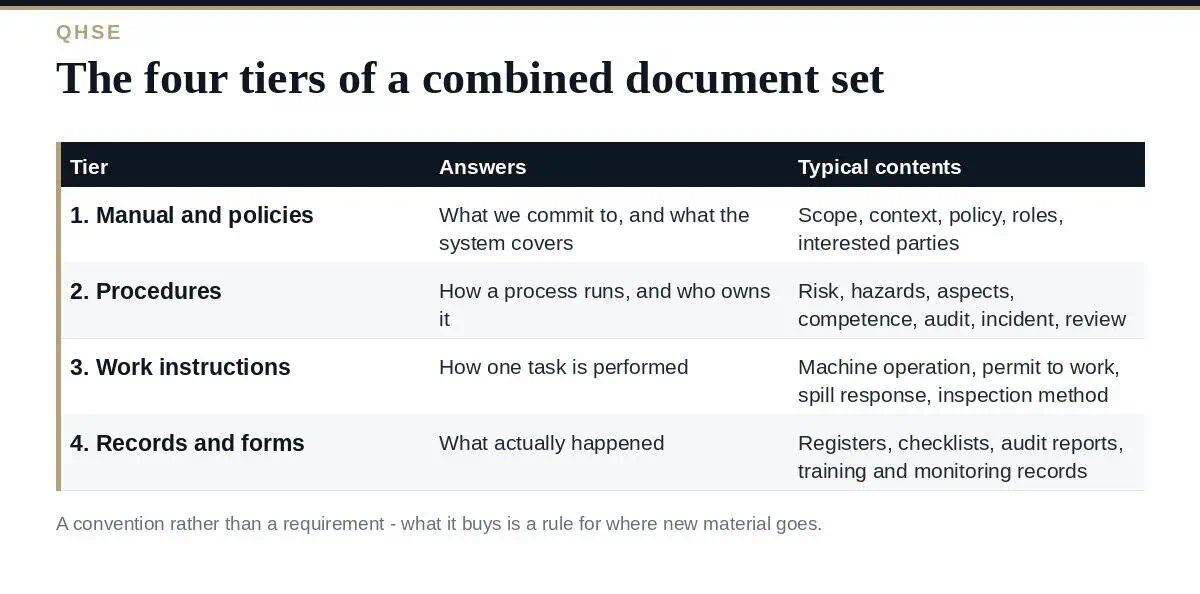
| Tier | Answers | Typical contents |
|---|---|---|
| 1. Manual and policies | What we commit to, and what the system covers | Scope, context, integrated policy or separate Q/H/S/E policies, roles and responsibilities, interested parties |
| 2. Procedures | How a process runs, and who owns it | Risk and opportunity, hazard identification, aspects and impacts, competence, internal audit, nonconformity, incident, management review, document control |
| 3. Work instructions | How one task is performed, step by step | Machine operation, permit to work, spill response, calibration, inspection method, safe system of work |
| 4. Records and forms | What actually happened | Registers, checklists, audit reports, training records, incident reports, monitoring results, review minutes |
The tiers of QHSE documentation are a convention rather than a requirement — the standards ask for “documented information” and leave the structure to you. What the convention buys is a rule for where new material goes, which is the thing that decays first in a combined system.
The management-system standards share a common structure, so most of tier 1 and much of tier 2 can be written once and applied to all of them. Scope, context of the organization, interested parties, leadership and policy, roles, planning, competence, awareness, communication, documented information, internal audit, management review, nonconformity and corrective action, and continual improvement are common ground.
What cannot be merged is the technical core of each standard, and this is where combined systems get thin:
Three practices decide whether integrated QHSE documentation stays integrated:
The economics are worth stating plainly: an integrated set is typically a third smaller than three separate ones and materially cheaper to audit, because certification bodies can run combined audits with shared time for the common clauses. The saving is real but it is not automatic — it depends on the document set actually being shared rather than merely stored together. Our guide to running an integrated management system covers the operating side of that.
Is a QHSE manual still required?
No standard has required a manual for years — the requirement is documented information. Most organizations keep one anyway because it is the natural home for scope, context and the clause map, and because customers ask for it.
How many documents does a QHSE management system need?
Enough that the required processes are defined and evidenced. Counting documents is the wrong measure; counting processes without an owner is the right one.
Should policies be integrated or separate?
Either works. A single integrated policy signed by top management reads better to staff; separate policies are easier when different standards are certified on different cycles or scopes.
Who owns QHSE documentation?
The process owner owns the content; a single document controller owns the register, numbering, versioning and retention. Conflating those two roles is why version control fails.
Can we certify a QHSE management system as one thing?
You certify against each standard, but an accredited body can audit them together and issue certificates from one combined audit. There is no single “QHSE certificate”.
Decide the tiers before you write anything, then hold the line: commitments in tier 1, cross-functional processes in tier 2, task detail in tier 3, evidence in tier 4. Maintain one register with a standards column and one clause map, keep the technical requirements of each standard explicit rather than assuming the common core covers them, and run one review cycle across the whole system. The saving from integration comes from documents genuinely being shared — not from filing four systems in the same drive.
A complete four-tier set across quality, health, safety and environment is in the QHSE Documentation Bundles, or start with the free ISO templates.

October 14, 2026
October 13, 2026
October 12, 2026
October 12, 2026

October 12, 2026

