CART
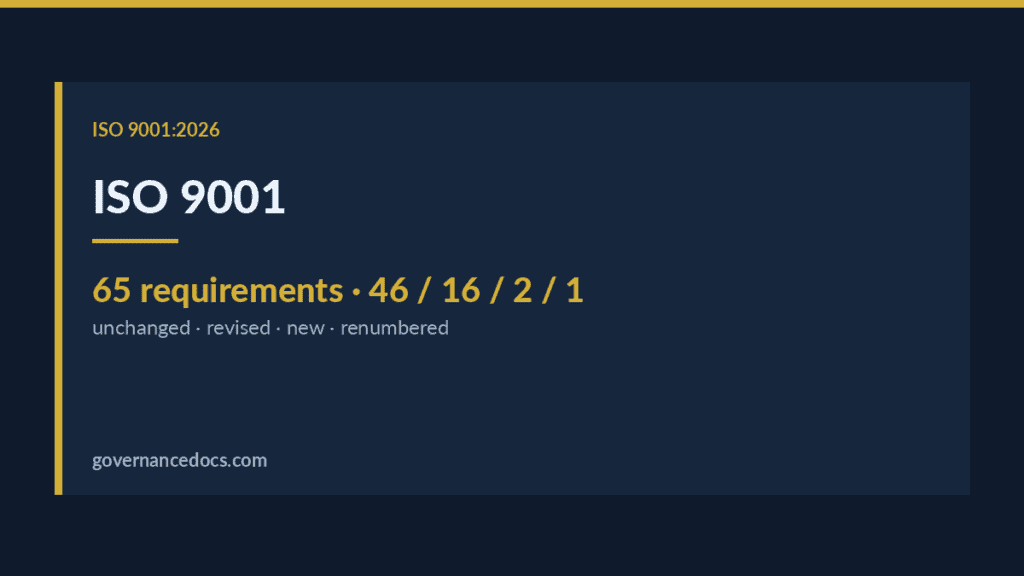
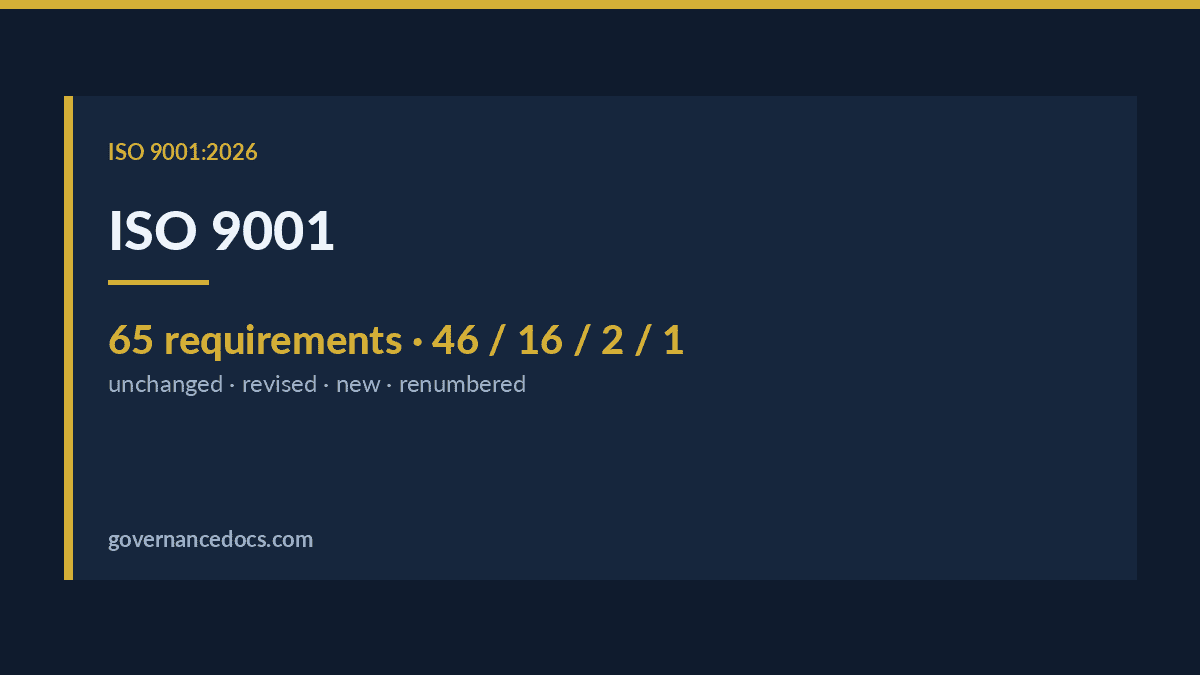
The ISO 9001:2026 changes are smaller than the noise around them and larger than a year swap on the cover. ISO published the sixth edition of ISO 9001 in September 2026; it cancels and replaces ISO 9001:2015 and absorbs the 2024 climate amendment. Counted one requirement per numbered sub-clause of clauses 4 to 10, the new edition has 65 requirements: 46 are unchanged in substance, 16 are revised, 2 are new as separate clauses, and 1 is renumbered. This guide walks the whole list, side by side with the 2015 numbering, from the published text.
If you want the transition plan rather than the comparison, start with our ISO 9001:2026 guide. For the standard itself, see our complete ISO 9001 guide.
Free gap assessment
Are you ready for the 2026 edition of ISO 9001?
Score yourself against the new edition, free, including the risk and opportunity split and the clause 10 renumbering that breaks converted checklists.
Run the free ISO 9001 gap assessment → or View premium report sample
The Foreword to the sixth edition lists six main changes. Everything else in the standard is either untouched or reworded to match the harmonized structure shared by ISO management system standards.
| Change | 2015 | 2026 |
|---|---|---|
| Terms and definitions | Clause 3 points to ISO 9000 and defines nothing | Clause 3 defines 20 core management-system terms; ISO 9000 still covers the rest of the quality vocabulary |
| Quality culture and ethical behaviour | Not mentioned | Promoted by top management (5.1.1), recognized as influencing the process environment (7.1.4), and an awareness item (7.3) |
| Risks and opportunities | One clause, 6.1.2, covers actions for both | 6.1.2 addresses risks, 6.1.3 addresses opportunities; each is determined, analyzed, evaluated and actioned in its own right |
| Management of change | Clause 6.3 lists four considerations | Clause 6.3 lists seven — adds communication, monitoring and evaluation of effectiveness, and review of results |
| Annex A | Clarification of new structure, terminology and concepts | Expanded clause-by-clause clarification; still informative, no new requirements |
| Annex B | List of other ISO/TC 176 standards | Removed; references moved to Annex A notes and the bibliography |
Two of the ISO 9001:2026 changes the Foreword does not headline matter just as much in practice. Climate change is now in the main text: clause 4.1 requires the organization to determine whether climate change is a relevant issue, and a note at 4.2 observes that interested parties can have climate-related requirements. And the documented-information wording changed throughout — “maintain documented information” became “shall be available as documented information”, and “retain” became “shall be available as evidence of”. The obligations did not move; the phrasing in your procedures should.
Clauses 4.1 and 4.2 keep their numbers and their substance. The one addition is the climate sentence in 4.1, which organizations that applied Amendment 1:2024 already have. Clause 4.3 (scope) and 4.4 (the QMS and its processes) are unchanged: the nine determinations for each process — inputs and outputs, sequence and interaction, criteria and indicators, resources, responsibilities, risks and opportunities, evaluation, improvement — are the same list under new wording.
Clause 5.1.1 grows from ten commitments to twelve. The new item is promoting quality culture and ethical behaviour; the 2015 item that combined the process approach with risk-based thinking is split, and risk-based thinking is now paired with opportunity-based thinking. Accountability for the effectiveness of the QMS stays.
Clause 5.2.1 separates “takes into account the context of the organization and supports its strategic direction” into its own criterion, so the quality policy now has five tests instead of four. Clause 5.3 loses the word “Organizational” from its title and splits reporting: reporting on QMS performance and reporting on opportunities for improvement are now separate assignments, giving six responsibilities for top management to assign rather than five.
This is the clause a 2015 system has to do real work on; four of the eighteen revised or new ISO 9001:2026 changes sit here.
| 2026 clause | 2015 clause | What changed |
|---|---|---|
| 6.1.1 Determining risks and opportunities | 6.1.1 | Unchanged in substance; the four purposes are reordered |
| 6.1.2 Actions to address risks | 6.1.2 (part) | New as a separate clause. Risks are determined, analyzed and evaluated; actions are planned with how they integrate into processes and how effectiveness is evaluated; actions must be proportionate to potential impact. A note recognizes risks to providing conforming products during and after a disruption |
| 6.1.3 Actions to address opportunities | 6.1.2 (part) | New as a separate clause. Same cycle for opportunities; actions must be appropriate to context. A note lists example actions — new practices, products, partnerships, technologies, initiatives |
| 6.2.1 / 6.2.2 Quality objectives | 6.2.1 / 6.2.2 | Unchanged in substance; eight criteria and five planning elements |
| 6.3 Planning of changes | 6.3 | Seven considerations instead of four |
The practical consequence of 6.1.2 and 6.1.3 is that a single risks-and-opportunities register, where opportunities were a column nobody filled in, no longer evidences the requirement. Opportunities need their own analysis, their own actions and their own effectiveness result — and clauses 9.1.3 and 9.3.2 then ask for that result separately from the risk result. Our ISO 9001 risks and opportunities guide covers the mechanics.
Clause 6.3 keeps the 2015 four — purpose and consequences, QMS integrity, resources, responsibilities and authorities — and adds three: how the change is communicated, how its effectiveness is monitored and evaluated, and how the results are reviewed. A change form with four boxes now has three missing. See the ISO 9001 change management template guide for what a compliant form contains.
The ISO 9001:2026 changes in clause 7 are light. No sub-clause changed its number. Four changed their content, all through notes and one new list item:
Competence (7.2), communication (7.4) and documented information (7.5) are unchanged apart from the maintain/retain wording.
Clause 8 is the longest clause and the least changed. Every sub-clause from 8.1 operational planning through 8.7 nonconforming outputs keeps its number and its substance. Three notes were added or extended: 8.3.1 recognizes that design and development can run in cycles of review, verification, validation and feedback; 8.3.3 notes that inputs can evolve through repeated development cycles; and 8.5.3 still lists intellectual property and personal data as customer property. If your operational procedures were sound under 2015, the ISO 9001:2026 changes touch them only through the clause 6 actions they implement and the documented-information wording.
Clause 9.1.3 grows from seven evaluations to eight, because the effectiveness of actions to address risks (e) and the effectiveness of actions to address opportunities (f) are now separate items. Clause 9.3.2 does the same for management review inputs — g) and h) are the two effectiveness inputs — and input d) 4) now reads “customer satisfaction and feedback from relevant interested parties”. Clause 9.3.3 is retitled from management review outputs to management review results; the required decisions are the same. Clause 9.1.2 adds social media to the sources of customer-satisfaction information, and clause 9.2 internal audit is unchanged.
ISO 9001:2015 had three sub-clauses: 10.1 General, 10.2 Nonconformity and corrective action, 10.3 Continual improvement. ISO 9001:2026 has two: 10.1 Continual improvement and 10.2 Nonconformity and corrective action. The 2015 general clause and the 2015 continual-improvement clause were merged into the new 10.1, which lists the three kinds of improvement action — improving processes, products and services; addressing future needs and expectations; correcting, preventing or reducing undesired effects.
There is no clause 10.3 in ISO 9001:2026. Every procedure, audit checklist, training slide and software field that cites “10.3” now points at nothing. It is the single most common re-pointing job in the transition, and the easiest to find with a search. The substance of nonconformity and corrective action in 10.2 is unchanged.
Certificates to ISO 9001:2015 stay valid through the transition period, which the IAF sets on publication; previous ISO 9001 transitions allowed three years, so around September 2029 is the working assumption until your certification body confirms a date. Sector schemes that build on ISO 9001 — IATF 16949, AS9100, ISO 13485 — reference it by edition and will move on their own timetables.
The work itself is specific. Add a climate-change determination if you never applied the amendment. Write down what quality culture and ethical behaviour mean in your organization and brief it. Split the register. Extend the change form. Take the two effectiveness inputs separately at management review. Re-point 10.3 and 6.1.2. Then re-audit. Our ISO 9001 Toolkit — 84 editable templates rebuilt on the published 2026 text, $99 — includes a transition gap assessment pre-loaded with every revised, new and renumbered requirement, and a guide with this clause map in full.
Counting one requirement per numbered sub-clause of clauses 4 to 10, there are 65 requirements: 46 unchanged in substance, 16 revised, 2 new as separate clauses (6.1.2 and 6.1.3) and 1 renumbered (10.1). The Foreword lists six headline changes.
No. Clauses 4 to 10 keep their titles and, with the exception of clause 6.1 splitting and clause 10 merging, their sub-clause numbers. The standard’s Annex A also says explicitly that its clause structure is not a model for documenting your QMS.
Yes. On iso.org the sixth edition is published and ISO 9001:2015 and its Amendment 1:2024 are marked withdrawn. Certificates to 2015 remain valid during the transition period.
Most 2015 procedures need re-pointing and wording updates, not replacement. The documents a 2015 system genuinely lacks are a climate-change determination, a statement of quality culture and ethical behaviour, a separate opportunity register and a seven-consideration change form.
No. Neither the 2015 nor the 2026 edition requires one. Many organizations keep a short manual because it is the fastest map from the clauses to their evidence.

October 11, 2026
October 11, 2026
October 11, 2026
October 11, 2026
October 11, 2026

