CART
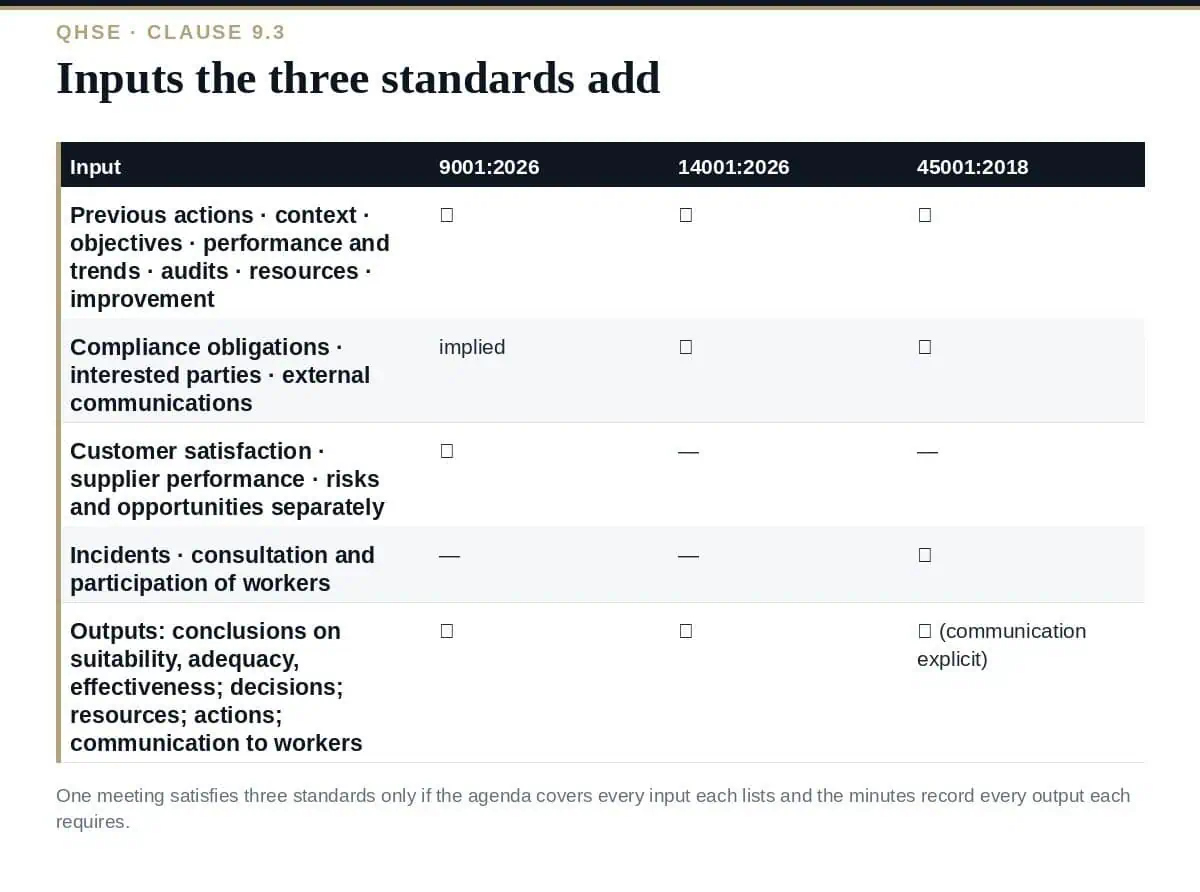
A QHSE management review is one meeting satisfying three clause 9.3s, and the reason it so often fails an audit is that the three are not the same list. ISO 9001, ISO 14001 and ISO 45001 all require top management to review the management system at planned intervals to ensure its continuing suitability, adequacy and effectiveness, and all three prescribe inputs and outputs; but ISO 14001 adds compliance obligations and the needs and expectations of interested parties, ISO 45001 adds consultation and participation of workers and the results of incidents, and ISO 9001 adds customer satisfaction, supplier performance and — in the 2026 edition — separate items on the effectiveness of actions on risks and on opportunities.
A review run from one standard’s agenda leaves the other two with missing inputs, and missing inputs are a finding whatever the minutes say. This guide sets out the combined input list clause by clause, the outputs the three standards require, a three-standard agenda that covers all of them in one sitting, how to run the review so top management decides rather than listens, the record that evidences it, and the errors that make a management review a presentation.
Free gap assessment
Are you ready for the 2026 edition of ISO 9001?
Score yourself against the new edition, free, including the risk and opportunity split and the clause 10 renumbering that breaks converted checklists.
Run the free ISO 9001 gap assessment → or View premium report sample
| Input | ISO 9001:2026 | ISO 14001:2026 | ISO 45001:2018 | Evidence to table |
|---|---|---|---|---|
| Status of actions from previous reviews | Yes | Yes | Yes | Action log with status |
| Changes in external and internal issues relevant to the system | Yes | Yes — including climate change as a context issue | Yes | Context register updates |
| Needs and expectations of interested parties, including compliance obligations | Implied via requirements | Yes — explicit | Yes — explicit, including legal requirements and other requirements | Interested-party and legal register changes |
| Significant environmental aspects; OH&S risks and opportunities; quality risks and opportunities | Effectiveness of actions on risks and, separately, on opportunities (9.3.2) | Significant aspects | Risks and opportunities | Register changes; treatment effectiveness |
| Extent to which objectives have been met | Yes | Yes | Yes | Objectives register with KPI results |
| Performance and effectiveness, including trends | Customer satisfaction and feedback; process performance and conformity; nonconformities and corrective actions; monitoring results; audit results; external provider performance | Nonconformities and corrective actions; monitoring results; fulfilment of compliance obligations; audit results | Incidents, nonconformities and corrective actions; monitoring results; evaluation of compliance; audit results; consultation and participation of workers | The KPI pack; the compliance evaluation; the incident and NC log; the audit programme results |
| Adequacy of resources | Yes | Yes | Yes | Resource requests and gaps |
| Communications from external interested parties, including complaints | Customer feedback | Yes — explicit | Yes — relevant communications | Complaints and regulator correspondence log |
| Opportunities for continual improvement | Yes | Yes | Yes | Improvement register |
| Consultation and participation of workers | — | — | Yes — explicit | Safety committee outputs |
ISO 14001:2026 restructured its management review clause; the inputs above follow the concepts the 2026 edition carries rather than the 2015 sub-numbering. Our guide to the integrated management review covers the general method; this one adds the three-standard specifics.
| Output | Required by | What it looks like in the minutes |
|---|---|---|
| Conclusions on the continuing suitability, adequacy and effectiveness of the system | All three (ISO 14001 and ISO 45001 state it; ISO 9001 implies it in the purpose) | A recorded conclusion per system, or one per discipline within the integrated system |
| Decisions on continual improvement opportunities | All three | Named improvements with owners and dates |
| Decisions on any need for changes to the management system | All three | Changes to scope, policy, objectives, processes, resources |
| Resource needs | All three | Approved, deferred or declined, with reasons |
| Actions, if needed, when objectives have not been achieved | ISO 14001 and ISO 45001 explicit | Per unmet objective: action, owner, date |
| Opportunities to improve integration with other business processes | ISO 14001 and ISO 45001 | Recorded where relevant |
| Implications for the strategic direction | ISO 14001 and ISO 45001 | A sentence, minuted |
| Communication of relevant outputs to workers and their representatives | ISO 45001 explicit | The communication record |
| # | Item | Covers | Owner | Minutes |
|---|---|---|---|---|
| 1 | Actions from the last review | All | QHSE manager | Status per action |
| 2 | Context: internal and external issues; interested parties; compliance obligations and legal changes; climate and other context changes | All; 14001 and 45001 explicit on obligations and parties | QHSE manager | Register changes accepted |
| 3 | Policy and objectives: is the policy still appropriate; objectives met or not, per discipline | All | Top management | Policy confirmed or changed; unmet objectives → actions |
| 4 | Quality performance: customer satisfaction and complaints; process performance; product conformity; supplier performance; effectiveness of actions on risks and on opportunities | 9001 | Operations / quality | Trends noted; decisions |
| 5 | Environmental performance: significant aspects; monitoring results; compliance evaluation; environmental incidents and complaints | 14001 | QHSE manager | Trends; decisions |
| 6 | OH&S performance: incidents and investigations; hazard reporting; monitoring results; compliance evaluation; worker consultation and participation outcomes | 45001 | QHSE manager / worker representative | Trends; decisions; communication to workers agreed |
| 7 | Nonconformities and corrective actions across all three; internal and external audit results | All | QHSE manager | Closure status; systemic causes |
| 8 | Resources: adequacy, requests, competence gaps | All | Top management | Approved / deferred |
| 9 | Improvement opportunities and changes to the system; integration with business processes; strategic implications | All; 14001 and 45001 explicit on the last two | Top management | Decisions with owners and dates |
| 10 | Conclusion on suitability, adequacy and effectiveness | All | Top management | Recorded per discipline |
Two hours is realistic for a single-site organisation if the pack is circulated a week ahead and items 4 to 6 are presented as trends with a proposed decision rather than as raw data. Our guide to QHSE KPIs covers the pack that carries items 4 to 6.
All three standards require documented information as evidence of the results of management reviews. The record that satisfies an auditor is not a set of slides: it is minutes that list attendees (with top management identified), the inputs considered against each standard’s list, the decisions and actions with owners and dates, and the conclusions on suitability, adequacy and effectiveness — plus the circulated pack as the evidence the inputs were real. A one-page decision record over a thirty-page pack is the right shape.
What must a QHSE management review cover?
The union of the three clause 9.3 input lists: previous actions; context changes; interested parties and compliance obligations; aspects, hazards, risks and opportunities; objectives; performance and trends including customer satisfaction, incidents, nonconformities, monitoring, compliance evaluation and audits; supplier performance; resources; external communications; improvement opportunities; and, for ISO 45001, worker consultation and participation.
How often should it be held?
At planned intervals set by the organisation — annually as a minimum in practice, commonly with quarterly performance reviews feeding a full annual review. The interval is stated in the manual and evidenced by the dates.
Who must attend?
Top management — the review is theirs under clause 9.3. The QHSE manager prepares and records; process owners present their areas; a worker representative attends for the OH&S items and receives the communicated outputs.
Can one meeting satisfy all three standards?
Yes, if the agenda covers every input each standard lists and the minutes record the outputs each requires, including conclusions on suitability, adequacy and effectiveness, and communication to workers for ISO 45001.
What changed in 2026?
ISO 9001:2026 lists the effectiveness of actions on risks and on opportunities as separate inputs and names its outputs as ‘results’; ISO 14001:2026 restructured its management review clause and brought climate change into context. ISO 45001 is unchanged. The transition audits will look for the new items.
Run the QHSE management review from the union of the three input lists, on a ten-item agenda that gives each discipline its own performance item and every item a decision, chaired by top management with a worker representative present, recorded as minutes that conclude on suitability, adequacy and effectiveness. One meeting can satisfy three standards; one standard’s agenda cannot.
The three-standard management review agenda, the input checklist by clause, the pre-read pack template, the minutes and decision record and the action log are in the QHSE Documentation Bundles, or start with the free templates.

October 12, 2026
October 12, 2026

October 12, 2026

October 12, 2026
October 12, 2026

