CART
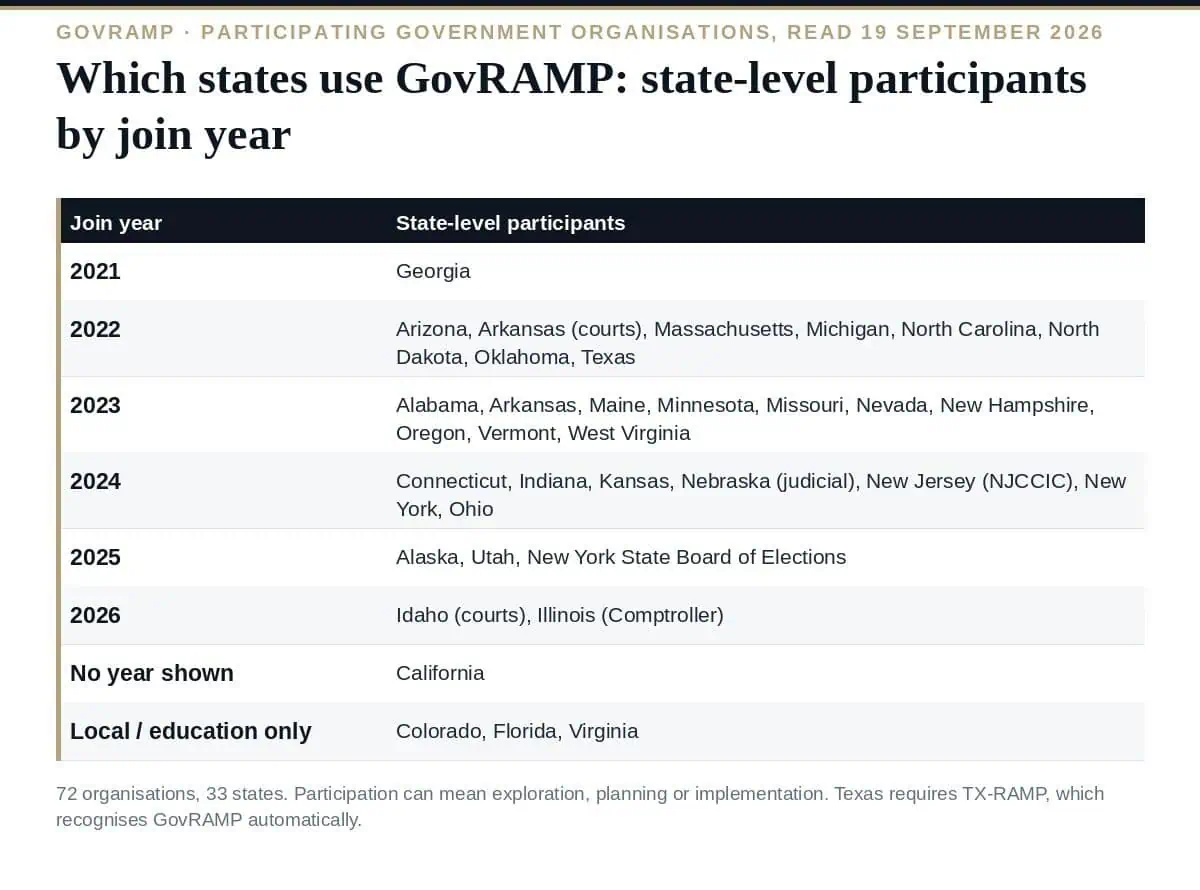
Which states use GovRAMP is the question providers ask when a solicitation names the programme, and the honest answer has two parts. GovRAMP’s own participating-organisations list, read on 19 September 2026, shows 72 government organisations across 33 states — 30 of them with a state-level participant, from Georgia’s 2021 adoption to Idaho’s and Illinois’s in 2026, plus counties, cities, school districts, universities, one tribal government and one federal agency.
But GovRAMP itself notes that participation “can reflect exploration, planning, or active implementation”, and adoption ranges from accepting Core for low-risk tools to writing GovRAMP into procurement policy. Texas sits outside the list’s logic entirely: its law requires TX-RAMP, which recognises GovRAMP with automatic reciprocity. This guide sets out the states with state-level participants and their join years, the states where only local or education bodies participate, what “adopt” means on GovRAMP’s own adoption roadmap, how to read a solicitation, and the three mistakes providers make about state requirements.
Free gap assessment
Are you working to the 2026 FedRAMP rules or the old ones?
Score the Key Security Indicators and the CR26 obligations, free, including the Security Decision Record that replaced the SSP.
Run the free FedRAMP gap assessment → or View premium report sample
| State | State-level participant(s) | Join year | Other participants listed |
|---|---|---|---|
| Georgia | State of Georgia | 2021 | — |
| Arizona | State of Arizona | 2022 | City of Chandler (2022), Pima Community College (2025), Buckeye Union High School District (2026) |
| Arkansas | State of Arkansas (2023); Administrative Office of the Courts (2022) | 2022–23 | Five K-12 districts and cooperatives (2024) |
| Massachusetts | Commonwealth of Massachusetts | 2022 | City of Boston, City of Northampton (2025) |
| Michigan | State of Michigan | 2022 | — |
| North Carolina | State of North Carolina | 2022 | UNC System, Fayetteville State University (2022) |
| North Dakota | State of North Dakota | 2022 | — |
| Oklahoma | State of Oklahoma | 2022 | Tulsa County (2024) |
| Texas | State of Texas | 2022 | UT System, Texas A&M AgriLife, Texas Tech HSC, THECB, Clarendon College, Austin ISD, City of Arlington |
| Alabama | State of Alabama | 2023 | — |
| Maine | State of Maine | 2023 | Maine Community College System (2026) |
| Minnesota | State of Minnesota | 2023 | Lower Sioux Indian Community (tribal, 2024) |
| Missouri | State of Missouri | 2023 | — |
| Nevada | State of Nevada | 2023 | — |
| New Hampshire | State of New Hampshire | 2023 | — |
| Oregon | State of Oregon | 2023 | — |
| Vermont | State of Vermont | 2023 | — |
| West Virginia | State of West Virginia | 2023 | — |
| Connecticut | State of Connecticut | 2024 | — |
| Indiana | State of Indiana | 2024 | City of Fishers (2023) |
| Kansas | State of Kansas | 2024 | Johnson County Park and Recreation District (2024) |
| Nebraska | Judicial Branch | 2024 | Nebraska Cybersecurity Network for Education (K-12, 2024) |
| New Jersey | NJ Cybersecurity & Communications Integration Cell | 2024 | — |
| New York | State of New York (2024); State Board of Elections (2025) | 2024–25 | NYS Local Government IT Directors’ Association, Fordham University, NYC DCAS (2026) |
| Ohio | State of Ohio | 2024 | — |
| Alaska | State of Alaska | 2025 | — |
| Utah | State of Utah | 2025 | — |
| Idaho | Administrative Office of the Courts | 2026 | — |
| Illinois | Office of the Comptroller | 2026 | — |
| California | State of California (no year shown) | — | Sacramento County, El Dorado County, San Gabriel Valley COG, San Joaquin County Office of Education |
Asked which states use GovRAMP below state level, three further states appear only through local or education participants: Colorado (Glenwood Springs, Fountain, Greeley-Evans School District 6 and one more local body), Florida (Hillsborough County Sheriff’s Office, Palm Beach Gardens, Lake County) and Virginia (Richard Bland College and, unusually, the US Coast Guard as a federal participant). Some state-level entries are a single branch or office rather than the executive — Nebraska’s and Idaho’s courts, Illinois’s Comptroller, New Jersey’s cybersecurity cell — which matters for what the entry implies. Texas has the most participants at eight. Georgia was first, in 2021, and GovRAMP’s news page reports its adoption as a milestone.
GovRAMP’s guidance for governments describes three adoption approaches, and they explain why a state on the list may still not require anything. The first is an adoption roadmap: inventory systems by impact level, engage procurement, IT and legal, and “define milestones for recognizing, preferring, or requiring GovRAMP verification” — the example given is a state agency accepting GovRAMP Core immediately for low-risk tools while developing a plan for more.
The second is to require GovRAMP in procurement. The third is alternative approaches that integrate the framework without a mandate. The programme also supplies sample procurement language and templates through its Government Engagement Team. In other words, “which states use GovRAMP” spans recognise, prefer and require, and only the solicitation tells you which applies to the contract in front of you. Our guide to GovRAMP status levels covers the statuses a solicitation can name.
Any answer to which states use GovRAMP has a Texas footnote. Texas passed a law in 2021 requiring vendors using cloud to serve Texas state agencies, higher-education institutions and community colleges to hold TX-RAMP certification, run by the Department of Information Resources. TX-RAMP recognises GovRAMP with automatic reciprocity by administrative rule, and GovRAMP syncs its Authorized products to the TX-RAMP list weekly — so a GovRAMP Authorized product is a Texas-compliant product, but a Texas contract still turns on TX-RAMP status, not GovRAMP membership. Our guide to TX-RAMP covers the two levels and the provisional route.
Which states use GovRAMP?
As of 19 September 2026 GovRAMP lists 72 participating government organisations across 33 states, with state-level participants in 30 — including Georgia (2021), Arizona, Arkansas, Massachusetts, Michigan, North Carolina, North Dakota, Oklahoma and Texas (2022), and Alaska, Utah, Idaho and Illinois more recently — plus local, K-12, higher-education, tribal and federal participants. Participation ranges from exploration to a procurement requirement.
Does being listed mean the state requires GovRAMP?
No. GovRAMP describes adoption as recognising, preferring or requiring verification, and its example is a state accepting Core for low-risk tools while planning further steps. The solicitation decides.
Does Texas require GovRAMP?
Texas requires TX-RAMP under its 2021 law; TX-RAMP recognises GovRAMP with automatic reciprocity and GovRAMP Authorized products are synced to the TX-RAMP list weekly.
Which state adopted first?
Georgia, listed with a 2021 join year; eight states joined at state level in 2022.
Is the list growing?
Yes. Idaho’s Administrative Office of the Courts, Illinois’s Office of the Comptroller, New York City’s DCAS, Maine’s community college system and an Arizona school district all show 2026 join years.
Read which states use GovRAMP as a market map, not a rulebook: 33 states have participants and 30 have a state-level one, but each solicitation names its own programme, status, impact level and deadline. Check the requiring agency’s page, plan for Texas through TX-RAMP reciprocity, and pursue the status the contracts you are chasing actually name.
The Pursuit Strategy, the Reciprocity Mapping, the State Sponsor Engagement Pack and the Customer Implementation Guide are in the GovRAMP (StateRAMP) TX-RAMP Compliance Toolkit, or start with the free templates.

October 12, 2026
October 12, 2026
October 12, 2026

October 12, 2026
October 12, 2026

