CART
GovRAMP vs FedRAMP is a comparison between two programmes that share one control catalogue and almost nothing else. Both rest on NIST SP 800-53 Revision 5. FedRAMP is the US federal government’s cloud certification programme, run under GSA, whose Consolidated Rules for 2026 took effect on 4 July 2026 and retired the System Security Plan and POA&M in favour of JSON-and-human-readable artifacts and “Ongoing Certification”.
GovRAMP — StateRAMP until 2025 — is a non-profit whose Security Program serves state, local, tribal, territorial and education buyers, with a progressive ladder from a 40-control Security Snapshot through Core (60 controls, no 3PAO), Ready (80 controls, 3PAO) to Authorized (300-plus controls, 3PAO and a government sponsor), a published fee schedule, and a Fast Track that accepts FedRAMP packages as they are. This guide sets out the seven differences that decide which programme a provider needs, where the two connect, and the sequence for a provider that needs both.
Free gap assessment
Are you working to the 2026 FedRAMP rules or the old ones?
Score the Key Security Indicators and the CR26 obligations, free, including the Security Decision Record that replaced the SSP.
Run the free FedRAMP gap assessment → or View premium report sample
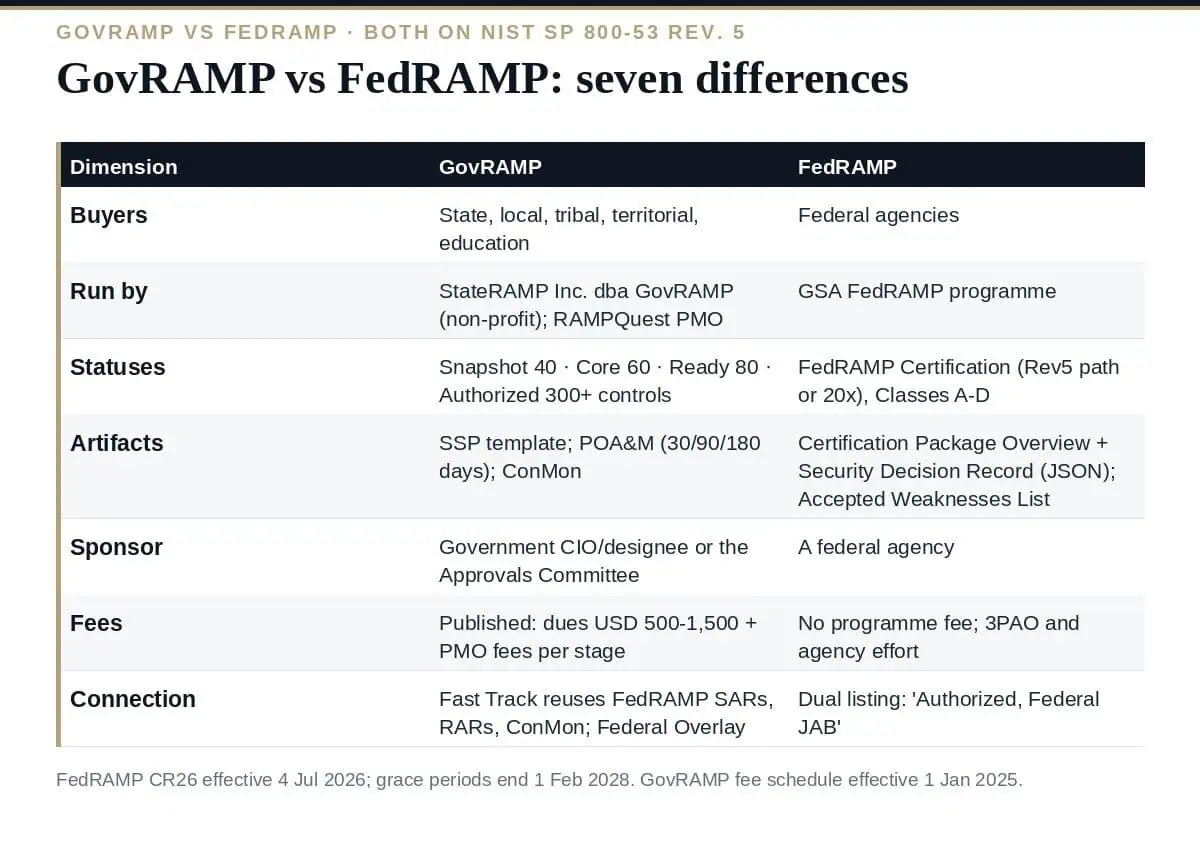
| Dimension | GovRAMP | FedRAMP |
|---|---|---|
| Buyers | State, local, tribal and territorial governments and public education — 72 participating government organisations across 33 states listed in September 2026 | US federal agencies |
| Who runs it | StateRAMP Inc. dba GovRAMP, a non-profit; RAMPQuest as the contracted Program Management Office; a board and an Approvals Committee of government officials | GSA’s FedRAMP programme under federal law and OMB policy |
| Control basis | NIST SP 800-53 Rev. 5, with Low, Moderate and High impact levels | NIST SP 800-53 Rev. 5 baselines by impact level |
| Statuses | Snapshot (40 controls, scored, private); Progressing; Core (60 controls, PMO-validated, no 3PAO); Ready (80 controls, 3PAO); Provisionally Authorized; Authorized (300+ controls, 3PAO, sponsor) | FedRAMP Certification via the Rev5 path or 20x, with Certification Classes A to D scaling automation and historical-metrics duties; no partial stopping point |
| Core artifacts | System Security Plan on the published GovRAMP template; POA&M with 30/90/180-day remediation for high, moderate and low findings; ConMon packages | Certification Package Overview and Security Decision Record, both required in human-readable and JSON form; Accepted Weaknesses List replaces the POA&M; SSP retired |
| Sponsorship | A government CIO or designee, or the GovRAMP Approvals Committee acting as sponsor | A federal agency |
| Programme fees | Published: annual membership $500 to $1,500 by revenue tier, plus PMO fees per stage — Authorized $4,500 to $19,500 a year; 3PAO fees separate | No programme fee; 3PAO assessment and agency effort are the costs |
| Ongoing obligations | Continuous monitoring from the day a verified status is awarded; quarterly for Core, monthly for Ready and Authorized; annual assessment | Ongoing Certification with enhanced vulnerability detection and response beyond monthly scanning |
FedRAMP exists because federal agencies buy cloud; GovRAMP exists because the tens of thousands of state and local governments and public education bodies below the federal line faced the same problem with no shared answer. GovRAMP’s participating-government list in September 2026 shows 72 organisations — 32 state-level entries, 18 local, 11 higher-education, 10 K-12, one tribal and one federal — across 33 states, and the programme itself notes that participation “can reflect exploration, planning, or active implementation”. A provider’s first question in any GovRAMP vs FedRAMP decision is simply which of those buyers it sells to. Our guide to which states use GovRAMP works through the list.
The second GovRAMP vs FedRAMP difference is shape. FedRAMP is pass or fail at a baseline; GovRAMP is progressive by design. A provider can buy a Single Security Snapshot — a PMO-validated score against 40 NIST controls, private to the provider — then enter the Progressing Snapshot Program with quarterly rescoring, stop at Core with 60 PMO-validated controls and no 3PAO, or continue to Ready and Authorized with a 3PAO. The programme’s own page says a provider may stop “at Core or continuing to Authorized”. FedRAMP has no equivalent of a verified partial status. Our guide to GovRAMP status levels covers all eight.
This is where GovRAMP vs FedRAMP diverged in 2026. FedRAMP’s Consolidated Rules retired the System Security Plan and the POA&M, replaced them with the Certification Package Overview, the Security Decision Record and the Accepted Weaknesses List, and require the core artifacts in JSON as well as human-readable form. GovRAMP still publishes an SSP template in its document library, still runs a POA&M with fixed remediation clocks — 30 days for high-risk items, 90 for moderate, 180 for low — and reviews packages in FedRAMP formatting under Fast Track. A provider maintaining both therefore keeps two document models, not two copies of one. Our guide to the two documents that replaced the FedRAMP SSP covers the federal side.
FedRAMP certification needs a federal agency. GovRAMP Authorized needs a government sponsor too, but defines one broadly — any CIO or designee of a state, local, tribal or territorial government or public higher-education institution — and offers an alternative: the GovRAMP Approvals Committee, five government officials who meet monthly and collectively act as sponsor. A provider with no agency relationship can still reach Authorized; that route does not exist federally.
GovRAMP publishes its costs. Membership is $500, $1,000 or $1,500 a year by revenue tier (under $1 million, $1 million to $5 million, over $5 million), and PMO fees per stage range from $1,000 for a Single Snapshot in the smallest tier to $19,500 a year for Authorized in the largest, with 3PAO fees on top. FedRAMP charges no programme fee; the cost is the 3PAO assessment and the agency’s effort. Our guide to GovRAMP cost sets out every line; the FedRAMP certification cost post does the same federally.
On monitoring, GovRAMP vs FedRAMP is a difference of scope, not of principle. Both programmes make the status a subscription. GovRAMP’s ConMon begins “immediately upon the award of a verified security status”: quarterly for Core, monthly for Ready and Authorized, with an annual assessment. FedRAMP’s 2026 rules widened “continuous monitoring” into “Ongoing Certification” with vulnerability detection and response beyond monthly scanning. Our guide to FedRAMP continuous monitoring covers the six rulesets.
FedRAMP is mid-transition: rules effective 4 July 2026, new Rev5 applications bound from 1 January 2027, the last new Rev5 application on 11 June 2027, and every grace period expiring on 1 February 2028. GovRAMP’s fee schedule has been in force since 1 January 2025, and its Progressing Snapshot rules tightened on 1 January 2026 — a product must score above zero to be listed and is expected to improve each quarter. GovRAMP is the more stable of the two right now.
What is the difference between GovRAMP vs FedRAMP?
Both use NIST SP 800-53 Rev. 5, but FedRAMP is the federal government’s cloud certification programme with a single baseline gate, JSON-based artifacts since July 2026 and no programme fee, while GovRAMP is a non-profit serving state, local and education buyers with a progressive ladder — Snapshot, Core, Ready, Authorized — a published fee schedule, an Approvals Committee that can act as sponsor, and a Fast Track that accepts FedRAMP packages.
Does FedRAMP certification count for GovRAMP?
Substantially. Fast Track lets providers reuse SARs, RARs and continuous monitoring data in FedRAMP formatting; the PMO reviews alignment and the fees are the same as the standard process.
Does GovRAMP count for FedRAMP?
There is no formal reverse path. The control work transfers because both rest on Rev. 5, but a FedRAMP certification requires its own package under the 2026 rules.
Which is cheaper?
GovRAMP has published programme fees — from $1,500 a year for a small provider’s Single Snapshot to $21,000 a year for Authorized in the largest tier before 3PAO costs — while FedRAMP has none; the 3PAO assessment dominates both, and FedRAMP’s baseline is the larger scope.
Can a provider stop at GovRAMP Core?
Yes. Core is a verified status on 60 PMO-validated controls with no 3PAO assessment, and the programme states a provider may stop there. FedRAMP has no equivalent.
Decide GovRAMP vs FedRAMP by buyer: federal agencies mean FedRAMP, everyone below the federal line means GovRAMP, and a provider selling to both should certify federally first and bring the package to GovRAMP through Fast Track. Build the controls once to Rev. 5 with the Federal Overlay, keep the two artifact models separate, and budget both statuses as subscriptions.
The Pursuit Strategy, the Authorization Pathway and Reciprocity Mapping documents, the Baseline and Framework Crosswalks, the System Security Plan and the ConMon Plan are in the GovRAMP (StateRAMP) TX-RAMP Compliance Toolkit, or start with the free templates.

October 12, 2026
October 12, 2026

October 12, 2026

October 12, 2026
October 12, 2026

