CART
GovRAMP status is what a state or local government buyer actually checks before they shortlist you. It is not a single pass or fail: the programme publishes a ladder of statuses, and where you sit on it tells a procurement team how far your security posture has been verified and by whom.
This guide covers the two families of status, what each one requires, what changed for the Progressing Snapshot programme in 2026, and how to choose a target.
Free gap assessment
Are you working to the 2026 FedRAMP rules or the old ones?
Score the Key Security Indicators and the CR26 obligations, free, including the Security Decision Record that replaced the SSP.
Run the free FedRAMP gap assessment → or View premium report sample
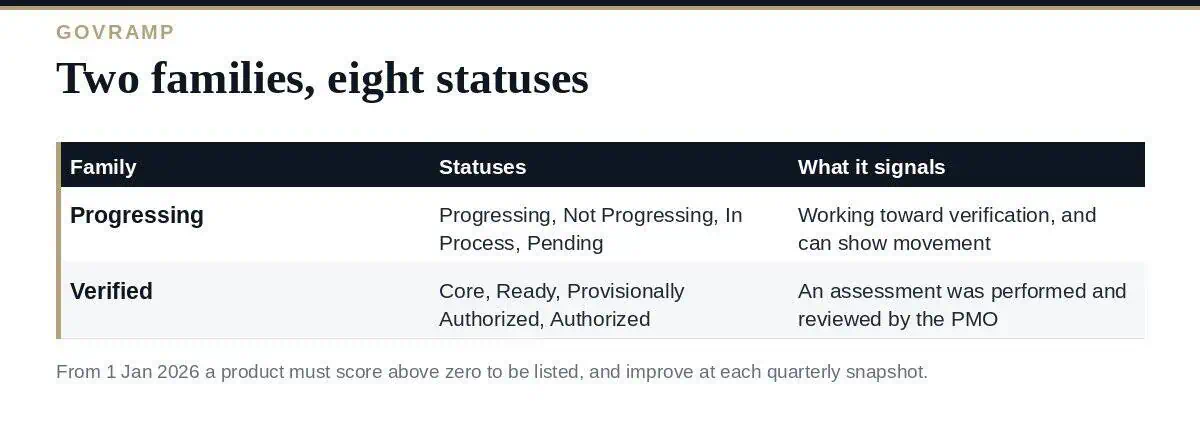
StateRAMP was renamed GovRAMP in 2025 to reflect a remit beyond states, and the status model carried across. Statuses fall into two groups:
| Family | Statuses | What it signals |
|---|---|---|
| Progressing | Progressing, Not Progressing, In Process, Pending | The provider is working toward verification and can show movement |
| Verified | Core, Ready, Provisionally Authorized, Authorized | An assessment has been performed and reviewed by the PMO |
The line between them is the one buyers care about. A progressing status says you are engaged with the programme; a verified GovRAMP status says somebody independent has looked at your controls and the PMO has reviewed the result. Authorized sits at the top, with a sponsoring government entity behind it.
From 1 January 2026 the Progressing Security Snapshot programme tightened, with the explicit aim of ensuring every listed product is actually advancing rather than parked. Three changes matter:
The practical consequence: listing yourself as progressing is no longer a low-cost marketing position. If you enter the programme, plan the remediation work that produces a better score every quarter, or expect the listing to work against you.
Work backwards from the contracts you are chasing when picking a GovRAMP status. Read the solicitations: many name a status and a deadline, and some accept a progressing status at award with a verified status required within a set period. That language decides your target far more reliably than an internal ambition.
Then weigh three things. The data your product handles, since higher categorisation raises the control count. The sponsor, because Authorized needs a government entity willing to sponsor you. And the reuse you can claim: work done for FedRAMP or under NIST SP 800-53 carries over substantially, and providers with an existing authorization usually find the GovRAMP path shorter than expected. Our guides to the GovRAMP verification pathway and TX-RAMP’s two levels cover the neighbouring programmes.
Some states run their own schemes and recognise GovRAMP work to varying degrees — Texas being the most prominent. Check the recognition rules for each state you sell into before assuming one status covers them all; reciprocity is real but it is not universal.
Entering the programme before the controls exist. The 2026 rules punish stasis. Get the score above the floor and the remediation plan funded before you list.
No sponsor strategy. Authorized requires sponsorship, and providers routinely complete the technical work with no agency relationship to convert it.
Treating the snapshot as an assessment. It is a progress measure, not a verified GovRAMP status. Only the verified statuses tell a buyer that an independent assessment happened.
Ignoring continuous monitoring. Verified statuses come with ongoing obligations. A status earned and then left unmaintained lapses, and lapsing publicly is worse than never having listed.
How many GovRAMP statuses are there?
Eight in total: four progressing statuses — Progressing, Not Progressing, In Process and Pending — and four verified statuses: Core, Ready, Provisionally Authorized and Authorized.
Is GovRAMP the same as StateRAMP?
Yes. StateRAMP was renamed GovRAMP in 2025; the programme, the statuses and the product list continued.
Does FedRAMP work count?
Substantially. Both rest on NIST SP 800-53, so an existing authorization or a mature control set transfers with rework rather than rebuilding.
Do we need a sponsor?
For Authorized, yes — a government sponsor is part of the model. Lower verified statuses can be reached without one.
What happens if our score does not improve?
Under the 2026 rules, identical or declining snapshot scores can trigger escalation and a change of status. Progressing is meant to mean progressing.
Read the solicitations you are actually bidding for and take your target GovRAMP status from them, not from ambition. Do the control work before you list, because the 2026 snapshot rules turn a stalled listing into a visible negative. Reuse FedRAMP and 800-53 work aggressively, line up a sponsor early if Authorized is the goal, and budget for continuous monitoring — the status is a subscription, not a purchase.
Control mappings, policy templates and the submission checklist are in the GovRAMP (StateRAMP) TX-RAMP Compliance Toolkit, or start with the free ISO templates.


October 13, 2026
October 12, 2026
October 12, 2026
October 12, 2026

October 12, 2026

