CART
If you are looking for StateRAMP, you are looking for a programme that has changed its name. stateramp.org now redirects to govramp.org, and the organisation operates as GovRAMP.
The rename is not cosmetic. “State” was always slightly wrong: the programme has been used by local government, higher education and K-12 alongside state agencies, and the new name describes what it actually is. The programme, the pathway and the verifications carry over.
Free gap assessment
Are you working to the 2026 FedRAMP rules or the old ones?
Score the Key Security Indicators and the CR26 obligations, free, including the Security Decision Record that replaced the SSP.
Run the free FedRAMP gap assessment → or View premium report sample
Public sector buyers face the same problem federal agencies faced: every agency assessing every cloud provider independently, using its own questionnaire, arriving at its own conclusion. Multiply that across fifty states and thousands of local agencies and the cost lands on providers, who answer the same questions in different formats forever.
FedRAMP solved this federally. StateRAMP was created to do the equivalent below the federal line — one standardised assessment, recognised by many government buyers, so a provider proves its security posture once.
The programme reports over 1,200 member organisations, more than 70 government organisations engaged, and over 330 products in the programme.
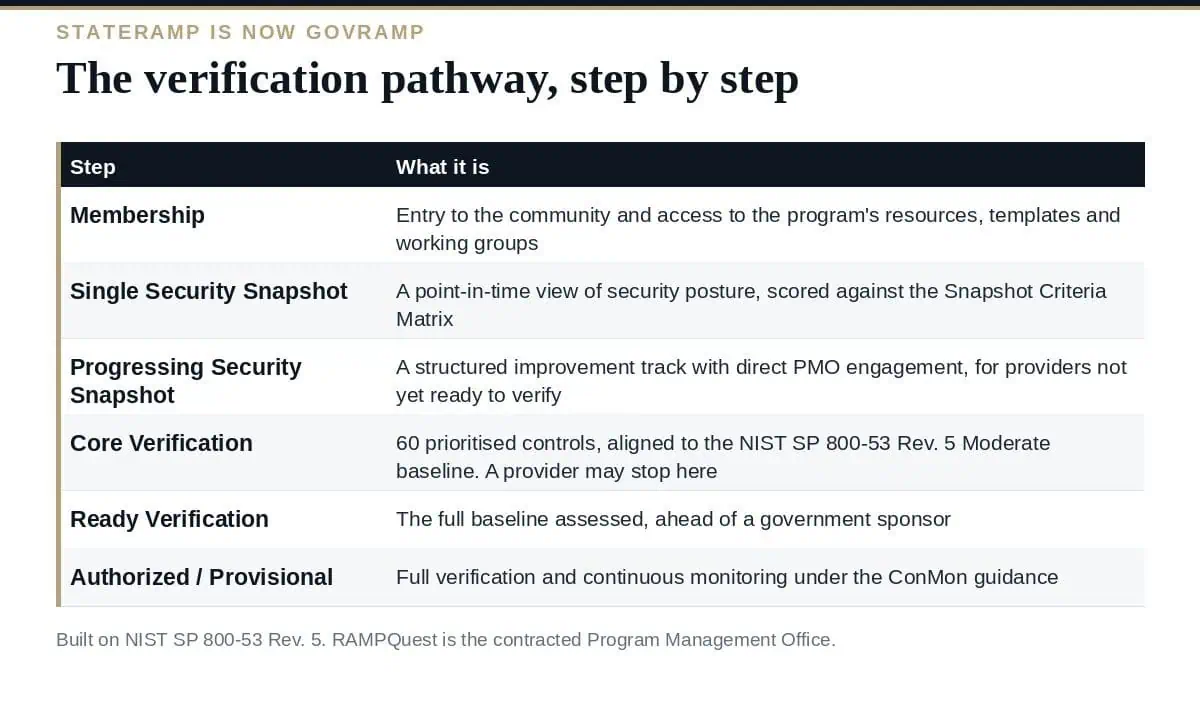
The Security Program is built on NIST SP 800-53 Rev. 5 and is deliberately progressive: a provider starts where it is and advances, rather than facing a single pass-or-fail gate.
Two features distinguish it from the federal model and both are worth planning around.
You may stop at Core. Core Verification covers 60 prioritised controls aligned to the NIST SP 800-53 Rev. 5 Moderate baseline. For a provider serving a small number of agencies with modest data sensitivity, that may be the right terminal state — a decision the federal programme does not offer.
The Snapshot is a real product, not a warm-up. A Single Security Snapshot scores your posture against a published criteria matrix, and the Progressing Snapshot track adds direct engagement from the Program Management Office. Providers who are not yet ready to verify can still show a government buyer something meaningful.
Administration sits with RAMPQuest as the contracted Program Management Office, which handles documentation review and works with the accredited 3PAOs. The framework, requirements and governance stay with GovRAMP itself.
The programme publishes overlays specifically to stop providers doing the same work twice.
There is also an AI task force alongside the CJIS-aligned one, which is where emerging guidance in that area is being developed.
A common and expensive confusion: not every state programme is this programme.
TX-RAMP is run by the Texas Department of Information Resources, has its own programme manual, its own request process and its own list of certified cloud products. It is a separate certification with its own identifiers, not a regional branch.
What the state programmes generally share is a reciprocity principle — an existing FedRAMP or GovRAMP status is usually the fastest route into a state programme rather than a fresh start. But “usually” is doing work in that sentence, and the answer is specific to each state’s manual.
Check the requiring agency’s own guidance first. Providers routinely pursue the wrong certification because a contract said “state authorisation” and nobody asked which one.
| GovRAMP (formerly StateRAMP) | FedRAMP | |
|---|---|---|
| Buyers | State, local, education | Federal agencies |
| Control basis | NIST SP 800-53 Rev. 5 | NIST SP 800-53 baselines by impact level |
| Partial status | Yes — Snapshot, Progressing, Core | No equivalent stopping point |
| Administration | Nonprofit community, PMO contracted to RAMPQuest | Government programme, currently mid-transition to 20x |
If you are pursuing both, sequence matters. The Federal Overlay exists precisely because the control work overlaps heavily, and doing them in parallel with two separate document sets is the expensive way.
This guide reflects govramp.org and dir.texas.gov at 15 August 2026. Update any internal documents, bid libraries or supplier questionnaires that still say StateRAMP — the redirect works, but the name on a tender response is read by a person.
The GovRAMP (StateRAMP) TX-RAMP Compliance Toolkit provides 50 editable templates covering the System Security Plan, the boundary definition, the control implementation records, the plan of action and the continuous monitoring artefacts. It was re-issued on 11 September 2026 in GovRAMP terminology throughout — the programme name, the Low / Moderate / High Impact Levels in place of the old Category 1/2/3 labels, and the current status names — so the documents you submit read the way a GovRAMP reviewer expects. If federal authorisation is also in scope, the FedRAMP Toolkit covers that side.

October 15, 2026
October 15, 2026
October 14, 2026
October 14, 2026
October 14, 2026

