

An EHS management system is the set of policies, procedures, records and routines an organization uses to control its environmental, health and safety risks as one program instead of three. There is no single “EHS standard” to certify against. In practice you build an EHS management system from ISO 14001 (environment) and ISO 45001 (occupational health and safety), then add ISO 50001 (energy), ISO 39001 (road traffic safety) and ESG reporting only where your operations or customers call for them.
This guide helps you decide which of those five frameworks you need, how they overlap, and what order to implement them in.
Why build an EHS management system on ISO standards
Many EHS programs start the same way. A customer asks for an ISO 14001 certificate, a safety incident forces a review of ISO 45001, and someone in finance mentions ESG data requests. Three projects start, three document sets get written, and three sets of internal audits appear on the calendar.
The better route is one EHS management system with one document structure. That works because ISO 14001 and ISO 45001 are written to the same management system skeleton: context of the organization (clause 4), leadership (5), planning (6), support (7), operation (8), performance evaluation (9) and improvement (10). Policy, objectives, document control, internal audit, management review and corrective action exist once and serve every standard you add.
If you also run quality, read our integrated management system guide, which covers combining ISO 9001, ISO 14001 and ISO 45001. This post does not repeat that. It stays on the EHS side and extends it to energy, road safety and ESG.
The five frameworks in an EHS management system
The table below shows what each framework is, who needs it, and whether anyone can certify against it.
| Framework | What it is | Who it applies to / when | Certifiable? | Our toolkit |
|---|---|---|---|---|
| ISO 14001 | Environmental management system standard | Any organization with environmental aspects: waste, emissions, discharges, resource use. Usually a voluntary choice driven by customers, tenders or supply chain rules. | Yes, by an accredited certification body | ISO 14001 Environmental |
| ISO 45001 | Occupational health and safety management system standard | Any organization with workers on site or on the road. Voluntary as a standard, though it sits alongside legal safety duties. | Yes | ISO 45001 Occupational H&S |
| ISO 50001 | Energy management system standard | Organizations with significant energy use or energy cost targets: manufacturing, data centers, buildings, logistics. Voluntary. | Yes | ISO 50001 Energy Management |
| ISO 39001 | Road traffic safety management system standard | Fleet operators, transport and logistics firms, and any organization whose activity puts vehicles on public roads. Voluntary. | Yes, stand-alone | ISO 39001 Road Traffic Safety |
| ESG reporting | A disclosure practice covering environmental, social and governance data, not a management system standard | Depends on your jurisdiction, size, investors and customers. Some reporting is required by law in some places; much of it arrives as customer questionnaires. | No. Reports can be assured, but there is no ESG certificate. | ESG |
The first four are management system standards, so a certification body can audit you against them. ESG reporting is different in kind: it is an output, and your EHS management system is where its data comes from.
How the shared structure makes an EHS management system practical
Walk through the clauses and you see where one piece of work serves several standards.
- Context and interested parties (clause 4). One register of interested parties and one scope statement. Regulators, neighbors, employees, customers and insurers show up in both the environmental and safety views.
- Leadership and policy (clause 5). One policy that commits top management to environmental protection, safe and healthy workplaces and, if relevant, energy performance and road safety. Roles and responsibilities sit in one matrix.
- Planning (clause 6). Two separate risk exercises remain: environmental aspects and impacts for ISO 14001, hazards and risks for ISO 45001. The method (criteria, scoring, review cycle) can be common. Objectives share one tracker.
- Support (clause 7). Competence, awareness, communication and documented information are handled once. One training matrix, one document control procedure.
- Operation (clause 8). This is where the standards diverge, and it should. Operational controls for waste and spills differ from lockout, permits and contractor safety. Emergency preparedness, however, can be one plan covering fire, chemical release and injury.
- Performance evaluation (clause 9). One internal audit program with combined audits, one management review agenda, one legal compliance evaluation schedule.
- Improvement (clause 10). One nonconformity and corrective action log. An incident that is both an injury and a spill needs one investigation, not two.
The saving is real in the shared clauses (4, 5, 7, 9 and 10). Clause 6 is partly shared and clause 8 is mostly separate, so do not expect a merged system to halve your documents. Expect it to stop you writing the same procedure three times.
Start with the right edition of ISO 14001 and ISO 45001
Two of these standards are in motion, and they are in different places.
ISO 14001. The 2015 edition is withdrawn. ISO 14001:2026, the fourth edition, was published on 15 April 2026. The transition period is 36 months from publication. Certification bodies quote a lapse date, but the exact date has not been confirmed in one authoritative place, so confirm it with your certification body. Changes reported for the new edition include a new clause 6.3 on planning of changes, climate change built into the context clause, extended operational control over externally provided processes, products and services, a restructured management review, and more weight on the life cycle perspective. Our ISO 14001 toolkit is built on the 2026 edition. You can check the edition on the ISO catalogue page for ISO 14001.
ISO 45001. The current edition is ISO 45001:2018, and it is the one certificates are issued against today. A revision is under way: ISO describes the upcoming revision as ISO 45001:2027 and expects it in the first half of 2027, although certification bodies disagree on the timing. The draft has closed its ballot, but the final text has not been published, and no transition arrangements exist yet. Anything you read about specific clause changes comes from commentators who have seen the draft, not from a published standard. Our ISO 45001 revision guide sets out what is known and what is not.
The practical advice: do not delay an ISO 45001 project waiting for the new edition. Build on the 2018 requirements, keep your procedures at the level of the shared structure, and expect to adjust when the final text appears.
Which frameworks does your organization need?
Start from the demand, not from the standards list.
You need ISO 14001 and ISO 45001 if
Customers, tenders or parent companies ask for certificates, or you want a disciplined way to prove legal compliance on environment and safety. These two form the core of any EHS management system. If you have to pick one first, pick the one that matches the pressure you are under: a customer audit asking for environmental controls, or an incident history on the safety side.
Add ISO 50001 if
Energy is a material cost or a reported number. ISO 50001 is built around energy reviews, performance indicators and baselines, which gives you evidence that holds up when someone asks how you measured an improvement. Our ISO 50001 toolkit covers the documents behind that.
Add ISO 39001 if
Vehicles are part of your operation. ISO 45001 covers work-related road risk in principle, but ISO 39001 is built around road traffic deaths and serious injuries and protects everyone affected, including other road users. Our ISO 39001 vs ISO 45001 comparison explains the difference for fleets. The ISO 39001 toolkit supports the implementation.
Add ESG reporting if
Investors, lenders, large customers or regulators want sustainability data from you. ESG reporting rules are changing, and what applies to you depends on your size and where you operate, so check current requirements for your situation rather than assuming. What does not change is the need for reliable underlying data. Environmental and safety records from ISO 14001, ISO 45001 and ISO 50001 are exactly that data. Our ESG reporting guide covers the current reporting picture, and the ESG toolkit supports the policies, KPIs and data controls.
A sensible order to implement an EHS management system
- Build the shared core first. Scope, interested parties, policy, roles, document control, internal audit and corrective action. This is clauses 4, 5, 7, 9 and 10, and it serves every later standard.
- Do the two risk registers. Environmental aspects and impacts, and hazards and risks, plus one legal requirements register.
- Write operational controls where the risk is highest. Do not try to cover everything at once.
- Run one combined internal audit and one management review. Fix the gaps before an external auditor finds them.
- Certify the standards a customer or tender needs. Certification is decided by an accredited body after an audit. Documents support that outcome but never guarantee it.
- Layer on energy, road safety and ESG data. These reuse the core, so each addition is smaller than the first project.
If your wider program also covers quality, see our quality management standards guide for how those frameworks fit alongside this one.
Common mistakes with an EHS management system
- Merging too early. If the team is new to both standards, write separate operational controls first and merge only the shared clauses.
- Treating ESG as a fifth management system. It is a reporting output. Do not build parallel data collection when your EHS records already exist.
- Copying a generic template unchanged. Templates give you structure. Your aspects, hazards and legal requirements are yours to fill in.
- Ignoring the edition. A procedure that cites a withdrawn edition of a standard is a finding waiting to happen.
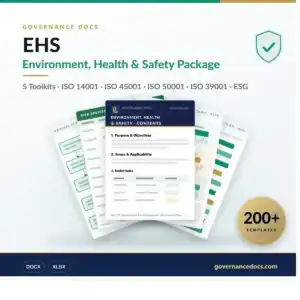
The EHS Package bundles all five toolkits (ISO 14001, ISO 50001, ISO 45001, ISO 39001 and ESG) for $229. It is one purchase with a separate download per toolkit, licensed for internal use by one organization. Consultants serving clients need the Consultant Package.
EHS management system FAQ
Is there a certifiable EHS management system standard?
No single one. Organizations certify to the individual standards, mainly ISO 14001 and ISO 45001, and run them as one EHS management system internally. A certification body audits each standard you choose to certify.
Do I need all five frameworks?
No. ISO 14001 and ISO 45001 form the core. Add ISO 50001 when energy matters, ISO 39001 when vehicles are part of your operation, and ESG reporting when stakeholders or regulations ask for it.
Should I wait for ISO 45001:2027 before starting?
No. ISO 45001:2018 is the edition in force, and the final text and any transition arrangements for the revision have not been published. Build on the current requirements and review when the final text appears.
Can one internal audit cover several standards?
Yes, where the clauses are shared. A combined audit can cover leadership, documented information, performance evaluation and improvement across standards, with separate checks on the operational controls.

Recent Posts
November 18, 2026
November 18, 2026
November 18, 2026
November 18, 2026

November 18, 2026