CART
ESG reporting in Europe spent 2025 and 2026 being taken apart and put back together. If your understanding of the rules dates from 2024, almost every scoping conclusion you reached is now wrong — usually in your favour.
This is a guide to what the EU simplification actually did, read from the European Commission’s own timeline rather than from commentary.
Free gap assessment
Are you ready for the 2026 edition of ISO 14001?
Score every clause of the new edition, free, including the aspects, life cycle and compliance evaluation work that carries most of the findings.
Run the free ISO 14001 gap assessment → or View premium report sample
The Corporate Sustainability Reporting Directive — Directive (EU) 2022/2464 — requires companies above a certain size to disclose the risks and opportunities they see arising from social and environmental issues, and the impact of their own activities on people and the environment.
Companies in scope report against the European Sustainability Reporting Standards, drafted by EFRAG. The first wave applied the rules for financial year 2024, in reports published in 2025.
Then the direction of travel reversed, and ESG reporting became the clearest example of the EU simplifying a file it had only just built.
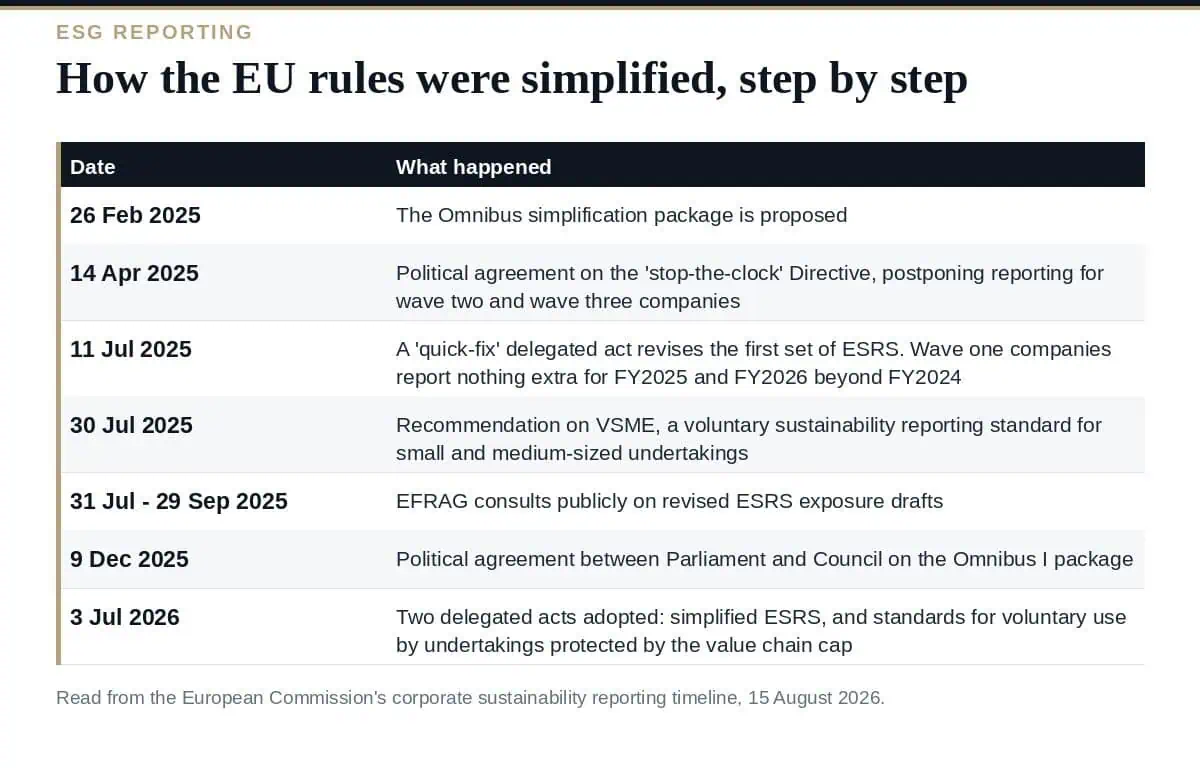
Four moves matter more than the rest, and they do different things.
Stop-the-clock (April 2025). Parliament and Council agreed a Directive postponing the entry into application of the reporting requirements for companies that would otherwise have reported for the first time for financial year 2025 or 2026 — wave two and wave three. If you were in either group, your first reporting year moved.
The quick fix (July 2025). A delegated act revised the first set of ESRS to give wave one companies additional flexibility, and — this is the useful part — ensured they do not have to report additional information for financial years 2025 and 2026 beyond what they reported for financial year 2024. Wave one’s disclosure burden was frozen at its starting level for two years.
Omnibus I (December 2025). Parliament and Council reached political agreement on the wider simplification package.
The simplified standards (July 2026). Two delegated acts were adopted: one amending Delegated Regulation (EU) 2023/2772 to simplify certain sustainability reporting standards, and one establishing standards for voluntary use by undertakings protected by the value chain cap.
Most ESG reporting coverage skips this, and it is the part that decides what an out-of-scope supplier actually has to do.
The single most important development for a company that is not in scope is the value chain cap.
The problem it solves is familiar to any supplier. A company below the reporting thresholds has no direct obligation — and then receives an ESG questionnaire from a customer who does, asking for whatever that customer decided it needed. Out-of-scope companies ended up doing in-scope work, without the standards, resourcing or timeline.
The cap limits what large reporting companies may demand from smaller undertakings in their value chain, and the July 2026 delegated act gives those protected undertakings a defined standard for voluntary reporting instead.
Alongside it sits VSME — a voluntary sustainability reporting standard for small and medium-sized undertakings, recommended in July 2025.
Together these change the right answer for a small supplier asked about ESG reporting. Previously: answer whatever you are sent. Now: report against a recognised voluntary standard, and point to it.
Simplification is not repeal, and three things are worth stating plainly.
The organisations that will struggle are the ones that read “simplification” as “cancelled”, stopped work in 2025, and will restart from nothing when a contract requires it.
| Standard | What it contributes |
|---|---|
| ISO 14001 | An environmental management system produces much of the environmental data ESRS asks for, already governed and auditable. The most efficient starting point for the E |
| ISO 45001 | Occupational health and safety data feeds the social disclosures directly |
| ISO 37001 | Anti-bribery evidence supports the governance strand, which is the one most organisations under-document |
| ISO 31000 | One risk method underneath the whole exercise, rather than a separate sustainability risk scale nobody else recognises |
The recurring insight: most of what ESG reporting demands is data you generate anyway. What is missing is usually governance over it — ownership, definitions, and a control that makes the number reproducible next year.
This guide reflects the European Commission’s corporate sustainability reporting page at 15 August 2026, which was last updated on 3 July 2026. This file has moved repeatedly — check the timeline before relying on a date in a board paper.
The ESG Toolkit provides 20+ editable templates covering the materiality assessment, the data collection and ownership records, the governance disclosures and the reporting structure — the parts that make next year’s numbers comparable with this year’s.

October 15, 2026
October 15, 2026
October 14, 2026
October 14, 2026
October 14, 2026

