
CART
No products in the cart.
ISO Compliance Insights & Best Practices
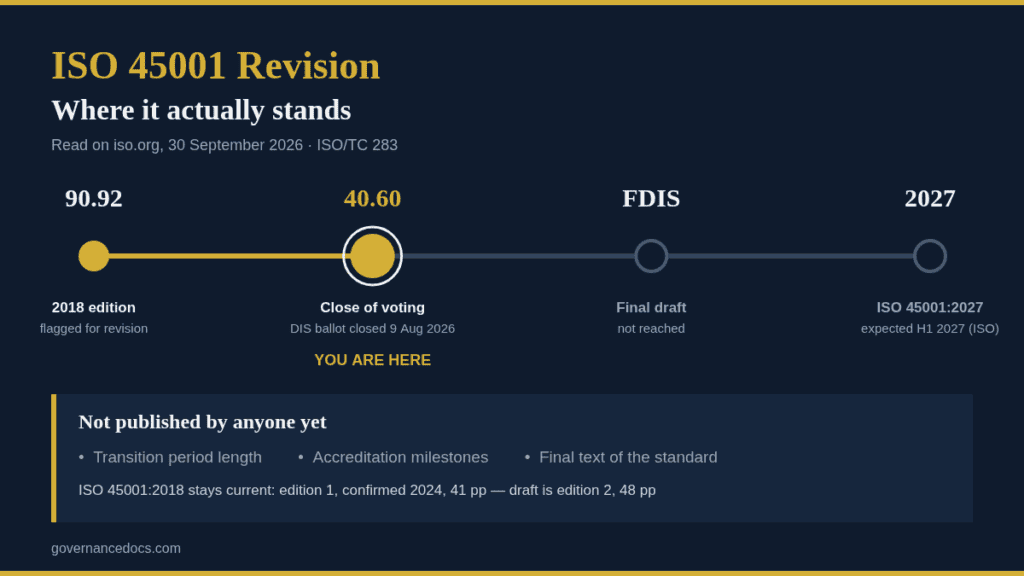
The ISO 45001 revision closed its Draft International Standard ballot on 9 August 2026 and now sits at stage 40.60, Close of voting, on ISO’s own catalogue page. ISO says the draft is expected to replace ISO 45001:2018 in the first half of 2027, and ISO’s FAQ names the result outright: ISO 45001:2027. That is further along than most safety managers realise, and it changes what you should be doing with your management system this quarter rather than next year.
This guide separates three things that get blended together everywhere else: what ISO has actually published about the ISO 45001 revision, what certification bodies are reporting from a draft they have read and you have not, and what nobody knows yet. The third list is longer than the marketing pages suggest, and it is the part that decides whether you should certify now or wait.
Free gap assessment
Could you prove workers take part in safety decisions?
Score every clause of ISO 45001, free, including the consultation and participation evidence that fails more audits than any other requirement.
Run the free ISO 45001 gap assessment → or View premium report sample
Read on iso.org today, the two documents look like this. Everything in this table is from ISO’s catalogue, not from a consultant’s summary.
| Item | ISO 45001:2018 | ISO/DIS 45001 |
|---|---|---|
| Status | Published, reviewed and confirmed in 2024 | Under development |
| Stage | 90.92 — International Standard to be revised | 40.60 — Close of voting |
| Edition | 1 (2018-03) | 2 (© ISO 2026) |
| Pages | 41 | 48 |
| Price | CHF 196 | CHF 67 (draft) |
| Committee | ISO/TC 283 | ISO/TC 283 |
| Climate amendment | Amd 1:2024, CHF 0, in force now | Integrated into the body text |
Two details in that table do real work. Stage 90.92 means the 2018 edition is formally flagged for revision, so a registrar cannot pretend the change is speculative. And the draft runs 48 pages against the current 41 — a 17% increase in a standard that is mostly requirements, which is consistent with certification bodies describing the extent of change as moderate but larger than the recent ISO 9001 and ISO 14001 editions.
The dates come from ISO/TC 283 itself. The committee announced on 18 June 2026 that the draft had entered the ballot the previous day and would remain open for voting and comment until 9 August 2026. Stage 40.60 is the record of that ballot closing; the committee has published nothing since, so the formal outcome and the disposition of comments are not yet in the public record.
Very little, and that is worth knowing precisely because so much is being written around the ISO 45001 revision. Three statements exist on iso.org:
That last one matters for a small reason with practical consequences: the designation ISO 45001:2027 is ISO’s own, not a vendor’s guess. You can use it in a board paper. What you cannot do is treat any specific month as settled, because ISO says first half of 2027 while certification bodies reading the same draft are telling clients mid-2027 (LRQA) and second half of 2027 (DNV). When the publisher and the auditors disagree about which half of the year it lands in, no transition plan should have a hard internal deadline keyed to publication month.
The draft is a paid document and its content is not public, so everything in this section is reported by organisations that bought and read it — principally DNV and the consultancy Antea Group, whose September 2026 summary matches DNV’s clause list closely. Treat it as a reliable steer on direction and an unreliable steer on exact wording. ISO/TC 283’s own working group said as much in January 2026, when it began publishing articles on the issues under discussion while explicitly declining to name the specific language the committee was considering, “which is bound to change”.
| Clause | Reported change | What it means in practice |
|---|---|---|
| 3 (Terms) | Three definitions added, one removed; the added terms are reported as work-related well-being, disability and external provider | New defined terms create new auditable requirements wherever they appear |
| 4.1 and 4.2 | Climate change moved from the 2024 amendment into the body text; an explicit requirement to consider the diversity of workers | Your context analysis and interested-parties register both need rework |
| 5.1, 5.2, 5.4 | Stronger emphasis on promoting work-related well-being, not only preventing harm | Policy wording and leadership evidence will not survive as written |
| 6.1.2.1 | Expanded hazard identification factors: new and changing technologies, digital platform work, remote workers, psychosocial hazards | The biggest gap in most existing hazard registers |
| 6.1.2.2 | Documented information must now include the result of the assessment | A records change, cheap to fix, easy to fail |
| 6.3 | New standalone “Planning of changes” clause | Same addition ISO 9001 and ISO 14001 received; a genuinely new procedure for most |
| 8.1 | Restructured, with new subclauses reported at 8.1.3 occupational health and 8.1.4 return to work following injury and ill health | Health surveillance and return-to-work move from good practice to requirement |
| 10.1 | Former 10.1 and 10.3 consolidated | Renumbering work in every cross-referenced document you hold |
| Annex A | Substantially extended | Guidance, not requirements — but auditors read it |
ISO/TC 283’s own article on this is the clearest signal in the public record of what the ISO 45001 revision is trying to do. The committee’s position is that broad language such as “all workers” or “diverse needs” fails in practice, because organisations read it through the lens of their dominant workforce and default to an average worker. The fix under discussion is to require explicit consideration of specific characteristics — age, gender, disability and language among them — so that the question becomes answerable and auditable rather than aspirational.
The examples the committee gives are the ones to test yourself against now: does your risk assessment account for pregnancy, do your evacuation procedures reflect mobility needs, and is your safety information genuinely understood by people whose first language is not the one it is written in. None of that requires the new edition. All of it will be asked about under it.
Two terminology shifts in the ISO 45001 revision will ripple through documented information. “Outsourcing” is reported to give way to “external provider”, and the definition of workplace is reported to broaden to remote settings — a home, a vehicle, a public space. Separately, “outcomes” is reported to be replaced throughout with “results”. Individually these are trivial. Collectively, in a toolkit of 40 to 60 controlled documents that quote clause language, they are a find-and-replace project with a review at the end of it — which is exactly the work our clause-by-clause guide to ISO 45001 mandatory documents maps out.
This is the section competitors leave out, and it is the reason not to buy a transition service in 2026.
If a consultant quotes you a firm transition deadline for ISO 45001 today, ask which document it comes from. There isn’t one. Compare that with the ISO 14001:2026 transition, where dated accreditation milestones do exist and can be planned against — that is what a real transition schedule looks like, and it is what ISO 45001 does not have yet.
Certify now, in almost every case. The reasoning is arithmetic rather than opinion: a certificate issued in late 2026 runs a full three-year cycle to late 2029, and a three-year transition from a mid-2027 publication would run to roughly mid-2030. Your recertification audit lands inside the transition window, which is the cheapest possible moment to absorb a new edition — the auditor is on site anyway.
| Your situation | Verdict | Why |
|---|---|---|
| Uncertified, need a certificate for a contract or tender | Go now to ISO 45001:2018 | Waiting costs you the contract; the transition lands at your recertification anyway |
| Uncertified, no deadline, starting from nothing | Go now, build against the draft’s direction | Implementation takes 6 to 12 months; you will not beat the standard to market by waiting |
| Certified, recertification due in 2027 or 2028 | Stay the course | Your cycle already intersects the likely transition window |
| Certified, recertification due late 2026 | Recertify to 2018 without hesitation | No accreditation rule yet stops a 2018 certificate being issued |
| Running an integrated 9001/14001/45001 system | Sequence deliberately | Two of the three standards have already changed edition; align the third to that work |
The one case for waiting is narrow: an organisation with no external pressure, no customer asking, and a management system that would need rebuilding either way. Even then the cost of waiting is real, because the audit-duration rules do not change with the edition. Certification body audit time is still calculated from Global ACI’s mandatory duration document, and for an organisation of 86 to 125 people in scope that is roughly 11, 8 or 5.5 days depending on assessed OH&S complexity — the same before and after the revision. Our ISO 45001 certification cost breakdown walks through how those days become a number, and how ISO 45001 certification actually works covers the stage 1 and stage 2 mechanics that the revision leaves untouched.
None of the following requires the published text of the ISO 45001 revision, and all of it is work you would do anyway. That is the test for any pre-publication activity: if it only makes sense once the standard exists, it is too early.
If your documentation is the bottleneck rather than your practice — the usual case in a 50 to 250 person organisation — our ISO 45001 Toolkit ships the 50+ templates the current edition requires, structured clause by clause so that a renumbering exercise in 2027 is an edit rather than a rewrite. For the argument about whether the certificate earns its keep at all, we priced that out separately.
ISO says the draft is expected to replace ISO 45001:2018 in the first half of 2027 and refers to the result as ISO 45001:2027. Certification bodies reading the draft put it later — mid-2027 or the second half of the year. Treat 2027 as the year and nothing narrower as reliable.
Yes. The 2018 edition is current, was reviewed and confirmed in 2024, and remains the only version you can be certified to. Certificates stay valid throughout whatever transition period is eventually published, and no such period has been published yet.
Three years is widely expected because ISO 9001 and ISO 14001 got three years. No accreditation body or accreditation cooperation has issued an ISO 45001 transition schedule, so any specific end date you are quoted in 2026 is an estimate presented as a fact.
Yes, and this is the most commonly missed point in the whole ISO 45001 revision story. Amd 1:2024 already applies to the 2018 edition, it is free from ISO, and it requires climate change to be considered in clauses 4.1 and 4.2. The revision folds it into the body text; it does not introduce it.
No. A draft international standard is not certifiable, and no accredited certification body can issue a certificate against it. Anyone offering ISO 45001:2027 certification in 2026 is selling something that does not exist.
The ISO 45001 revision is real, it is at Close of voting, and ISO expects ISO 45001:2027 to replace the 2018 edition in the first half of next year. The reported changes — explicit worker diversity, work-related well-being, psychosocial and remote-work hazards, a planning-of-changes clause, occupational health and return to work — are directionally certain and textually uncertain. The transition arrangements are not merely unconfirmed; they have not been written. So the correct response to the ISO 45001 revision in 2026 is to certify if you need a certificate, close the four hazard gaps, and stop treating a consultant’s date as a deadline.
Primary sources worth reading yourself: ISO’s catalogue entry for ISO 45001:2018, which carries the stage, the amendment and the replacement note, and the ISO/TC 283 news feed, where the committee publishes its own ballot announcements and revision articles.


October 11, 2026

October 11, 2026

October 11, 2026

October 11, 2026

October 11, 2026
