CART
The BRCGS fundamental clauses are the 12 requirement groups in Issue 9 where a major against the statement of intent blocks or removes the certificate, whatever else you did well. They are marked in the Part II introduction. Knowing them, and what evidence each needs, is the best use of your preparation time.
This post lists all 12, explains what a major against one causes and says what a BRCGS auditor looks for in each. It is independent of BRCGS; the Standard is at brcgs.com. For the full picture, start at BRCGS certification.
Most clauses feed the grade by number. A minor is one of many. A fundamental clause is different because the consequence attaches to its statement of intent, the short purpose statement at the top of the group.
If the auditor raises a major against the statement of intent of any fundamental, the result is:
Note the wording. The consequence attaches to the statement of intent, not automatically to a major on one clause beneath it. A major on a single detailed clause counts toward the grade in the normal way. A major that shows the intent itself is not met is the one that stops certification. That is the reason to fix whole systems, not single clauses.
See BRCGS audit grades for how the counts work around it.
| Clause | Subject | Intent, in short |
|---|---|---|
| 1.1 | Senior management commitment | Senior management shows full commitment to the Standard and to improving food safety, quality and culture. |
| 2 | The food safety plan (HACCP) | A fully implemented, effective plan built on Codex HACCP is in operation. |
| 3.4 | Internal audits | The company can show it verifies that the plan, the Standard and its own system work. |
| 3.5.1 | Approval and monitoring of suppliers | Risks from raw materials and primary packaging are understood and managed. |
| 3.7 | Corrective and preventive action | Problems found through product, audits, complaints, recalls, testing and reviews are corrected and prevented. |
| 3.9 | Traceability | Every raw material lot can be traced forward to customers and back to suppliers. |
| 4.3 | Layout and product flow | Layout, flow and people movement prevent contamination and meet the law. |
| 4.11 | Housekeeping and cleaning | Cleaning keeps hygiene at the right standard, all the time. |
| 5.3 | Allergen management | Cross-contact is minimised and labelling meets the law of the country of sale. |
| 6.1 | Control of operations | The site works to specifications and instructions that deliver safe, legal product in line with the plan. |
| 6.2 | Labelling and pack control | Products end up correctly labelled and coded. |
| 7.1 | Training and competence | Everyone whose work affects safety, legality and quality is demonstrably competent. |
Pet food and feed carry one concession: allergen management can be not applicable when the country of sale has no allergen law, unless the site makes an allergen claim.
1.1, senior management. A culture plan with activities, an action plan and a review of its effectiveness, updated annually. Objective results reported to management and all staff each quarter. A management review each year and a meeting programme to senior management each month. A senior manager free to discuss culture in the audit. Our post on food safety culture goes further.
Section 2, HACCP. Section 2 is a whole section, not one clause, so a weakness anywhere in it can reach the statement of intent. Expect a team with competence, product descriptions, verified flow diagrams, a hazard analysis, justified critical control points, validation and monitoring. The plan is reviewed at least annually and before relevant change. If it needs work, read HACCP principles and the HACCP plan.
3.4, internal audit. Two tests apply at once: at least four audit dates spread across the year, and every system activity audited once a year. Hygiene and fabrication inspections of open product areas are a separate monthly programme. They are not internal audit, and neither replaces the other.
3.5.1, supplier approval. A risk assessment of raw materials, updated at least every three years and on triggers. A questionnaire is allowed for initial approval of low-risk suppliers, with a valid risk-based justification. Questionnaires are reissued every three years. Where a broker is approved by questionnaire, verify traceability at the last manufacturer, packer or consolidator.
3.7, corrective action. Records that show cause, correction and prevention, drawn from every source the statement lists. The auditor wants to see that audits, complaints and test results produce action, not only that a log exists.
3.9, traceability. A traceability test at least once a year. It covers raw materials, including printed packaging and labels that carry safety and legal information, and includes a mass balance and a summary of linked documents. The time target is four hours, but that is a should rather than a shall. Do not harden it into a limit, and do not treat it as irrelevant. Our post on the traceability system explains the system side.
4.3, layout and flow. A site map with its required elements, and a flow of product and people that matches it. The production risk zone assessment, which decides whether section 8 applies, sits in this clause (4.3.1). The auditor compares the map with what is on the floor.
4.11, housekeeping. Cleaning that works continuously, not just on audit day. Schedules, verification of cleaning, and an environmental monitoring programme reviewed at least annually and on triggers. Consistently negative results are a reason to review the programme, too.
5.3, allergens. A risk assessment, controls to prevent cross-contact, and labelling that meets the law in the country of sale. The auditor will check that labels reflect the allergens actually in the recipe.
6.1, specifications and instructions. Process specifications and work instructions that match the food safety plan, available where work is done, and followed. Clause 6.1.7 also reaches materials outside the audit scope.
6.2, labelling and pack control. Label reconciliation, and pack and label checks at the start of a run, during it, at batch change and at the end. The printed text runs two of those checks together; we read them as two, which is the safer course.
7.1, training. Records that show each person is competent for the task they do. Competence is shown through training, experience or qualification, not attendance alone.
Tracing is a good way to expose a fundamental failure. A traceability test that cannot reconcile a batch also exposes goods-in records, packaging control and the recall plan. A labelling error leads back to specifications, artwork control and training.
That is why the best preparation is a live exercise, not a document review. Run a traceability test. Read a label back to its approved artwork. Ask a line operator why they take a reading. These are the same checks an auditor makes, and the BRCGS audit checklist turns them into a routine.
Choose one working day and test four of the twelve without warning anyone. Ask a line operator to explain the controls on their step. Pick a finished pack and read the label against the approved artwork and recipe. Ask for the last cleaning verification record for a high-contact surface and then look at the surface. Pull the supplier file for a raw material you bought this week.
Rotate the four every month. Within a quarter you will have touched all twelve, and you will have found gaps in a way no document review does.
The BRCGS Food Safety Toolkit has 123 templates, 78 in Word and 45 in Excel, for $149. Several map directly to fundamentals, including the Food Safety and Quality Culture Plan, the HACCP Plan Summary Workbook, the Internal Audit Programme, Report and Checklist, the Traceability Test and Mass Balance Workbook, the Allergen Risk Assessment and Validation Workbook and the Competency Matrix and Training Records.


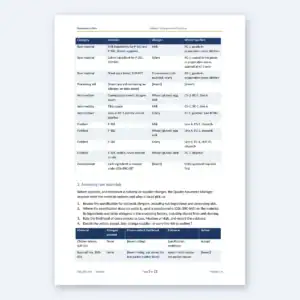
Sample pages from the toolkit: HACCP food safety plan procedure; Traceability test and mass balance; Allergen management procedure.
Twelve: 1.1, section 2, 3.4, 3.5.1, 3.7, 3.9, 4.3, 4.11, 5.3, 6.1, 6.2 and 7.1.
No certificate at an initial audit, or withdrawal at a later one, and a further full audit at least 28 calendar days afterwards.
No. The consequence attaches to the statement of intent. A major on a lower clause counts toward the grade in the usual way.
Yes. The same Standard applies, and the grade sums both parts.
No. Section 9 contains no fundamental. But its findings still count in the grade.

November 7, 2026
November 6, 2026
November 6, 2026
November 6, 2026
November 6, 2026

