CART
Key Takeaways
Free gap assessment
Would your HACCP plan survive an inspection?
Score the whole of the Codex text, free - the good hygiene practices as well as the seven principles, with the US and EU overlays on top.
Run the free HACCP gap assessment → or View premium report sample
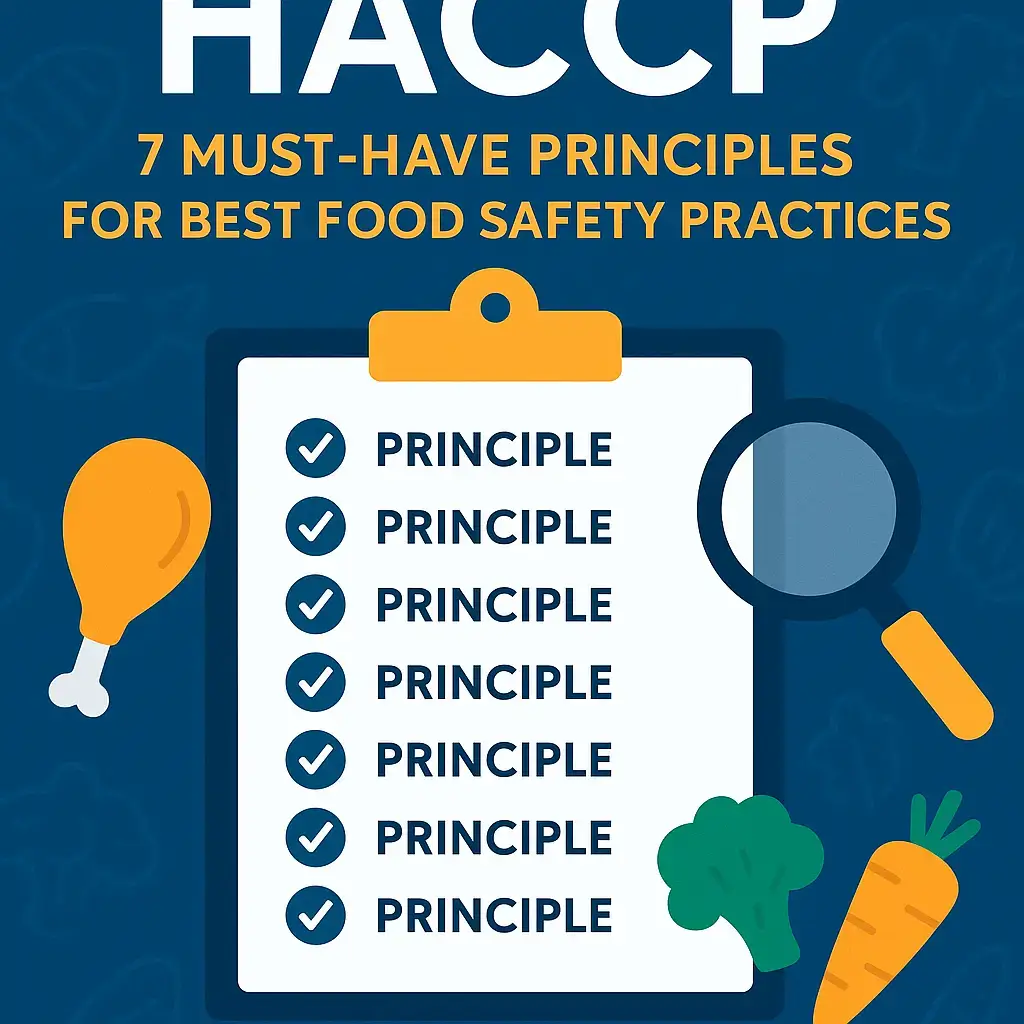
When it comes to ensuring the safety of our food supply, HACCP stands as a pivotal system that food producers, processors, and handlers rely on worldwide. HACCP, or Hazard Analysis and Critical Control Points, is a systematic preventive approach to food safety that identifies, evaluates, and controls hazards throughout the food production process. Understanding and applying the 7 must-have principles of this system is essential for anyone involved in the food industry, from farmers to restaurant operators, to ensure the highest standards of food safety.
In this comprehensive guide, we’ll explore each of the seven HACCP principles in detail, illustrate their practical applications, and explain why they are indispensable in preventing foodborne illnesses and maintaining consumer trust.
HACCP is a proactive methodology designed to prevent the contamination of food products before they reach consumers. Unlike traditional food safety approaches that may rely on end-product testing, HACCP focuses on critical points during production where hazards—whether biological, chemical, or physical—can occur. By identifying these points early, companies can implement control measures that guarantee food safety.
The importance of HACCP has grown tremendously over the decades, with many countries requiring HACCP certification for various sectors of the food industry. This system helps not only in minimizing risk but also in complying with regulatory requirements, reducing food waste, and improving overall product quality.
—
The foundation of the HACCP system begins with a detailed hazard analysis. This involves identifying potential hazards that could occur at any stage of the food production process—from raw material sourcing to processing, packaging, and distribution.
Hazards are generally categorized into three types:
– Biological: Bacteria, viruses, parasites, and other microorganisms that can cause foodborne illnesses.
– Chemical: Contaminants such as pesticides, allergens, toxins, or cleaning agents.
– Physical: Foreign objects like metal fragments, glass shards, or plastic that may accidentally enter the food.
The goal during this step is to systematically examine every step in the process and document possible hazards. Food safety teams assess the likelihood and severity of each hazard to prioritize which should be controlled.
Once hazards are identified, the next step is pinpointing Critical Control Points (CCPs). A CCP is where control can be applied to prevent, eliminate, or reduce a food safety hazard to acceptable levels.
For example, cooking may be a CCP for eliminating harmful bacteria in raw meat, while metal detection might be a CCP to prevent physical contamination in packaged products.
Determining CCPs is often done using decision trees or flow diagrams that help pinpoint stages where control is crucial for safety.
For each CCP, critical limits define the maximum and/or minimum values to which biological, chemical, or physical parameters must be controlled to ensure food safety.
These limits could be:
– Temperature thresholds (e.g., cooking poultry to an internal temperature of 165°F or 74°C),
– Time limits (e.g., maximum time food can be held in the temperature “danger zone”),
– pH or water activity levels preventing microbial growth.
Critical limits must be scientifically based, measurable, and achievable to effectively serve their purpose.
Monitoring is essential for ensuring that CCPs stay within their critical limits. This involves creating clear procedures and schedules for observation, measurement, or testing.
Monitoring can be continuous or intermittent. For instance, recording the temperature of a hot holding unit every hour or visually checking that equipment is properly sanitized after each use.
Effective monitoring allows food safety teams to detect deviations promptly and take corrective actions before hazards become risks to consumers.
Despite best efforts, deviations from critical limits may occur. When this happens, pre-established corrective actions must be implemented to address the issue.
Corrective actions could involve:
– Holding or rejecting affected product,
– Reprocessing the food under safe conditions,
– Adjusting equipment to return to compliance.
These actions should be documented thoroughly and include measures to prevent recurrence.
Verification ensures that the HACCP system works as intended. This principle involves activities beyond routine monitoring and corrective actions to confirm that processes meet safety standards.
Verification techniques include:
– Internal audits of the HACCP plan,
– Testing samples of the food product for hazards,
– Reviewing CCP records and documentation.
By regularly verifying the system, organizations can identify gaps, update plans, and continuously improve food safety.
Accurate documentation provides evidence that the HACCP system is properly implemented and maintained. It includes records of hazard analyses, CCP monitoring, corrective actions, and verification activities.
Good record-keeping not only helps during regulatory inspections but also facilitates transparency and accountability within the food safety management system.
—
Applying the 7 HACCP principles actively contributes to safer food products, but how do they come together in real-world scenarios?
– Hazard Analysis: Identify microbial contamination risks during grinding maize.
– CCPs: Cooking step where heat eliminates pathogens.
– Critical Limits: Minimum cooking temperature set at 80°C for 15 minutes.
– Monitoring: Using temperature sensors attached to the cooking equipment to continuously monitor heat.
– Corrective Actions: If temperature falls below limit, halt production and reprocess existing batch.
– Verification: Periodic microbiological testing of cooked maize batches.
– Record-Keeping: Maintain logs of temperature readings and corrective actions.
– Hazard Analysis: Avoiding cross-contamination between raw and cooked foods.
– CCPs: Washing hands and sanitizing utensils between tasks.
– Critical Limits: Hands to be washed for at least 20 seconds; sanitizer concentration maintained above required level.
– Monitoring: Visual checks and use of sanitizer test strips.
– Corrective Actions: Retraining staff or temporarily closing operations when critical limits are not met.
– Verification: Regular internal audits by kitchen manager.
– Record-Keeping: Logs of sanitation checks and staff training sessions.
—
Implementing HACCP offers numerous advantages:
– Improved Food Safety: The structured approach reduces risks of contamination, significantly decreasing foodborne illnesses.
– Regulatory Compliance: Many food safety authorities require HACCP or similar systems, making compliance smoother.
– Consumer Confidence: Customers look for safe products and often prefer brands that invest in food safety.
– Operational Efficiency: Early detection of hazards minimizes waste, recalls, and downtime.
– Cost Savings: Preventive measures often save money compared to dealing with food safety incidents after the fact.
—
Despite its benefits, some organizations face challenges in HACCP implementation such as:
– Lack of Expertise: Understanding hazards and critical limits can require specialized knowledge.
– Resource Constraints: Smaller businesses may find it costly or labor-intensive to maintain full HACCP documentation.
– Resistance to Change: Staff may be hesitant to adopt new procedures or thorough monitoring routines.
Overcoming these challenges involves investing in training, leveraging consultants when necessary, and fostering a food safety culture where everyone recognizes the importance of HACCP compliance.
—
Mastering the 7 must-have HACCP principles is vital for anyone committed to the highest standards of food safety. From conducting hazard analyses to maintaining impeccable records, each step plays an integral role in minimizing risks and protecting consumers.
By embracing this systematic approach, food businesses can not only meet regulatory demands but also build trust, ensure quality, and contribute to a safer global food supply. Whether you operate a farm, a processing plant, or a restaurant kitchen, integrating these fundamental principles into your daily operations is the cornerstone of sound food safety practice.
Skip the blank page. Download auditor-written, fully editable HACCP documentation templates and adapt them to your organization in minutes.
Further reading: For authoritative guidance, see FDA food-safety guidance.
In most major markets, yes in substance. EU food hygiene law requires food business operators to put in place procedures based on HACCP principles. In the United States, HACCP is mandatory for seafood, juice and meat and poultry, while the FSMA preventive-controls rules apply a closely related model to most other food facilities. The principles are the same even where the legal wording differs.
A prerequisite programme controls the general environment — cleaning, pest control, personal hygiene, maintenance. A critical control point is a specific step where control is essential to prevent, eliminate or reduce a hazard to an acceptable level, and where you can set a measurable critical limit and monitor it. If you cannot state a limit and monitor it, you have a prerequisite programme, not a CCP.
As few as genuinely qualify. A plan with fifteen CCPs is usually a sign that prerequisite programmes have been misclassified, and it dilutes attention across points that do not need it. Most single-process operations land somewhere between one and five. Use a decision tree to test each candidate rather than designating steps by intuition.
HACCP is a methodology set out in the Codex Alimentarius rather than a certifiable management-system standard, though many certification bodies audit HACCP plans against national or scheme-specific criteria. If you need certification a retailer will recognise, ISO 22000 or a GFSI-benchmarked scheme such as FSSC 22000 or BRCGS is normally the route, and each has HACCP embedded within it.
At least annually, and immediately whenever something changes that could introduce a new hazard — a new ingredient or supplier, a process or equipment change, a new product line, a customer complaint pattern, or a recall in your sector. Verification activities run continuously; the full reassessment is the periodic exercise.
If you are ready to move from reading to implementing, the HACCP Toolkit gives you every policy, procedure and record template mapped to the standard — auditor-written, fully editable and ready to download from $99. Not sure it is the right fit? Our Which ISO Toolkit Do I Need? buyer’s guide compares options by goal and industry.
A consultant can be invaluable for complex or high-risk programmes, but they typically charge $150–$400 per hour and take days to weeks to engage. A documentation toolkit delivers 80–90% of the same HACCP documentation instantly, for a one-time $99–$199 — and many teams buy the toolkit first, then use a consultant only for a final gap review or audit preparation. See our full toolkit vs. consultant comparison.


October 20, 2026

October 20, 2026
October 19, 2026
October 19, 2026

October 18, 2026

