CART
The BRCGS traceability test is the annual exercise in clause 3.9.3 of BRCGS Issue 9 that proves your system can follow product from supplier to finished product and back again. It is also one of the things a BRCGS auditor does on the day, so a site that has never practised it tends to learn the weak points in front of an audience. This post covers both directions, the quantity check, and what the 4-hour target really is.
Traceability sits under clause 3.9, which is one of the twelve fundamental clauses. The toolkit mentioned at the end is independent of BRCGS. For the wider system, see our general guide to a traceability system.
Clause 3.9.3 is one sentence of obligation after another, so it helps to separate what is mandatory from what is a target.
| Element of 3.9.3 | Shall or should | What an auditor looks for |
|---|---|---|
| Test both directions: supplier of raw material or primary packaging to finished product, and back | Shall | Evidence of a forward run and a backward run, not one of them |
| Test across the range of product groups | Shall | Different product groups tested over time, not the same easy product each year |
| Quantity check or mass balance for food raw materials and finished products, plus the printed packs and labels that carry safety and legal content | Shall | Quantities in, used, waste, rework and out, reconciled |
| Summary of the documents referenced during the test, with the links between them clearly shown | Shall | A trail someone else could follow without you there |
| Predetermined frequency, at least annually; keep results | Shall | A set schedule and retained records |
| Traceability achievable within 4 hours | Should | Our advice: note the time taken and, if it ran long, the reason and the action |
Everything above except the last row is a “shall”. The last row is a “should”, and we come back to it below.
The statement of intent for clause 3.9 says all raw material lots, primary packaging included, must be traceable from suppliers through processing and dispatch to customers, and in reverse. Because clause 3.9 is fundamental, a major non-conformity against its statement of intent stops certification: no certificate at an initial audit, withdrawal at later ones. Part II and Part III 2.3.2 set that out, and a further full audit is then needed. The consequence attaches to the statement of intent, not automatically to every minor shortfall in a sub-clause.
Forward means starting from a raw material or primary packaging lot and finding every finished product batch it went into and every customer who received it. Backward means starting from a finished product batch, normally one already dispatched, and finding every ingredient and packaging lot in it, plus the supplier of each.
Both directions matter because they fail in different places. Forward tracing breaks where lots of one material are mixed or where part-used materials are returned to store. Backward tracing breaks where blends and intermediates lose their lot codes. Clause 3.9.2 asks you to identify raw materials, primary packaging, part-used materials, intermediate or semi-processed products, finished products and materials under investigation well enough to keep them traceable. Clause 3.9.4 adds that rework must not break the chain.
A sound method:
The quantity check, also called mass balance, answers a simple question: of the amount of material you started with, can you account for all of it? Quantities in should equal quantities out, once you add finished product, waste, rework, samples and stock remaining.
The clause applies the check to food raw materials and finished products, and the clause names printed packaging and labels that carry safety and legal information. That last part catches people. A missing allergen label or a wrong-language pack can be a safety issue, so you should be able to reconcile label issue, use, destruction and returns in the same way you reconcile product.
The clause does not give a percentage tolerance. Set an acceptable variation on your own risk assessment, write it into the procedure, and explain unexplained gaps. A gap you cannot account for is the finding. A small, understood gap with a recorded reason is not.
Do not confuse this with the claims mass balance in clause 5.4.5. That clause covers product claims such as provenance. It wants status verified per batch, so a mass balance alone will not do, and it sets the mass balance test at the scheme’s frequency or, where the scheme sets none, every six months. The traceability test does not replace it.
The last sentence of clause 3.9.3 says traceability should be achievable within 4 hours. The wording is “should”, not “shall”. It can look like a pass mark. It is not one, in the way the clause is written.
That does not make it ignorable. Auditors will notice how long your test took, and a test that runs for two days raises questions about the system. The sensible approach is:
Be equally careful the other way. Do not write “4 hours maximum” into your own procedure unless you are prepared to be held to it. The traded products section has a matching target in clause 9.6.3 of 4 hours, or one day when external parties are involved, also a “should”. Our recommendation is to state the target as an aim and record the result.
The minimum is annual, at a predetermined frequency, with results kept for inspection. One workable approach is a rolling programme across product groups, with the results kept together. If your complexity, number of sites or incident history justifies it, test more often. The clause sets a floor.
The BRCGS auditor also runs a traceability challenge during the audit. Part III treats the traceability challenge as part of the minimum on-site work, even where records are reviewed remotely in a blended audit. Assume you will not choose the product. A site that runs its own tests regularly, across product groups, finds the live one routine.
Other clauses connect. Where a supplier was approved on a questionnaire, clause 3.5.1.6 asks for its traceability to be verified, and for an agent or broker that check falls on the last manufacturer, packer or consolidator. Clause 3.11.3 requires testing of your incident and recall procedures annually, and that goes beyond recall alone. The recall test and the traceability test can be run together, but they are different requirements. Our guide to a product recall procedure covers the recall side.
A one-page record format prevents several of these. Our BRCGS fundamental clauses post explains why traceability, being fundamental, deserves that care.
For a ready format, the BRCGS Food Safety Toolkit includes a Traceability Procedure, a Traceability Test and Mass Balance Workbook, and a Recall Team, Contacts and Test Workbook, within 123 templates (78 Word and 45 Excel) for $149. See also the BRCGS website for the BRCGS Standard itself.


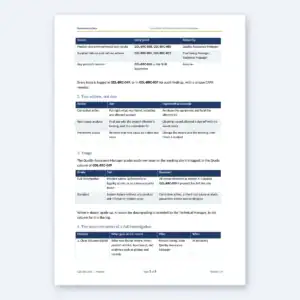
Sample pages from the toolkit: Traceability test and mass balance; Product withdrawal and recall; Corrective and preventive action.
At a predetermined frequency and at least annually, with results retained. A rolling programme across product groups is one workable design.
It is a target. Clause 3.9.3 says traceability should be achievable within 4 hours. Record your time and explain overruns.
Yes. The clause requires the test to show traceability from the raw material or primary packaging supplier to the finished product and back.
A reconciliation of quantities: material received against product made, waste, rework and stock left. It covers food raw materials, finished products and printed packaging with safety and legal content.

November 7, 2026
November 6, 2026
November 6, 2026

November 6, 2026
November 6, 2026

