CART
A traceability system under ISO 22000:2018 clause 8.3 has one job the standard states precisely: to be able to uniquely identify incoming material from the immediate suppliers and the first stage of the distribution route of the end product. Everything else in the clause serves that — considering the relationship of lots of received materials, ingredients and intermediate products to end products, the reworking of materials and products, and the distribution route; retaining the records for a defined period that includes at least the shelf life of the product; and verifying and testing that the system works. The same “one step back, one step forward” principle is law in the EU under Article 18 of Regulation (EC) 178/2002, and the US FDA’s Food Traceability Rule under FSMA section 204 adds lot-level critical tracking events and key data elements for foods on its Food Traceability List, with a compliance date now set at 20 July 2028. This guide sets out what clause 8.3 requires, the four design decisions — lot definition, links, rework and records — the regulatory requirements the system must also satisfy, how to test it with a mass-balance exercise, and the errors that produce findings at certification audits.
Free gap assessment
Would your HACCP plan survive an inspection?
Score the whole of the Codex text, free - the good hygiene practices as well as the seven principles, with the US and EU overlays on top.
Run the free HACCP gap assessment → or View premium report sample
| Requirement (8.3) | What it means | Evidence |
|---|---|---|
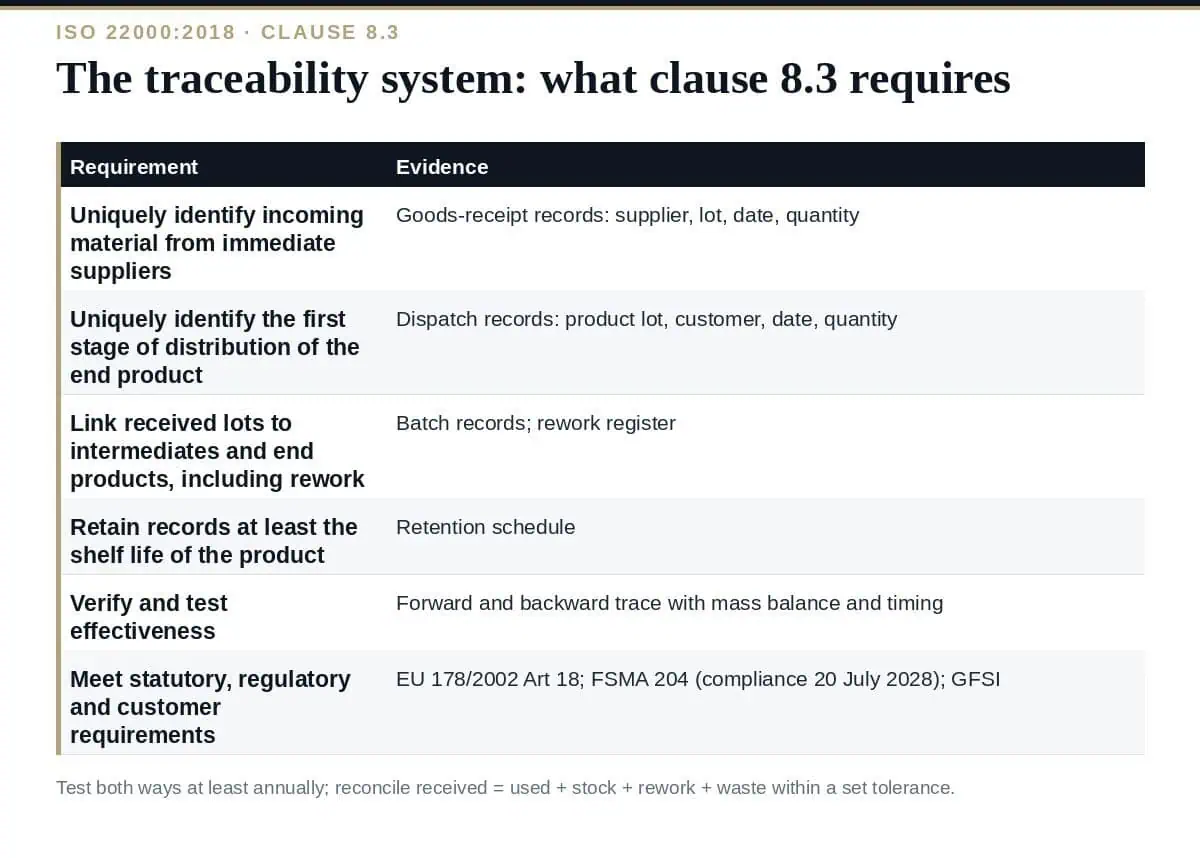
| Uniquely identify incoming material from the immediate suppliers | Every received lot of raw material, ingredient and product contact material is tied to a supplier and a supplier lot | Goods-receipt records with supplier, lot, date, quantity |
| Uniquely identify the first stage of the distribution route of the end product | Every end-product lot is tied to the customers or distribution points that first received it | Dispatch records with product lot, customer, date, quantity |
| Consider the relationship of received lots to end products | The system links which received lots went into which intermediate and end-product lots | Batch records, bills of materials with lot numbers |
| Consider reworking of materials and products | Rework is a material with its own lot that carries its original lots forward | Rework register linking rework lots to source and destination |
| Consider the distribution route of the end product | Where the product goes after the first stage, as far as the organisation controls it | Distribution records, customer lists |
| Retain records for a defined period that includes at least the shelf life | Retention set per product; longer where law or customers require | Retention schedule |
| Verify and test the effectiveness of the system | The system is exercised, not just described | Traceability test records with mass balance |
| Consider statutory, regulatory and customer requirements | EU 178/2002, FSMA 204, retailer standards | Requirements register |
Clause 8.3 does not prescribe lot sizes, coding formats or software. It requires a system whose design decisions are documented and whose output — the link from any supplier lot to any customer and back — can be produced on demand. Our guide to ISO 22000 covers where 8.3 sits in the operational clause; the ISO 22000 mandatory documents guide lists the records it generates.
| Decision | Options | Consequence |
|---|---|---|
| 1. Lot definition | A production run; a shift; a day; a batch of a defined size; a silo or tank fill | Smaller lots mean smaller recalls and more records; the lot is the unit that gets withdrawn |
| 2. Links | Manual batch sheets; ERP lot tracking; barcodes and scanning; GS1 identifiers | The link has to survive every transformation — mixing, splitting, packing — and every hand-off |
| 3. Rework and by-products | Rework as its own lot carrying source lots; by-products and returns traced the same way | Rework that is not lot-tracked is the commonest break in the chain |
| 4. Records and retention | Paper batch records; electronic records; a mix | Retention at least the shelf life; retrievable within the time a recall demands |
| Regime | Requirement | Note |
|---|---|---|
| EU Regulation (EC) 178/2002, Article 18 | Traceability at all stages of production, processing and distribution; identify any person who supplied a food, feed, food-producing animal or substance, and the businesses supplied; information available to the authorities on demand | One step back, one step forward; systems and procedures required, format not prescribed |
| EU Implementing Regulation 931/2011 | For food of animal origin: name and address of the operator and consignee, description, volume or quantity, lot or batch reference, date of dispatch | The data elements behind Article 18 |
| US FSMA section 204 — Food Traceability Rule (21 CFR Part 1 Subpart S) | For foods on the Food Traceability List: traceability lot codes, critical tracking events (harvesting, cooling, initial packing, first land-based receiving, shipping, receiving, transformation), key data elements per event, a traceability plan, and an electronic sortable spreadsheet within 24 hours of an FDA request | Compliance date moved from 20 January 2026 to 20 July 2028; Congress directed FDA not to enforce before that date |
| Codex CXG 60-2006 | Principles for traceability/product tracing as a tool within a food inspection and certification system | The international baseline ISO 22000 aligns with |
| GFSI schemes (FSSC 22000, BRCGS, SQF) | Traceability tests at defined frequencies (commonly at least annually), with mass balance and time targets | FSSC 22000 adds ISO/TS 22002 PRP requirements on identification |
The ISO 22000 system is the mechanism; the regulations set what it must contain and how fast it must answer. A site subject to FSMA 204 should design its lot codes and CTE records into the clause 8.3 system now, because the 2028 date is a compliance date, not a start date.
Clause 8.3 requires verification and testing; certification bodies and GFSI schemes expect a documented trace exercise at least annually, and most sites run one each way every six months. The exercise has a standard shape.
Our guide to product recall under clause 8.9.5 covers the exercise the traceability test is rehearsal for; run the mock recall on the output of the trace.
What does ISO 22000 require for a traceability system?
Clause 8.3: the ability to uniquely identify incoming material from immediate suppliers and the first stage of distribution of the end product, considering the relationship of received lots to end products, rework, and the distribution route; records retained for at least the product’s shelf life; and verification and testing of the system’s effectiveness.
How often should traceability be tested?
ISO 22000 requires testing without setting a frequency; certification bodies and GFSI schemes expect at least an annual documented exercise, and most sites test forward and backward every six months with a mass balance.
What is one step back, one step forward?
The principle in Article 18 of EU Regulation 178/2002 — and in Codex — that every food business must be able to identify who supplied it and whom it supplied. ISO 22000’s supplier-to-first-distribution requirement is the same scope.
How does FSMA 204 change traceability?
For foods on FDA’s Food Traceability List, the rule requires traceability lot codes, records of critical tracking events with key data elements, a traceability plan, and an electronic sortable spreadsheet within 24 hours of a request. The compliance date is 20 July 2028.
How long must traceability records be kept?
ISO 22000: a defined period that includes at least the shelf life of the product. Regulations and customers may require longer; FSMA 204 requires two years.
Design the traceability system around the four decisions — lot definition, links that survive every transformation, rework as a traced material, and records kept at least the shelf life — build the EU Article 18 and FSMA 204 data elements into it rather than alongside it, and test it both ways with a mass balance and a stopwatch, because clause 8.3 is verified by whether the trace works, not by whether the procedure exists.
The Procedure for Identification and Traceability, the handling, storage and distribution procedure, the non-conforming product procedure and the emergency preparedness and response procedure are in the ISO 22000 Toolkit, or start with the free templates.

October 13, 2026
October 12, 2026
October 12, 2026

October 12, 2026

October 12, 2026

