CART
BRCGS certification is a third-party audit result that tells your customers a food site runs its operation to the BRCGS Global Standard for Food Safety. BRCGS says the Standard supports over 24,000 businesses in more than 130 countries. Issue 9 is the current edition. This guide sets out how the scheme works, what the audit options are, how the grade is decided and how to prepare in a sensible order.
The toolkit we mention at the end is independent of BRCGS. It is not produced, endorsed or recommended by them. The Standard itself is theirs, and you should read it at brcgs.com, where BRCGS lists a free PDF.
The Standard has three parts. Part I explains the scheme. Part II holds the requirements. Part III is the audit protocol: how the audit is run, graded and closed out. Part III governs the audit day, so read it alongside Part II.
Part II has nine sections, 328 individual clauses and 57 statements of intent. The statements of intent matter because they are audited in their own right, not only the clauses beneath them. Twelve of them are fundamental, and a major non-conformity against one stops certification outright. We cover those in BRCGS fundamental clauses.
Four parts of the Standard apply only in some cases: pet food and animal feed, animal primary conversion, production risk zones (section 8) and traded products (section 9). Sections 1 to 7 apply to every site, apart from clauses 5.8 and 5.9, which depend on your products.
Certification comes from a certification body that BRCGS recognises. BRCGS writes the Standard. It does not run your certification audit.
No law makes a site hold it. The pressure comes from customers, who may ask for it in a supply agreement or a tender. If a buyer has asked you for BRCGS certification, ask them which issue and which audit option they accept, and whether they want the optional modules. Do not assume. Buyers differ, and we do not claim to know what any one of them requires.
Some sites hold more than one scheme. If you are weighing it against the others, our comparisons of SQF and FSSC 22000 show how those two differ from each other.
There are three routes under Part III. Additional modules can be added to any of them.
| Option | How it runs | Grades |
|---|---|---|
| Announced | Date agreed with the certification body. Fully on site. A mandatory unannounced audit is still required once in every three years. | AA to D |
| Blended announced | A remote part, then an on-site part. Same mandatory unannounced audit. | AA to D |
| Voluntary unannounced | No date given. Fully on site every cycle. | AA+ to D+ |
Blended is for recertification only. It is barred for a site’s first BRCGS audit and for a site with no current certificate. The certification body must complete a risk assessment first, covering your audit history (complaints and recalls included), how readily your records are available electronically, its own capability and that of your staff. Both sides must agree to it, and the terms on confidentiality, security and data protection must be settled or the option is not used.
A non-certificated site can choose the voluntary unannounced route, but should expect the audit may take up to 12 months to arrive. We deal with the unannounced cycle and its windows in our post on the BRCGS unannounced audit.
The audit report counts three kinds of finding: critical, major and minor. The count sets the grade. A critical or the wrong combination of majors and minors means no certificate and a full re-audit. A clean result gives AA on an announced audit or AA+ on an unannounced one.
The grade also sets how often you are audited. Grades AA, A and B give a 12-month cycle. C and D give a 6-month cycle. The full table, with worked examples checked boundary by boundary, is in BRCGS audit grades.
After the audit, your clocks start from the end of the audit:
Do not treat these as a queue. They run side by side, and the 28 days does not pause if you appeal.
The auditor opens with a meeting, tours the site, then splits time between the floor and the records. At the closing meeting, or within one working day, you receive a written summary of the non-conformities. Ask questions there. Once the clocks run, a misunderstanding about what a finding means costs days you do not have.
Treat the closing meeting as the start of the close-out, not the end of the audit. Agree an owner and a date for each finding before the auditor leaves, and you will rarely be rushing on day 27.
An audit typically takes two to three days, with each day of eight to nine hours and never more than ten. About half the time is spent in production. The auditor walks the site and examines how the food safety system is implemented, then reviews records. A site that does well on documents and badly on the floor will not get the grade it expects.
The same auditor may carry out no more than three consecutive audits at your site, so expect a fresh pair of eyes periodically.
If your unit is newly commissioned, take care. Under three months of operation is unlikely to show compliance, and the Standard says so.
This sequence works for a site starting from little. If you already hold a scheme, you can shorten steps two to four.
A few minor findings will not stop certification. Even the top grade tolerates up to five. What stops certification is a critical finding, a major against a fundamental clause’s statement of intent, or counts beyond the grade table.
Certification is a cycle, not an event. The 12 or 6 months run from the first day of your initial audit, then from each prior due date. A late audit has consequences, and the unannounced audit has its own window of the last four months before the due date. You must also tell the certification body about changes that affect validity immediately, and about certain incidents within three working days.
Three further habits protect the certificate:
For food safety culture, which clause 1.1 puts in front of senior management, read food safety culture.
Two guides help with the decisions before and during the build: what belongs in the BRCGS manual, and, if your customers leave the scheme open, how BRCGS vs SQF compares.
The BRCGS Food Safety Toolkit gives you 123 editable templates, 78 in Word and 45 in Excel, for $149. It includes the Issue 9 Self-Assessment and Implementation Roadmap, the Audit Preparation and Audit Day Procedure, the Audit Grade and Recertification Calendar and the Audit Non-Conformity Close-Out Tracker, so your certification work sits in one place.
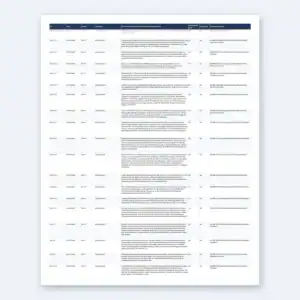


Sample pages from the toolkit: Issue 9 self assessment; Audit grade and recertification calendar; Food safety and quality manual cover.
BRCGS lists a free PDF of the Standard on its website. The audit is a separate matter. You pay a certification body for it, and fees depend on your site, your scope and the body you choose. We do not quote figures, because they vary.
That depends on the grade. Grades AA, A and B give a 12-month cycle. C and D give 6 months. The cycle runs from the initial audit, then from each prior due date.
No. Blended is available for recertification only, and not for a site without a current certificate.
One major does not by itself stop certification. A single major with ten or fewer minors still gives grade B. Two majors with ten or fewer minors give C, with a revisit. Three or more majors, or any critical, mean no certificate. A major against the purpose statement of any fundamental clause stops it as well.
No. The Standard is built on the Codex HACCP principles, and section 2 on the food safety plan is fundamental.

November 7, 2026
November 6, 2026
November 6, 2026
November 6, 2026
November 6, 2026