
CART
No products in the cart.
ISO Compliance Insights & Best Practices
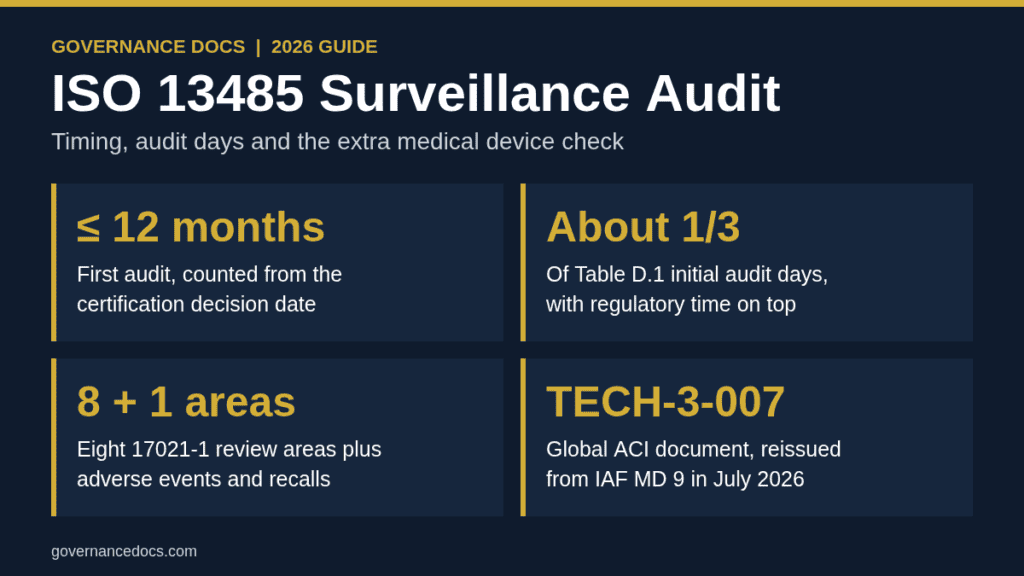
An ISO 13485 surveillance audit is the visit your certification body makes in each of the two years between your initial certification and your recertification, to confirm the quality management system still works and the certificate should stand. It runs for roughly a third of your initial audit days, it samples the system rather than covering all of it, and it carries one mandatory check that an ISO 9001 audit does not have: what you did about adverse events, advisory notices and recalls.
This guide explains the rules behind the audit, how many days to plan for, what the auditor must look at, and how it differs from the EU notified body and MDSAP audits that manufacturers often run alongside it. It assumes you already hold a certificate. If you are still working toward one, start with how ISO 13485 certification works and the stage 1 audit.
Free gap assessment
How much of ISO 13485 could you evidence today?
Score clauses 4 to 8, free, with the FDA QMSR and EU MDR duties kept separate so you can see what is the standard and what is the regulator.
Run the free ISO 13485 gap assessment → or View premium report sample
The standard you are audited against does not set the audit schedule. ISO 13485:2016 tells you how to run the system. Three other documents tell the certification body how to audit it:
The second document is the one most guides have not caught up with. For years the medical device rules were published as IAF MD 9, last issued as Issue 5 on 20 November 2023. When the International Accreditation Forum’s role moved to Global ACI, the text was reissued as Global ACI-TECH-3-007, with an issue date of 10 July 2026 and an implementation date of 28 August 2026. Its scope clause says the text was reformatted without substantive change, so an audit plan or contract that still cites MD 9 is out of date on the number, not on the requirement. Clause numbering such as “MD 9.6.2.2” carries over.
The standard itself is stable. The ISO 13485:2016 page on iso.org shows the third edition as reviewed and confirmed in 2025, at stage 90.93, with no amendment listed in its life cycle. So an ISO 13485 surveillance audit in 2026 has no edition transition attached to it. That is a real difference from ISO 9001, where the 2026 edition’s transition audit can be bundled into a surveillance audit and the 2015 certificates lapse on 30 September 2029.
Clause 9.1.3.2 of ISO/IEC 17021-1 sets out the program: a two-stage initial audit, a surveillance audit in each of years one and two, and a recertification audit in year three. The first cycle starts at the certification decision, not at the end of the stage 2 audit. Two timing rules follow from clause 9.1.3.3:
The trap is the date you count from. It is not the stage 2 closing meeting. Read the decision date on your certificate or the decision letter and work back from there.
| Event | Worked example | Rule |
|---|---|---|
| Certification decision | 10 March 2026 | Cycle starts here (9.1.3.2) |
| First surveillance audit | No later than 10 March 2027 | Within 12 months of the decision (9.1.3.3) |
| Second surveillance audit | During calendar year 2028 | At least once a calendar year (9.1.3.3) |
| Recertification audit | Planned to finish before expiry in 2029 | Timely renewal before expiry (9.6.3.1.1) |
Booking is your job as much as the auditor’s. Not allowing a surveillance audit at the required frequency is a listed ground for suspension under clause 9.6.5.2. Suspended certification is temporarily invalid under clause 9.6.5.3, and a note to clause 9.6.5.4 says suspension would in most cases not exceed six months. If the issue is not resolved, the certification is withdrawn or its scope reduced.
This is where medical devices differ most from ISO 9001. TECH-3-007 clause MD 9.1.4 applies TECH-3-004 but replaces its quality table with Table D.1 in its own Annex D. Table D.1 gives more days at every size band. Clause 5 of TECH-3-004 then sets annual surveillance at about one third of the initial audit time (stage 1 plus stage 2), with a note that less than one audit day is unlikely. Clause 2.2.3 rounds decimals to the nearest half day.
Annex D is headed “initial audit only”, which leads some readers to think it has nothing to do with surveillance. It does, because it is the number the one-third rule works from. The table below applies that arithmetic. These are our calculated starting points, not figures printed in the documents, and your body must adjust them.
| Effective personnel | ISO 13485 initial days (Table D.1) | ISO 13485 surveillance, about 1/3 | ISO 9001 surveillance, for comparison |
|---|---|---|---|
| 1-5 | 3 | 1 | 1 |
| 6-10 | 4 | 1.5 | 1 |
| 11-15 | 4.5 | 1.5 | 1 |
| 16-25 | 5 | 1.5 | 1 |
| 26-45 | 6 | 2 | 1.5 |
| 46-65 | 7 | 2.5 | 1.5 |
| 66-85 | 8 | 2.5 | 2 |
| 86-125 | 10 | 3.5 | 2.5 |
| 126-175 | 11 | 3.5 | 2.5 |
| 176-275 | 12 | 4 | 3 |
Annex D lists what moves the initial figure, and so the third taken from it:
Four further points tend to surprise people when the quote arrives:
The body must also review the planned time at every audit, using updated client data. For how these days feed into fees, see our ISO 13485 certification cost breakdown.
Clause 9.6.2.2 of ISO/IEC 17021-1 describes surveillance audits as on-site audits that need not be full system audits, and lists eight areas to review each time. MD 9.6.2.2 adds a ninth for medical devices. Here is how each one lands on ISO 13485:2016 and what to have ready:
| Mandatory review area | ISO 13485 clause | Evidence to have ready |
|---|---|---|
| Internal audits and management review | 8.2.4, 5.6 | Audit schedule and reports since the last visit; review minutes with outputs and actions |
| Actions on nonconformities from the previous audit | 8.5.2 | Closed corrective actions with proof they worked |
| Complaint handling | 8.2.2 | Complaint log, investigations, decisions on whether to report |
| Effectiveness against your objectives | 5.4.1, 8.4 | Quality objectives and the trended data behind them |
| Progress on planned improvement | 8.5.1 | Improvement actions and their status |
| Continuing operational control | 7.4, 7.5 | Supplier monitoring, validation status, production and release records |
| Review of changes | 4.1.4, 7.3.9 | Change records for processes, sites, suppliers and designs |
| Use of marks and references to certification | Certification body rules | Website, brochures and labels showing correct use |
| Adverse event notifications, advisory notices and recalls (MD 9.6.2.2) | 8.2.3, 8.3.3 | Vigilance reports filed, field actions taken, and how they fed CAPA |
That last row is what makes an ISO 13485 surveillance audit feel different. Expect the auditor to follow a live post-market trail from a complaint to a reporting decision, then to a corrective action, and sometimes to an advisory notice. If those records sit in a regulatory affairs folder the quality team cannot open, you will find out in the room. Our guides to ISO 13485 complaint handling and ISO 13485 CAPA cover what those records should show.
One wording point is worth knowing. The eight areas come from a generic standard, so they talk about continual improvement. ISO 13485 clause 8.5.1 is framed around keeping the system suitable, adequate and effective, because the standard is written for regulatory consistency. Answer that row with changes you made to maintain effectiveness, and do not invent an improvement program for the audit.
MD 9.4.5 gives examples of major nonconformities, for which the body must accept and verify the effectiveness of both correction and corrective action. In summary:
The last example is the one that catches established companies. A minor finding that comes back at the next ISO 13485 surveillance audit can be raised as a major, so a corrective action that only fixed the instance is a risk you are carrying forward. Check every finding from the last report before the auditor does.
On closure time, be careful with what you read. ISO/IEC 17021-1 has a before-expiry deadline for major findings in its recertification clause, but no fixed number of days for surveillance. A figure such as 90 days comes from your certification body’s own procedure. Read that procedure and your contract, then plan around them.
A planned surveillance program can be interrupted. MD 9.6.4.2 says short-notice or unannounced audits may be required when:
The clause gives examples of changes that could be significant, while saying none should automatically trigger an audit: new ownership, a new or relocated manufacturing site, a change to a special process such as moving sterilization in-house, a change to the management representative’s authority, and a new device category in scope. Changes in standards and regulations, and post-market surveillance or vigilance matters, are also named. The body can also act on justifiable concerns about corrective actions or compliance.
The practical step is to add “does the certification body need to know?” to your change control form. Telling the body early gives it the chance to handle the change at the next ISO 13485 surveillance audit, instead of finding it there.
Medical device manufacturers can face three different surveillance regimes, plus an FDA inspection that is not a surveillance audit under any certification scheme. They are easy to mix up in a planning meeting.
| Regime | Who audits | Frequency | What it supports |
|---|---|---|---|
| ISO 13485 certification | Accredited certification body | At least once a calendar year, except the recertification year; three-year cycle | A voluntary ISO 13485 certificate |
| EU MDR, Annex IX | Notified body | At least every 12 months (3.3); unannounced at least once every five years (3.4); certificates valid up to five years (Art. 56) | CE marking under a legal conformity route |
| MDSAP | Recognized auditing organization | Partial surveillance in years one and two, complete re-audit in year three | One audit used by participating regulators |
| FDA inspection under the QMSR | FDA investigators | Set by FDA | US regulatory oversight; no certificate results |
EU MDR. Annex IX of Regulation (EU) 2017/745 has the notified body check both the approved system and the post-market surveillance plan, on your premises and at suppliers where appropriate. Its unannounced audits may be combined with a periodic surveillance visit or run in addition, and include testing a sample of devices or of the manufacturing process. See notified body fees under the MDR for what this costs.
MDSAP. The MDSAP audit approach document (we read revision .009, dated 6 August 2024; check for a later revision) builds on the same 17021-1 clause. Each surveillance audit need not cover everything, but all requirements must be audited across the three-year cycle, and if the first visit takes in design and development, the second should take in production and service controls, or the reverse. For sterile devices, surveillance may be limited to the validated parameters, monitoring and release when nothing significant has changed, and remote activity alone cannot ensure control of sterilization.
FDA. The QMSR, effective 2 February 2026, incorporates ISO 13485:2016, which is why people assume the certificate helps at inspection. It does not. In the final rule’s preamble, FDA says an ISO 13485 certificate will not be accepted as a substitute for any oversight process, including an inspection. MDSAP reports are different, because FDA may accept them in place of routine inspections. A passed ISO 13485 surveillance audit says nothing to an FDA investigator, so keep QMSR inspection readiness as its own workstream.
If one body audits you for more than one scheme, ask how it will combine the visits. MD 9.3.1 lets a body that has already audited a scheme which includes or goes beyond ISO 13485, such as the European device regulations, avoid repeating those elements if it can show all the requirements were met. That clause sits in the initial certification section, so ask your body to confirm how it applies at surveillance. Also don’t confuse the audit with post-market surveillance, which is your own monitoring of devices on the market. The two overlap mainly at complaint handling and the ninth review area.
This is a practical sequence we suggest, not a requirement in any of the documents. Shorten it if your system is already in steady use.
Our ISO 13485 Toolkit gives you 125 editable templates in Microsoft Office format, including a CAPA register and a complaint register of the kind this audit samples. It costs $99 and saves drafting from a blank page, though the records still have to come from your own system running.
At least once a calendar year, except in a recertification year, and the first must fall within 12 months of the certification decision date. Your body can plan more often where there is a reason to.
Not as a simple swap. ISO/IEC 17021-1 describes surveillance audits as on-site audits, while TECH-3-007 counts audit time spent using on-site, remote or combined methods. Clause 9.6.2.1.2 also expects on-site auditing as part of surveillance. Expect some remote work at most, and ask your body what it permits and what evidence it needs under Global ACI-TECH-3-003, the ICT document.
Not automatically. They serve different certificates under different rules, although one organization may hold both roles and combine the visits. Get the arrangement in writing, and confirm that both certificates’ requirements are met and reported.
There is no pass or fail grade as such. Findings are raised, and major ones need accepted correction and corrective action, verified for effectiveness. If you don’t resolve them within your body’s limits, or you fail certification requirements, the body can suspend the certificate, and it may then be withdrawn or reduced in scope.
An ISO 13485 surveillance audit happens once a calendar year in years one and two of the cycle, within 12 months of the certification decision the first time, for about a third of your Table D.1 days. Regulatory time comes on top. The auditor samples eight standard areas plus your adverse event, advisory notice and recall actions, and a repeated finding can turn into a major. Rule citations should now read Global ACI-TECH-3-007 instead of IAF MD 9, the standard’s edition has not changed, and neither an EU notified body visit nor an FDA inspection stands in for this audit by default.

November 7, 2026

November 6, 2026
November 6, 2026
November 6, 2026
November 6, 2026