CART
ISO 50001 certification cost follows a rule the other management-system standards do not have: the audit time is set by ISO 50003, the standard for bodies certifying energy management systems, from the complexity of the energy system — the number of energy sources, the significant energy uses and the consumption — and the number of personnel who affect energy performance, rather than from headcount alone. Two consequences follow. A single-site manufacturer with one electricity supply and gas boilers can be a low-complexity system whose audit is short even with several hundred staff; and a multi-source estate with steam, compressed air, refrigeration and a fleet can be high-complexity at fifty. The second rule that shapes the price is that ISO 50003 requires the certification body to verify energy performance improvement before it issues the certificate, which means the baseline, the indicators and the data have to exist before the audit and cannot be produced during it. This guide gives our estimate of ISO 50001 certification cost by system complexity, using the day-rate band accredited bodies charge in 2026, the implementation cost that sits outside the audit — metering above all — a worked example, and the decisions that move the total.
| Driver | Effect | What you control |
|---|---|---|
| Energy complexity (ISO 50003) | More energy sources, more significant energy uses and higher consumption raise the complexity category and the audit days | Accurate identification of SEUs — not everything is significant |
| Effective personnel | The number of people who affect energy performance — operators of SEUs, maintenance, energy managers — not total headcount | A defensible count in the scope |
| Sites | Each site with its own energy uses adds sampling or full days | Multi-site sampling where the system is centrally managed |
| Metering and data | Sub-metering of SEUs is what makes EnPIs and baselines credible; its absence is the largest single implementation cost | Meter the SEUs first, not everything |
| Existing management systems | ISO 14001 or ISO 9001 supplies the management clauses; the energy-specific clauses 6.3–6.6, 8.2, 8.3 and 9.1.1 are new | Integration and combined audits under IAF MD 11 |
| Evidence of improvement | ISO 50003 requires verified energy performance improvement before certification; no data, no certificate | A baseline period and at least one reporting period before stage 2 |
The band is US$1,200 to $2,500 per auditor day, the range accredited certification bodies typically charge in 2026 and the one used across this site’s certification-cost guides (UK registrars roughly £850–1,500). The day counts are our assumptions for the three complexity categories; the certification body’s ISO 50003 calculation for your system is the number that matters.
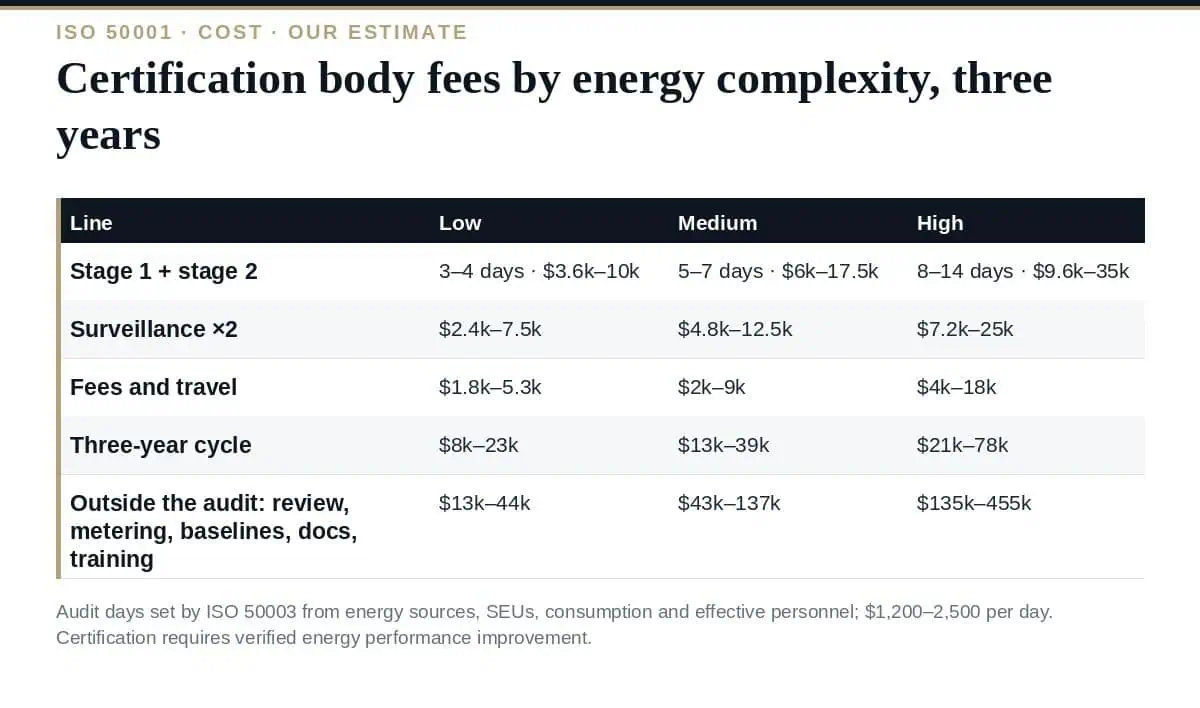
| Cost line | Low complexity (one or two sources, few SEUs, ≤30 effective personnel) | Medium (several sources, 3–6 SEUs, 30–100 effective personnel) | High (many sources and SEUs, multi-site, 100+ effective personnel) |
|---|---|---|---|
| Stage 1 + stage 2 initial audit | 3–4 days: $3,600 – $10,000 | 5–7 days: $6,000 – $17,500 | 8–14 days: $9,600 – $35,000 |
| Surveillance audit, years 2 and 3 | 1–1.5 days each: $1,200 – $3,750 | 2–2.5 days each: $2,400 – $6,250 | 3–5 days each: $3,600 – $12,500 |
| Recertification, year 3 or 4 | 2–3 days: $2,400 – $7,500 | 3.5–5 days: $4,200 – $12,500 | 6–10 days: $7,200 – $25,000 |
| Application, certificate and administration | $300 – $800 | $500 – $1,500 | $1,000 – $3,000 |
| Auditor travel and expenses | $500 – $1,500 per audit | $500 – $2,500 per audit | $1,000 – $5,000 per audit |
| Three-year cycle, certification body only: initial, two surveillances, fees, travel (our estimate) | $8,000 – $23,000 | $13,000 – $39,000 | $21,000 – $78,000 |
| Line | Low complexity | Medium | High | Note |
|---|---|---|---|---|
| Energy review: consumption analysis, SEU identification, opportunity list | $3,000 – $8,000 or 10–20 internal days | $8,000 – $20,000 | $20,000 – $60,000 | The foundation; ISO 50002 energy audits can supply it |
| Sub-metering and data collection for SEUs | $5,000 – $20,000 | $20,000 – $80,000 | $80,000 – $300,000+ | The largest and most variable line; meters, data loggers, integration |
| Baselines, EnPIs and the data plan (ISO 50006 method) | $2,000 – $6,000 or 5–15 internal days | $6,000 – $15,000 | $15,000 – $40,000 | Regression models and normalisation take specialist time |
| Documentation: policy, procedures, registers, action plans | $2,000 – $6,000 or 10–20 internal days | $5,000 – $12,000 | $10,000 – $30,000 | Compressible with templates |
| Training: energy team, SEU operators, internal auditors | $1,500 – $4,000 | $4,000 – $10,000 | $10,000 – $25,000 | |
| Improvement projects to evidence performance improvement | Variable | Variable | Variable | Often self-funding — the point of the standard |
| Internal time, year one | 40–80 staff days | 80–160 staff days | 160–400 staff days | Energy manager plus SEU owners |
Our guides to the energy review, the energy baseline and energy performance indicators cover the three lines that decide whether the audit finds improvement to verify.
A food manufacturer, one site, 220 staff, electricity and gas, with refrigeration, compressed air, steam raising and process heating as SEUs — medium complexity, around 60 effective personnel. Our estimate, illustrative only, at a $1,700 day rate:
| Line | Basis | Estimate |
|---|---|---|
| Stage 1 + stage 2 | 6 days | $10,200 |
| Surveillance ×2 | 2 days each | $6,800 |
| Fees and expenses over the cycle | $3,500 | |
| Certification body, three years | $20,500 | |
| Energy review with an ISO 50002 audit | External | $12,000 |
| Sub-metering of the four SEUs | 12 meters, loggers, integration | $35,000 |
| Baselines and EnPIs (regression on production and degree days) | Specialist support | $8,000 |
| Documentation and training | Templates plus 3 days of training | $6,000 |
| Internal time | ≈110 staff days | Budget the days |
| Improvement projects | Compressed air leaks, refrigeration set points, boiler sequencing | Typically paid back within the cycle |
| Total external, three years | ≈$81,500 plus projects |
How much does ISO 50001 certification cost?
Certification body fees of roughly $8,000–23,000 over a three-year cycle for a low-complexity energy system, $13,000–39,000 for medium and $21,000–78,000 for high, in our estimate at $1,200–2,500 per auditor day; the energy review, sub-metering, baselines and EnPIs, documentation and training add $13,000 to $450,000 depending on complexity, with metering the largest and most variable line.
How are ISO 50001 audit days calculated?
Under ISO 50003, from the complexity of the energy management system — energy sources, significant energy uses and consumption — and the number of personnel who affect energy performance, not from total headcount. The certification body applies the standard’s method to your system.
Can we be certified without showing energy savings?
No. ISO 50003 requires the certification body to verify energy performance improvement before certification, which is why a baseline period and at least one reporting period must exist before stage 2 and why the EnPI method has to be defensible.
Is ISO 50001 cheaper if we have ISO 14001?
Yes. The management clauses are shared and a combined audit reduces time under IAF MD 11; what remains is the energy-specific work — review, SEUs, baseline, EnPIs, data plan, design and procurement — and the metering it depends on.
Are these official prices?
No. Certification bodies quote per organisation using their ISO 50003 calculation. Our figures use the $1,200–2,500 day-rate band typical of accredited bodies in 2026 and our own day assumptions by complexity; confirm with quotes.
Budget ISO 50001 certification cost in three parts: the certification body’s ISO 50003 audit days at a day rate, the metering and analysis that make energy performance measurable, and the improvement projects that pay for both. Identify the significant energy uses honestly, meter those, run a baseline year, integrate with ISO 14001 where you have it — and let the projects fund the certificate.
The energy policy, the energy review and SEU register, the baseline and EnPI method documents, the data collection plan, the action plan templates and the internal audit checklist that compress the documentation and analysis lines are in the ISO 50001 Energy Management Toolkit, or start with the free templates.

September 22, 2026
September 21, 2026
September 21, 2026
September 20, 2026
September 20, 2026

