CART
Energy performance indicators are the reason ISO 50001 is harder than the other management system standards. Most standards ask you to set objectives and improve the system; this one asks you to improve a physical quantity and prove it — and the proof lives in your EnPIs and the energy baseline they are measured against.
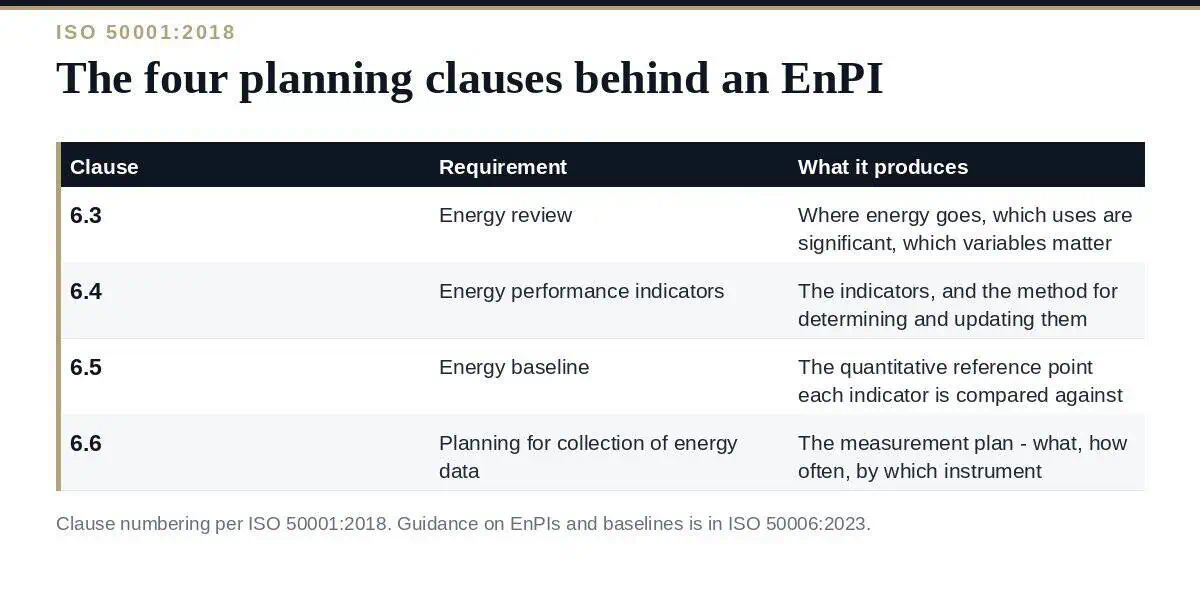
Four clauses in ISO 50001:2018 decide whether that proof holds up: the energy review, the energy performance indicators, the energy baseline, and the planning for collection of energy data. This guide covers what each requires, how normalization works, and the mistakes that turn an audit into an argument.
Free gap assessment
Are you ready for the 2026 edition of ISO 14001?
Score every clause of the new edition, free, including the aspects, life cycle and compliance evaluation work that carries most of the findings.
Run the free ISO 14001 gap assessment → or View premium report sample
| Clause | Requirement | What it produces |
|---|---|---|
| 6.3 | Energy review | Where the energy goes, which uses are significant, and which variables affect them |
| 6.4 | Energy performance indicators | The indicators themselves, and the method for determining and updating them |
| 6.5 | Energy baseline | The quantitative reference point each indicator is compared against |
| 6.6 | Planning for collection of energy data | The measurement plan — what is measured, how often, by what instrument |
The order is not decorative. You cannot choose sensible energy performance indicators without knowing your significant energy uses, you cannot set a baseline without the data behind those indicators, and you cannot maintain either without a data collection plan that says who reads which meter and when.
An EnPI is a measure of energy performance, and the useful ones share three properties: they respond to the thing you can control, they are comparable over time, and their data can actually be collected at the frequency you claim.
There are three broad forms, in increasing order of usefulness and effort:
Whichever form you choose, clause 6.4 wants the method for determining and updating the indicator documented — not just the number. An indicator whose calculation lives in one engineer’s spreadsheet fails that test the moment they leave.
A relevant variable is something that routinely changes and measurably affects energy performance: production volume, ambient temperature, occupancy, operating hours. A static factor is something that affects consumption but does not routinely change — building fabric, installed equipment, product mix. The distinction matters because normalization adjusts for relevant variables, while a change in a static factor is usually the trigger to revisit the baseline instead.
Normalization is what makes a comparison honest. Comparing this January’s gas consumption with last January’s tells you about the weather. Comparing consumption normalized for heating degree days tells you about the building. ISO 50006:2023 is the guidance standard for exactly this work — establishing, using and maintaining EnPIs and energy baselines, including data handling, normalization and reporting.
The energy baseline is the quantitative reference point that your energy performance is compared against. It is set from data covering a suitable period — long enough to include the normal cycle of operations, which for most manufacturers means a full year rather than a convenient quarter.
The temptation is to reset the baseline whenever the numbers look bad, and that is precisely what auditors look for. ISO 50001 expects the baseline to be revised for defensible reasons: where the energy performance indicators no longer reflect energy performance, where there have been major changes to processes, operational patterns or energy systems, or according to a predetermined method you documented in advance. Recording the reason for every baseline revision, with the date and the approval, is the single cheapest piece of audit evidence in the whole standard.
A worked case: a plant installs a new production line. Consumption rises, the specific energy consumption per tonne improves, and the old baseline no longer describes the same system. That is a legitimate baseline revision — but only if you say so at the time, keep the old series, and can show the improvement on a like-for-like basis before the change.
What is the difference between an EnPI and an energy baseline?
The EnPI is the measure; the energy baseline is the reference point it is compared against. You need both to make a statement about improvement.
How many energy performance indicators should we have?
Enough to cover each significant energy use, plus one organization-level indicator for reporting. A single site-wide number cannot tell you where performance changed.
Which clause requires EnPIs in ISO 50001:2018?
Clause 6.4. The energy review is 6.3, the energy baseline is 6.5, and planning for collection of energy data is 6.6.
Do we need ISO 50006?
Not to certify. ISO 50006:2023 is guidance rather than a requirement, but it is the reference for normalization and baseline method, and it saves inventing an approach that an auditor then questions.
Can we use estimated data?
For some uses, yes, provided the method is documented and consistent. What matters is that the same method is applied to the baseline and to the current period, so the comparison stays valid.
Energy performance indicators only prove something if the baseline behind them is stable, the relevant variables are named, and the data collection plan is real. Work the clauses in order — review, indicators, baseline, data plan — pick ratios over absolutes, write down the calculation method and the normalization approach, and record every baseline revision with its reason at the time it happens. Do that and the improvement claim survives an audit; skip it and you are arguing about the weather.
EnPI registers, baseline records and the data collection plan are in the ISO 50001 Energy Management Toolkit, or start with the free ISO templates.

October 14, 2026
October 13, 2026

October 12, 2026

October 12, 2026

October 12, 2026

