CART
Significant energy uses — SEUs — are the energy uses that account for substantial energy consumption or offer considerable potential for energy performance improvement, and ISO 50001 makes almost everything else in the system depend on them. Clause 6.3 requires the energy review to identify them; 6.3 then requires, for each SEU, the relevant variables, the current energy performance and the persons who influence or affect it; 6.6 requires them to be measured; 7.2 requires the people who affect them to be competent; 8.1 requires criteria for operating and maintaining them; and 8.2 and 8.3 reach them through design and procurement. An organisation that identifies too many SEUs meters, trains, controls and audits too much; one that identifies too few cannot show where its performance comes from. This guide sets out what ISO 50001 says an SEU is, the two criteria and how to apply them with a worked selection, what the standard then requires per SEU, the relevant variables and the people, how SEUs feed the baseline and EnPIs, when the list is revisited, and the errors that make an SEU register a list of equipment.
Free gap assessment
Are you ready for the 2026 edition of ISO 14001?
Score every clause of the new edition, free, including the aspects, life cycle and compliance evaluation work that carries most of the findings.
Run the free ISO 14001 gap assessment → or View premium report sample
| Term | ISO 50001:2018 meaning | Practical reading |
|---|---|---|
| Energy use | The manner or kind of application of energy — ventilation, lighting, heating, cooling, transportation, data centres, a process | A function, not a meter or a machine |
| Significant energy use (SEU) | An energy use accounting for substantial energy consumption and/or offering considerable potential for energy performance improvement — with significance criteria determined by the organisation | The uses that matter, by consumption or by opportunity, under criteria you write down |
| Relevant variable | A quantifiable factor that routinely changes and significantly impacts energy performance — production, weather, occupancy, operating hours | What normalisation adjusts for |
| Static factor | An identified factor that significantly impacts energy performance and does not routinely change — installed equipment, building fabric, product mix | What triggers a baseline revision when it changes |
| Persons doing work under the organisation’s control that influence or affect SEUs | Operators, maintenance, procurement, contractors whose actions change the SEU’s consumption | Who needs competence and awareness under 7.2 and 7.3 |
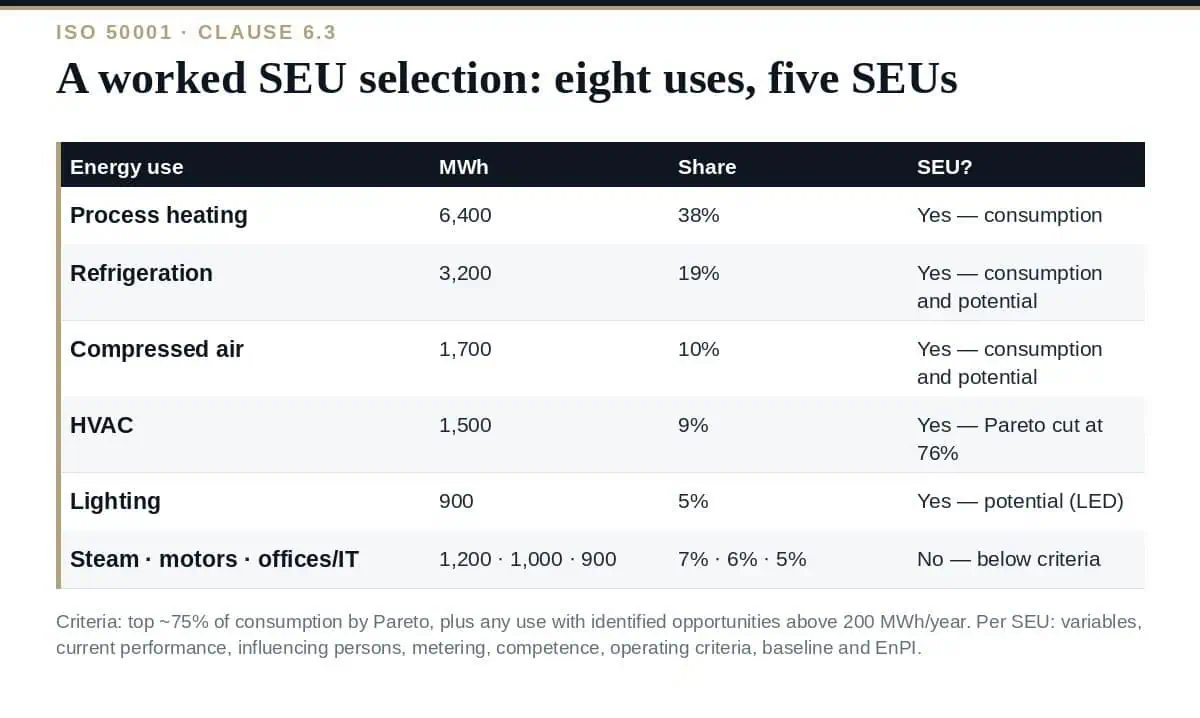
| Energy use | Annual consumption (MWh, all sources) | Share | Improvement potential | SEU? |
|---|---|---|---|---|
| Process heating (gas ovens) | 6,400 | 38% | Burner tuning, scheduling: moderate | Yes — consumption |
| Refrigeration | 3,200 | 19% | Set points, condenser cleaning, controls: high | Yes — consumption and potential |
| Compressed air | 1,700 | 10% | Leaks, pressure reduction, sequencing: high | Yes — consumption and potential |
| HVAC (production areas) | 1,500 | 9% | Controls and scheduling: moderate | Yes — consumption (Pareto cut at 76%) |
| Lighting | 900 | 5% | LED conversion: high absolute saving | Yes — potential |
| Steam raising | 1,200 | 7% | Insulation, condensate: moderate | No — below cut; reviewed next cycle |
| Motors and conveyors | 1,000 | 6% | Low without capital | No |
| Offices, IT, other | 900 | 5% | Low | No |
Five SEUs out of eight uses, 81% of consumption, criteria documented as “uses within the top 75% of consumption by Pareto, plus any use with identified opportunities above 200 MWh a year”. A register that named all eight would meter, train and control the office IT load with the same rigour as the ovens.
| Clause | Requirement per SEU | Deliverable |
|---|---|---|
| 6.3 b) | Determine the relevant variables; determine the current energy performance; identify the persons doing work under the organisation’s control who influence or affect the SEU | SEU register columns: variables, current performance (with the EnPI), named roles |
| 6.4 / 6.5 | EnPIs and baselines that reflect the SEU’s performance, normalised for its relevant variables | An EnPI and baseline per SEU, beneath the site baseline |
| 6.6 | Plan for collection of energy data: measurement of SEUs, relevant variables and static factors; measurement equipment calibrated | Metering points, frequency, accuracy, calibration in the data plan |
| 7.2 / 7.3 | Competence of the persons who affect the SEU; awareness of their impact on energy performance | Training matrix rows for SEU operators and maintainers |
| 8.1 | Criteria for effective operation and maintenance of SEUs where their absence can lead to a significant deviation from intended performance; communicated to the relevant persons; operation according to the criteria | Operating and maintenance criteria per SEU — set points, schedules, maintenance intervals — in procedures |
| 8.2 / 8.3 | Energy performance considered in the design of new, modified and renovated facilities, equipment, systems and processes that can significantly impact energy performance; energy performance evaluated in procuring energy-using products and services with significant impact | Design review and procurement specification records for SEU-related purchases |
| 9.1.1 | Monitoring and measurement of the key characteristics, including SEUs | SEU EnPI trends in the monitoring report |
Our guide to the energy baseline covers the SEU baselines; energy performance indicators covers the per-SEU indicators.
Each SEU’s relevant variables are what its EnPI is normalised for and what its operators can see: for the refrigeration SEU above, ambient temperature and product throughput; for compressed air, production hours and the number of air-using stations running; for process heating, tonnes through the ovens and product type. The persons who influence each SEU are named by role — oven operators and the maintenance technician who tunes the burners; the refrigeration contractor and the shift supervisor who sets the set points; the procurement lead who specifies the next compressor. Those roles are the ones whose competence 7.2 requires, whose awareness 7.3 requires, and who receive the operating criteria under 8.1. An SEU register that lists equipment and no people has done half of 6.3 b).
Clause 6.3 requires the energy review to be updated at defined intervals and in response to major changes in facilities, equipment, systems or processes; the SEU list is updated with it. Three triggers in practice: the annual review, where consumption shares shift and a use crosses the threshold in either direction; a static-factor change — a new line, a fuel switch, an extension — which changes the allocation; and the closure of an opportunity, after which a use designated for its potential may no longer qualify. Removing an SEU is as legitimate as adding one, provided the criteria say so and the record shows it. Our guide to the energy review covers the review cycle.
What are significant energy uses in ISO 50001?
Energy uses — functions such as process heating, refrigeration, compressed air, HVAC or lighting — that account for substantial consumption or offer considerable potential for energy performance improvement, identified in the energy review under clause 6.3 using significance criteria the organisation sets and documents.
How many SEUs should we have?
Enough to cover most of the consumption and the main opportunities, and few enough to meter, train and control properly — typically three to eight for a single site. The criteria, not a target count, decide; a Pareto cut around 75–80% of consumption plus uses with large identified savings is the common approach.
What must we record for each SEU?
Its relevant variables, its current energy performance and the persons who influence or affect it (6.3 b)), then an EnPI and baseline, the measurement in the data plan, competence and awareness for the named roles, operating and maintenance criteria, and design and procurement consideration for changes to it.
Is an SEU the same as a meter point?
No. An SEU is an energy use; a meter measures part or all of it. The data plan decides how each SEU is measured — one meter, several, or a calculation from sub-meters and estimates — and the accuracy that is acceptable.
Can an SEU be removed from the list?
Yes, when the energy review is updated and the use no longer meets the criteria — because consumption fell below the threshold or the opportunity was realised — with the reason recorded. Removing SEUs to reduce audit scope without a criteria-based reason is the error auditors look for.
Identify significant energy uses as functions, not machines, under two written criteria — consumption and improvement potential — with a worked allocation that shows the uses that did not qualify as well as the ones that did. Then give each SEU its variables, its performance, its people, its meter, its operating criteria and its baseline, and revisit the list whenever the review runs or the plant changes.
The SEU register with criteria, variables, performance and influencing persons, the energy use allocation workbook, the operating and maintenance criteria template, the data collection plan and the competence matrix are in the ISO 50001 Energy Management Toolkit, or start with the free templates.

October 11, 2026
October 11, 2026

October 11, 2026

October 11, 2026

October 11, 2026

