CART

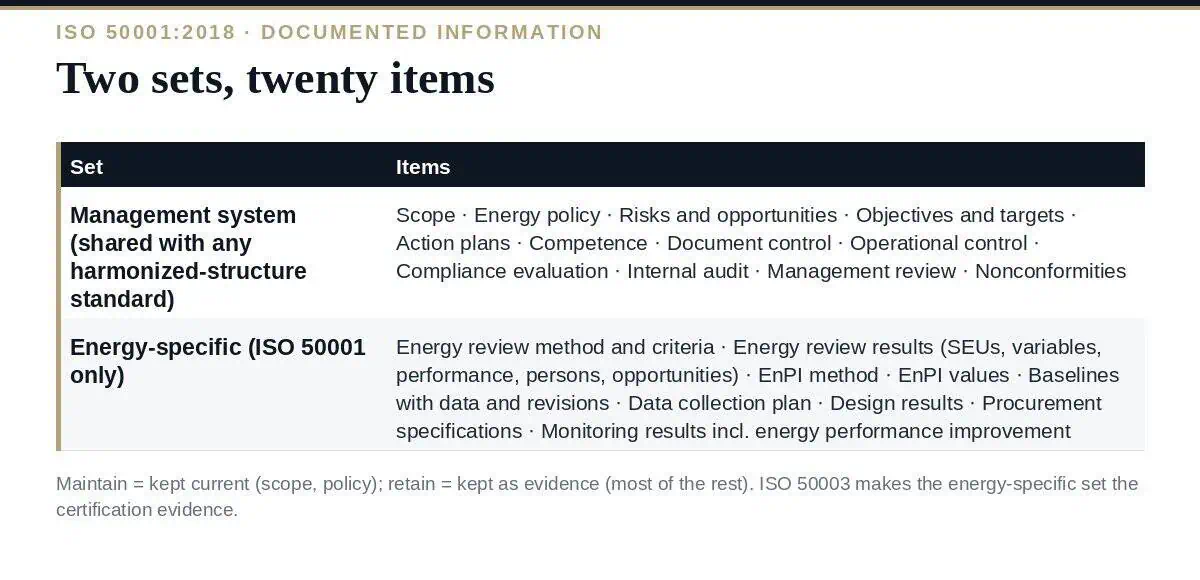
The ISO 50001 mandatory documents divide into two sets that an auditor reads differently: the documented information every harmonized-structure standard requires — scope, policy, objectives, competence evidence, operational control, monitoring results, internal audit, management review, nonconformities — and the energy-specific documented information that ISO 50001:2018 names clause by clause and that no other management system standard supplies: the method and criteria of the energy review and its results, the significant energy uses with their variables and people, the method for determining and updating EnPIs and the EnPI values, the energy baselines with their normalisation and revisions, the energy data collection plan, the design and procurement records, and the results of monitoring energy performance.
Because ISO 50003 makes the certification body verify energy performance improvement, the second set is the evidence the certificate stands on. This guide lists the twenty ISO 50001 mandatory documents by clause with what each has to contain, separates “maintain” from “retain”, adds the non-mandatory documents that a working system usually has, shows how to structure the set with an ISO 14001 system where one exists, and lists the documents commonly produced that the standard does not require.
Free gap assessment
Are you ready for the 2026 edition of ISO 14001?
Score every clause of the new edition, free, including the aspects, life cycle and compliance evaluation work that carries most of the findings.
Run the free ISO 14001 gap assessment → or View premium report sample
| # | Clause | Documented information | Maintain or retain | What it contains |
|---|---|---|---|---|
| 1 | 4.3 | The scope and boundaries of the EnMS | Maintain | Organisational units, sites, energy sources and uses within the system |
| 2 | 5.2 | The energy policy | Maintain | Commitments to continual improvement of energy performance and the EnMS, availability of information and resources, compliance, and energy-efficient design and procurement |
| 3 | 6.1 | Risks and opportunities and the actions to address them | Retain (as needed to have confidence) | The risk and opportunity register relevant to energy performance and the EnMS |
| 4 | 6.2 | Objectives and energy targets | Retain | Measurable targets, tied to EnPIs, with owners and dates |
| 5 | 6.2 | Action plans | Retain | What will be done, resources, timescale, how results are verified, how energy performance improvement is verified |
| 6 | 6.3 | The methods and criteria used to develop the energy review | Retain | How consumption was analysed; the SEU significance criteria; how opportunities were prioritised |
| 7 | 6.3 | The results of the energy review | Retain | Consumption analysis, SEUs with relevant variables, current performance and influencing persons, prioritised opportunities, estimates of future consumption |
| 8 | 6.4 | The method for determining and updating the EnPIs | Retain | The indicator, its formula, normalisation, data sources |
| 9 | 6.4 | The EnPI values | Retain | The indicator results by period |
| 10 | 6.5 | The energy baselines, relevant variable data and modifications | Retain | Baseline period, data, normalisation, revision history with reasons |
| 11 | 6.6 | The energy data collection plan | Retain | What is measured — SEUs, relevant variables, static factors, consumption — where, how, how often, with what accuracy; calibration |
| 12 | 7.2 | Evidence of competence | Retain | Training and qualification records for persons affecting energy performance |
| 13 | 7.5 | Documented information required by the standard and determined necessary by the organisation | Both | The document control system itself |
| 14 | 8.1 | Operational planning and control — to the extent necessary for confidence that processes are carried out as planned | Retain | Operating and maintenance criteria for SEUs and records that they were applied |
| 15 | 8.2 | Design activity results | Retain | Energy performance considerations in designs affecting SEUs |
| 16 | 8.3 | Procurement specifications and energy purchasing specifications | Retain | Energy performance criteria for products, equipment, services and energy |
| 17 | 9.1 | Results of monitoring and measurement, including energy performance improvement; investigation of significant deviations | Retain | EnPIs against baselines; deviation investigations and responses; calibration evidence |
| 18 | 9.1.2 | Results of the evaluation of compliance | Retain | Legal and other requirements evaluated, with status |
| 19 | 9.2 | The audit programme and audit results | Retain | Programme, plans, reports, findings |
| 20 | 9.3 / 10.1 | Results of management review; nonconformities and corrective actions | Retain | Minutes with decisions on energy performance and the EnMS; NC register with actions and results |
“Maintain” means the document is kept current; “retain” means the record is kept as evidence. Items 6 to 11 and 15 to 17 are the energy-specific set — the documents that do not exist in an ISO 14001 or ISO 9001 system and cannot be borrowed from one. Our guide to the energy review covers items 6 and 7; the energy baseline covers item 10.
| Document | Not mandatory, but | Why it exists |
|---|---|---|
| Energy manual or EnMS description | Common | The auditor’s index: where each of the twenty items lives |
| Energy team terms of reference | Clause 5.3 requires roles and responsibilities to be assigned; a document is the usual evidence | Who the energy manager and SEU owners are |
| SEU register | The results of the energy review require it in substance | Variables, performance and persons per SEU in one place — see significant energy uses |
| Opportunity register | Part of the energy review results | Prioritised opportunities with estimates, feeding objectives and action plans |
| Legal and other requirements register | Clause 4.2 requires the requirements to be determined and 9.1.2 evaluated | Energy legislation, efficiency obligations, permits |
| Measurement equipment and calibration register | 6.6 requires calibration; a register evidences it | Meters, loggers, accuracy, calibration dates |
| Communication records | 7.4 requires a process; records evidence it | Internal communication on energy performance; suggestions from persons under the organisation’s control |
| Management review pack | The 9.3 inputs need a vehicle | EnPI results, action plan status, opportunities, resources |
Our guide to ISO 50001 vs ISO 14001 covers which clauses transfer; significant energy uses covers the register at the centre of the chain.
What documents does ISO 50001 require?
Twenty items: the management-system set — scope, energy policy, risks and opportunities, objectives and targets, action plans, competence evidence, document control, operational control, compliance evaluation, internal audit, management review, nonconformities — and the energy-specific set — the energy review’s methods, criteria and results, the EnPI method and values, the baselines with data and modifications, the data collection plan, design and procurement records, and monitoring results including energy performance improvement and deviation investigations.
Which documents are unique to ISO 50001?
The energy review method and results, the SEU information, the EnPI method and values, the energy baselines and their revisions, the energy data collection plan, the design and procurement energy records, and the energy performance monitoring results. None exists in ISO 14001 or ISO 9001.
What is the difference between maintain and retain?
Maintain applies to documents kept current — scope, policy; retain applies to records kept as evidence — audit results, EnPI values, baseline revisions. Most of the twenty are records.
Is an energy manual mandatory?
No. ISO 50001:2018 does not require one. Many organisations keep a short EnMS description as the auditor’s index to the twenty items.
Do we need to document the baseline calculation?
Yes. Clause 6.5 requires the baselines, the relevant variable data and any modifications to be retained, and 6.4 requires the method for determining and updating the EnPIs. The workbook is documented information and belongs under document control.
Build the ISO 50001 mandatory documents as two sets: the management-system items shared with whatever system you already run, and the energy-specific chain — review, SEUs, data plan, baselines, EnPIs, objectives and action plans, monitoring results — kept separate, under document control, and linked in order, because the certificate is issued on what that chain proves.
All twenty mandatory items as templates — the energy policy, the energy review method and results, the SEU register, the EnPI and baseline method documents, the data collection plan, the design and procurement procedures, the action plan, and the audit, review and corrective action records — are in the ISO 50001 Energy Management Toolkit, or start with the free templates.

October 12, 2026

October 12, 2026

October 12, 2026
October 12, 2026
October 12, 2026

