CART
The energy review is the analytical work that makes the rest of ISO 50001 possible. Everything downstream — the baseline, the performance indicators, the objectives, the action plans — is derived from it, which is why a weak review produces an energy management system that measures things nobody can influence.
This guide covers what clause 6.3 asks for, the three questions the review has to answer, how to identify significant energy uses defensibly, and when to redo it.
Free gap assessment
Are you ready for the 2026 edition of ISO 14001?
Score every clause of the new edition, free, including the aspects, life cycle and compliance evaluation work that carries most of the findings.
Run the free ISO 14001 gap assessment → or View premium report sample
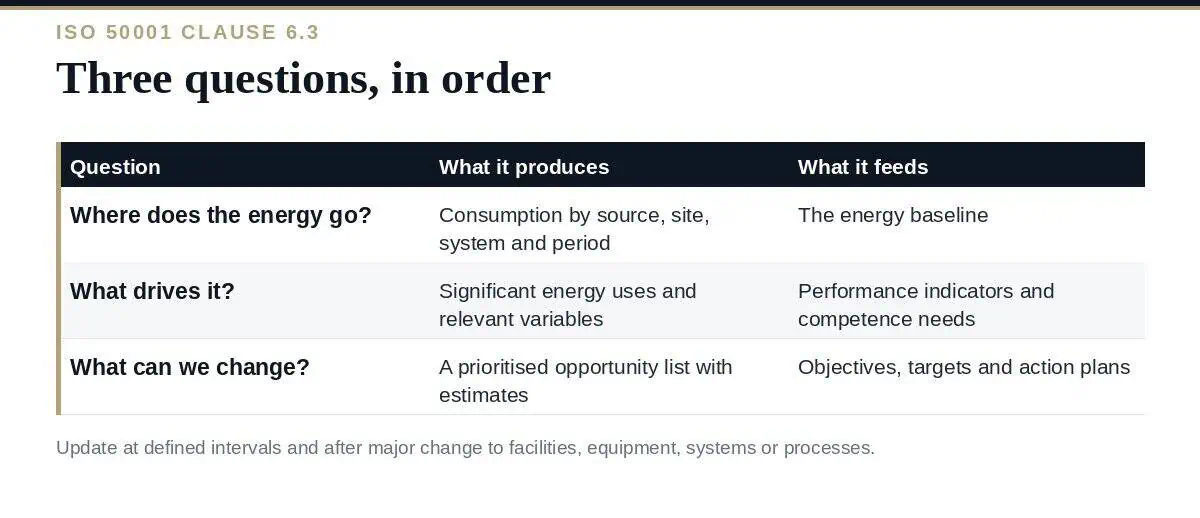
The energy review is a documented method with three parts, performed in sequence:
All three have to be retained as documented information, and the review has to be updated at defined intervals and after major changes to facilities, equipment, systems or processes. The sequence matters: SEUs cannot be chosen before the consumption analysis, and opportunities cannot be prioritised before the SEUs are known.
| Question | What it produces | What it feeds |
|---|---|---|
| Where does the energy go? | Consumption by source, site, system and period | The energy baseline |
| What drives it? | Significant energy uses and their relevant variables | Energy performance indicators and competence requirements |
| What can we change? | A prioritised opportunity list with estimates | Objectives, targets and action plans |
The standard leaves the threshold to you, and that freedom is where energy review work goes wrong. Write the criteria down before you apply them. Workable approaches:
For each SEU the energy review also has to identify the relevant variables — production volume, degree days, occupancy, running hours — because those are what make later comparisons honest. A plant that used less energy because it produced less has not improved anything, and the relevant variables are how you prove the difference. Our guide to energy performance indicators covers what happens to those variables next.
Most first energy reviews run on utility invoices, because that is what exists. That is a legitimate starting point, and it caps what you can conclude: invoices tell you the site’s total, not which system consumed it. The review should say plainly where the data came from, what was estimated, and what metering would be needed to do better — and the metering plan then becomes an output of the review rather than an excuse for it.
It is done once and cited for years. The requirement is to update at defined intervals and after major change. A review describing a plant configuration from three years ago is a document, not an analysis.
Opportunities with no numbers. “Upgrade lighting” is not an opportunity; an estimated saving, a cost and a confidence level is. Without them the prioritisation is opinion.
SEUs picked to be flattering. Leaving out the process that consumes 40% of the site because nobody wants to touch it produces a system that cannot improve energy performance, which is the one thing certification actually tests.
Nobody named. The review identifies the people whose work affects SEUs — that list drives competence and awareness requirements, and it is regularly left blank.
How often must an energy review be updated?
At intervals you define, and whenever there is a major change to facilities, equipment, systems or processes. Annual is the common interval, tied to the management review cycle.
Is an energy review the same as an energy audit?
No. An energy audit is a technical survey, often to ISO 50002 or a national scheme, and can be a valuable input. The energy review is the management system’s own analysis and is required by ISO 50001.
How many significant energy uses should we have?
Enough to cover most of your consumption and few enough to manage — often a handful of systems rather than dozens of assets. The number matters less than the written criteria behind it.
Can we use estimated data?
Yes, if you say so. Estimates are acceptable where measurement does not exist; undisclosed estimates presented as measurement are not.
Who should perform the energy review?
Someone competent in energy analysis, working with the people who run the systems. It is not a task for the quality manager alone, and it is not a task for an external consultant alone either.
Treat the energy review as the engine of the system rather than a clause to satisfy. Analyse consumption from the best data you have, write the SEU criteria down before selecting, identify relevant variables and named influencers for each one, and put numbers against every opportunity. Then update it on a defined interval and after real change — the baseline, the indicators and every objective you set are only as good as the review they came from.
Review templates, SEU criteria and the baseline workbook are in the ISO 50001 Energy Management Toolkit, or start with the free ISO templates.

October 13, 2026
October 12, 2026

October 12, 2026

October 12, 2026

October 12, 2026

