

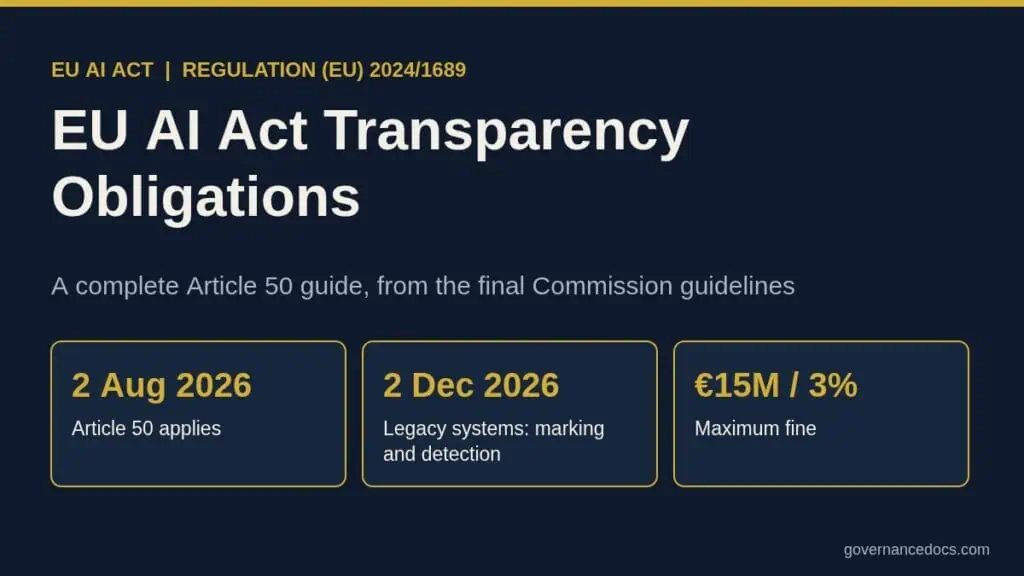
The EU AI Act transparency obligations in Article 50 have applied since 2 August 2026, and unlike the high-risk rules they were not postponed by the July 2026 Digital Omnibus. They reach far more organizations than the high-risk chapter does: anyone whose chatbot talks to people, anyone whose product generates text, images, audio or video, anyone who publishes a deepfake, and anyone who publishes AI-written text on matters of public interest. Breach sits in the second fine tier under Article 99: up to €15 million or 3% of worldwide turnover.
Updated 6 November 2026. This guide now works from the Commission’s final guidelines on Article 50, published on 20 July 2026, and not from the May draft. The English text now on the Commission’s page is C(2026) 7702 final, dated 5 November 2026, and every “point” cited below refers to that document. The guidelines are non-binding, and only the Court of Justice can give an authoritative reading of the Act (point 5).
It sets out the four duties, who carries each, what the guidelines put inside and outside each one, the Code of Practice and what signing changes, the 2 December 2026 deadline for older generative systems, and the evidence worth holding.
Free gap assessment
Which AI Act obligations do you actually owe?
Score what is already in force separately from the high-risk duties that now land in 2027, free.
Run the free EU AI Act gap assessment → or View premium report sample
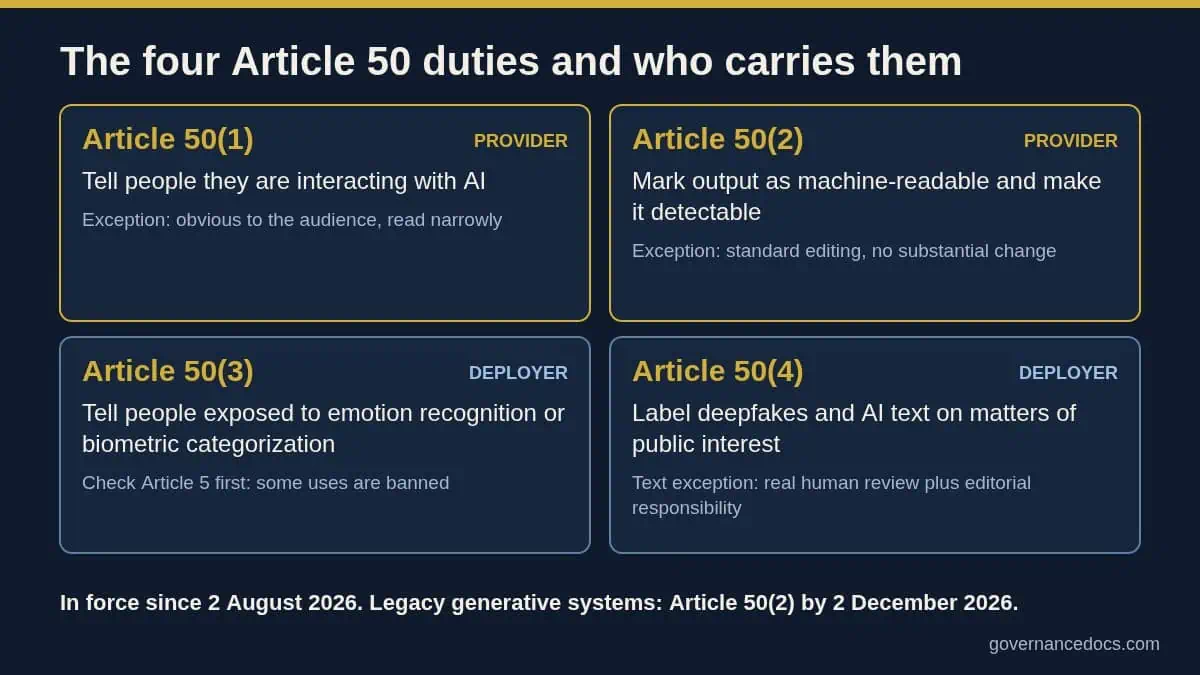
The four EU AI Act transparency obligations in Article 50
| Paragraph | Who | Obligation | Main exemptions |
|---|---|---|---|
| Article 50(1) | Providers | AI systems intended to interact directly with natural persons must be designed and developed so those persons are informed they are interacting with an AI system | Interaction obvious to a reasonably well-informed, observant and circumspect person; systems authorized by law to detect, prevent, investigate or prosecute crime, unless available to the public to report an offense |
| Article 50(2) | Providers, including of general-purpose AI systems | Outputs of systems generating synthetic audio, image, video or text must be marked in a machine-readable format and detectable as artificially generated or manipulated; solutions must be effective, interoperable, robust and reliable as far as technically feasible | Assistive function for standard editing; no substantial alteration of the input data or its semantics; use authorized by law for criminal offenses |
| Article 50(3) | Deployers | Deployers of emotion recognition or biometric categorization systems must inform the people exposed to them, and process personal data under GDPR, Regulation 2018/1725 and Directive 2016/680 | Systems permitted by law to detect, prevent or investigate criminal offenses, subject to safeguards |
| Article 50(4) | Deployers | Deployers must disclose that deepfake image, audio or video content has been artificially generated or manipulated, and must disclose AI-generated or manipulated text published to inform the public on matters of public interest | Use authorized by law; a lighter duty for evidently artistic, creative, satirical or fictional work; for text, human review or editorial control plus a person holding editorial responsibility |
Article 50(5) sets the manner of the EU AI Act transparency obligations: the information must be clear and distinguishable, given at the latest at the time of first interaction or exposure, and must conform to applicable accessibility requirements. The guidelines add that Article 50 creates no accessibility rules of its own (point 144). The European Accessibility Act and the Web Accessibility Directive decide whether you have to meet them. Article 50(6) confirms the duties are without prejudice to the high-risk requirements in Chapter III and to other transparency law, so a high-risk chatbot carries both.
The duties also stack on one system. A chatbot that generates images can put Article 50(1) and 50(2) on its provider and 50(4) on whoever uses it to publish a deepfake (point 8).
Who the EU AI Act transparency obligations reach
The two provider duties attach at design time and the two deployer duties attach at use. Most of the surprises in the guidelines sit in the examples, because they move organizations into a role they did not think they held and move others out of one.
| Your situation | Role | Result |
|---|---|---|
| You offer a chatbot, image generator or AI agent under your own name, free or paid | Provider | 50(1) and/or 50(2), wherever you are established (point 11) |
| You build a chatbot in-house and put it into service for your own use under your own name | Provider | 50(1), even though you sell nothing (point 11) |
| You take another provider’s generative system, modify it (for example with new training data) and put it into service under your name | Provider of the new system | 50(1) and/or 50(2) for your system (point 11) |
| Your marketing team uses AI to produce a deepfake for an advertisement | Deployer | 50(4). The organization is the deployer, and employees acting under its instructions are not separate deployers (point 14) |
| You commission an agency without deciding whether or how it uses AI | Not a deployer | The agency carries it (point 14). If you do decide how AI is used, you may be one |
| You only host or broadcast content made by others | Not a deployer | No Article 50 duty, but you are encouraged to preserve marks and labels, and other law may apply (points 16 and 17) |
| You publish a deepfake on the open internet from outside the EU | Deployer | In scope, because posting on the globally accessible internet counts as foreseeing EU use (point 13) |
| You release an AI system under an open-source license | Provider or deployer | Not exempt from Article 50. Components that are not themselves an AI system are outside it (points 23 and 24) |
| A private person makes a deepfake for a Christmas card | Outside the deployer duty | The provider of the tool must still mark the output (point 20) |
“Deployer” turns on authority: who decides to use the system, and for what purpose and in what way. Technical control over the system is not required (point 12). Article 50 does not apply directly to general-purpose AI models, only to systems. A system provider may rely on marking built by an upstream model provider or a third party, but it stays responsible for showing that the result complies (points 27 and 74). Our guide to who the EU AI Act applies to sets out the roles in full.
Free AI risk assessment
Which of your AI systems could harm people, or you?
List your AI systems, models and data, pick from 54 AI risk scenarios, including the attacks on AI described in ISO 27090, rate them for the people affected and for you, and plan treatment with ISO 42001 Annex A controls. You get a heat map, a process score and the findings an auditor would raise, free.
Run the free AI risk assessment → or View premium report sample
EU AI Act transparency obligations dates: in force now, with one grace period
| Date | What it means for Article 50 |
|---|---|
| 2 August 2026 | All four transparency obligations apply under Article 113, for every in-scope system on the market, whenever it was placed there (point 153). The Digital Omnibus on AI (Regulation (EU) 2026/1744) did not move this date |
| 2 December 2026 | Article 111(4), inserted by the Omnibus: providers of generative AI systems placed on the market or put into service before 2 August 2026 have until this date to meet the marking and detection duty in 50(2) |
| 2 February 2027 | Code signatories only: interoperability solution for detection mechanisms (Code, Section 1, Measure 3.4). This is a commitment under the Code, not a date in the Act |
| 2 December 2027 / 2 August 2028 | Annex III and Annex I high-risk obligations, separate from and in addition to Article 50 for systems that are both |
The grace period is narrow, and it is under a month away at this update. It covers legacy systems and the Article 50(2) duty only. A system that is partly interactive and partly generative still had to disclose itself from 2 August 2026 (point 153), and every deployer duty applied from that date regardless of when the system was built. The separate grandfathering of older high-risk systems in Article 111(2) gives no shelter from Article 50 (footnote 50). The full schedule is in our EU AI Act deadlines guide.
Content created before 2 August 2026
Nothing has to be labeled retroactively, with one exception that catches publishers (point 154).
| Content | Label or mark needed? |
|---|---|
| Outputs under 50(2) and deepfakes generated before 2 August 2026 | No. Labeling old deepfakes is encouraged, without disproportionate effort such as auditing old content databases |
| Public-interest text generated and published before 2 August 2026 | No |
| Public-interest text generated before 2 August 2026 but published on or after it | Yes, unless the human-review exception applies |
The Commission guidelines and Code of Practice on the EU AI Act transparency obligations
Two documents now fill in Article 50, and they do different jobs. The guidelines interpret all four duties. The Code of Practice is a voluntary route to showing compliance with Article 50(2), 50(4) and 50(5) only, so it does not cover chatbot disclosure under 50(1) or the 50(3) notice.
The Commission published a first draft of the Code on 17 December 2025, a second on 3 March 2026, and the final Code on 10 June 2026. Draft guidelines followed the same track on 8 May 2026, with the final text on 20 July. On 8 July the Commission concluded in its opinion on the Code that it adequately covers those three paragraphs, and the AI Board adopted its own assessment the next day. By the end of July, about 190 organizations had signed. On 30 September over 90 signatories set up two task forces, on marking and detection and on labeling, chaired by the AI Office.
The Code has two sections, each with four commitments. Section 1, for providers, has 17 measures, five of them optional. Section 2, for deployers, covers disclosure, internal processes, artistic works and human review. The Commission has also released EU icons that anyone may use to label content.
What signing actually changes
| Question | Code signatory | Non-signatory |
|---|---|---|
| How do you show compliance? | By adhering to the Code; authorities focus on whether you implemented its measures (point 147) | By explaining how your own measures comply, for instance through a gap analysis against the Code (point 148) |
| What scrutiny should you expect? | Assessment against a known text | Probably more detailed information requests; providers may face requests for access to test their solutions (point 148) |
| Is it proof of compliance? | No. The Commission’s opinion says adherence is not conclusive evidence | Not applicable |
| Does it affect fines? | Commitments may count as a mitigating factor, depending on the circumstances (point 149) | Your own measures still count under Article 99(7) |
| Can you opt out of a section? | Yes, but you lose the benefit for that section (point 147) | Not applicable |
Adherence to the Code is voluntary, and the EU AI Act transparency obligations are not. Treat it as a rulebook you can adopt, with no safe harbor attached. Even if you never sign, it is the benchmark a non-signatory is told to compare itself against.
Article 50(1): disclosing that people are talking to AI
The duty needs four things: an AI system, intended to interact, directly, with natural persons (point 30). Each one removes a group of systems. Rule-based quick replies are not AI systems. A one-way spam filter does not interact. A customer service agent who drafts with an AI tool and sends the reply as a person is not direct interaction. Yet the mere possibility that a human could step in does not get a chatbot out, and a service that blends AI answers with human-curated ones must disclose the AI parts, unless a person properly reviewed and sent them.
| In scope of 50(1) | Outside 50(1) |
|---|---|
| Chatbots and voice assistants in customer support, finance, healthcare, education, e-commerce | Recommender systems, spam filters, automated translation or transcription tools |
| AI hotlines, AI companions, robotic companion pets, humanoid robots, AI avatars | Search and retrieval that generates or modifies nothing |
| AI bots on social networks; coding agents and other agents that interact with people | Text and code autocomplete; authentication and biometric recognition systems |
| AI-assisted public fraud or crime reporting portals, even when humans make the final assessment | Virtual try-on, room staging, product rendering; backend decision support with no direct interaction |
The “obvious” exception is narrow
The test comes from EU consumer law’s average consumer, and the guidelines read it restrictively: it should be limited to cases where “almost no doubt” remains for an average person in the audience (point 45). The audience includes who you can reasonably foresee, not only who you target. If the general public can reach the system and that includes children, older people or people with lower AI literacy, the exception cannot be relied on.
The guidelines’ own examples settle most arguments. Exempt: code assistants available only to professional developers, an internal assistant for properly trained, AI-literate staff, tools used only by trained health professionals, and non-player characters in a single-player game. Not exempt: helpdesk chatbots on online platforms, realistic avatars in virtual reality, and robotic companion pets. A customer-facing chatbot should disclose, whatever your view of how obvious it looks.
What a disclosure has to look like
- Say it at the start of the session: a first-turn message or prominent label in chat, a spoken statement at the start of a call. One prominent notice is likely to be enough in most cases (point 40).
- Add periodic reminders in riskier settings: vulnerable users, emotional or immersive use, AI companions, financial, insurance, legal or health advice, and complaints handling (point 40).
- Answer honestly whenever someone asks if they are talking to AI, or seems confused about it (point 40).
- Adapt it for children and other vulnerable groups if they are likely users, including child-friendly wording (point 34).
The guidelines also list what fails on its own (point 38): disclosure only in terms and conditions or documentation, machine-readable marks the user cannot perceive, a generic label such as “assistant”, a site-wide line like “Services on this website use AI”, and technical statements such as “this system uses LLMs”. An audio tone is not enough by itself in voice settings (point 37).
AI agents
The final guidelines address agents directly. An agent that can interact with the person instructing it, or with anyone else while carrying out a task, must disclose both that it is AI and on whose behalf it is acting (point 31). If you cannot tell in advance whether it will meet a person, design it at the architecture level to disclose whenever that is reasonably likely, including when the person is acting for a company. It should also identify itself to the person instructing it at key steps such as authorization, reporting and validation. Backend machine-to-machine calls that never reach a person are out of scope (point 30).
Article 50(2): marking and detecting synthetic content
There are two duties here, and meeting only one fails (point 70). Outputs must carry a machine-readable mark, and the means to detect it must be available to people exposed to the content, with human-readable results (points 69 and 75). Content that is only partly AI-generated still counts (point 59).
The Act names no technique, and a provider may rely on one technique or several so long as the overall solution meets the four quality requirements (point 72). “Technically feasible” is objective and does not depend on your resources, although costs can be weighed (points 80, 81 and 85). A full provenance chain is not required (point 73), and marks should not carry information about who created the content (point 94).
What the Code asks of signatories
| Element | Code of Practice, Section 1 |
|---|---|
| Metadata | Digitally signed and, where possible, time-stamped, in any format that supports metadata (Sub-measure 1.1.1) |
| Watermark | Imperceptible and hard to separate from the content, except for very short text; free-form text over 200 tokens is included (Sub-measure 1.1.2) |
| Layers | At least two for audio, image, video and containerized text. One is enough for free-form text, and for closed systems embedded in physical products (Measure 1.1) |
| Fingerprinting or logging | Optional, and not sufficient on its own (Sub-measure 1.1.3) |
| Detection | Public specification, software or API, free of charge. Signatories under 1,000,000 monthly users with substantial operating costs may charge a fair fee to very high-volume users, but regulators, media, researchers and civil society always get free, unlimited access (Sub-measure 2.1.1) |
What falls outside 50(2)
- Source code, scripts, configuration and machine-readable specifications (point 68).
- Short strings: single words, captions, alt text and UI labels (point 68).
- Machine-to-machine output never exposed to people, and an agent’s intermediate reasoning (points 63 and 68).
- Interim outputs in closed industrial and production workflows, such as film or game production. Only the final output needs marking (point 68).
- Ephemeral real-time content, where marking is not feasible and people are told it is AI-generated (point 88).
- Strictly technical B2B output, only where all three conditions are met: the output is technical in nature, it is seen by a limited, predefined group of professionals, and safeguards keep it inside the organization (point 87). Consumer-facing and public systems cannot use this.
Standard editing or marking required?
| Standard editing: no marking (point 92) | Semantic change: marking required (point 92) |
|---|---|
| Grammar and spelling correction, minor stylistic polish, AI translation of text | AI summaries; paraphrasing or rewriting that changes style, structure and meaning |
| Format conversion, compression, noise reduction | Synthesized speech in a specific person’s voice |
| Minor cropping, color correction, red-eye removal, blurring faces | Removing, replacing or inserting objects or people; face replacement; altering body shape or skin color |
| Conversation transcripts; assistive tools for people with disabilities | Composite images or clips that change how people, objects or events are represented |
The test is per output, not per product. A tool that can do both must mark what it generates and need not mark what it only lightly edits (point 92).
Article 50(3): emotion recognition and biometric categorization
- Tell everyone exposed, including children, at the latest at first exposure. The duty applies whether the system runs in real time or after the fact (points 100, 106 and 108).
- Pick the means that suit the setting: written notice, standard icons, oral announcement or a mix. The guidelines give a pop-up before a game launches and a notice at each entrance to an exhibition room as examples (point 107).
- Article 50(3) only requires saying that the system is operating. Your data protection notice still has to give purposes and the rest (point 105).
- Check Article 5 first. Emotion recognition in workplaces and education is prohibited apart from narrow medical and safety exceptions, and giving notice does not make a prohibited use lawful (point 110). See our guide to prohibited AI practices.
- Expect a second layer of rules. Emotion recognition systems that are not prohibited are high-risk (point 102), while age or gender classification from biometric data is caught by Article 50(3) whether high-risk or not (point 104).
Article 50(4): labeling deepfakes
A deepfake has four elements: appreciable resemblance, to something existing, in the form of a person, object, place, entity or event, that would falsely appear authentic or truthful (point 113). “Existing” is wider than it sounds, since it covers subjects that could plausibly exist. A realistic synthetic person with no real-world original can qualify, whereas a dragon does not.
The fourth element is the one to watch. No intent to deceive is required (point 114), and you judge it against your actual foreseeable audience, including children and older people if they are likely to see it (point 115). You need not model spread beyond your reasonably foreseeable audience.
| A deepfake (guidelines’ examples) | Not a deepfake (guidelines’ examples) |
|---|---|
| A realistic avatar of the CEO congratulating staff on the year’s results | Mice arguing about cheese in a cheese maker’s advertisement |
| An AI product image in an advertisement or on packaging that makes the product look better than it is | A real car shown against an AI background, if the ad does not mislead about the car |
| Cloned voices of a podcast’s regular presenters discussing the news | AI voices for fictional characters, with no deception about who is narrating |
| An AI video of someone resembling a politician giving a speech | Volume normalization or noise reduction on a radio broadcast |
| A generated celebrity influencer in an advertising context | A presenter walking through mountains with an AI animation of glacier retreat |
The provider’s machine-readable mark does not do this job. The deployer’s label must be perceivable without any tool, so relying on embedded metadata fails Article 50(4) (point 117).
Where the Code puts the label
| Content | Code of Practice, Section 2, Measures 1.1 and 1.2 |
|---|---|
| Image | An “AI” icon or equivalent, somewhere free of overlays, for example the top right corner |
| Video | At the start, at regular intervals where possible, and at least after interruptions such as ad breaks |
| Audio only | A short audible disclaimer in plain language at the start, plus a visual label if a screen is available; repeat where appropriate for long-form or live audio |
| Published text | Above the text, near the headline, or in the colophon; you may label only the AI part |
| Closed internal professional use, such as staff training | In the interface or physical setting, before exposure |
| Evidently artistic or similar work | Icon or label placed to suit the work, for example in accompanying notes or at the beginning or end credits (Commitment 3) |
The artistic regime is lighter, and easy to overclaim
Evidently artistic, creative, satirical or fictional works still need disclosure, in a way that does not hamper enjoyment (points 119 and 123). “Evidently” is read strictly. If the nature of the work is unclear to the audience, the lighter regime is unavailable, and where a work mixes informative and creative character, the informative character wins (point 122). A film with a de-aged actor and a satirical image of a politician qualify. A teleshopping-style video and a synthetic influencer demonstrating a sponsored product do not.
Article 50(4): AI-generated text on matters of public interest
This duty has three parts (point 131), and each one removes a large class of content.
- Published: available to an indeterminate, fairly large number of unrelated readers, paid or not. Internal corporate networks, private correspondence and small closed groups are out.
- To inform the public: it communicates knowledge, opinions or facts.
- On matters of public interest: politics, public services, justice, fundamental rights, public security and health, the environment, consumer safety, and any economic, financial, political, scientific or cultural development that may merit public debate.
| In scope unless reviewed | Outside the duty |
|---|---|
| AI-manipulated corporate reports with investor information on a listed company’s website | Advertising and product descriptions, unless they make claims on health, consumer safety or sustainability |
| An AI summary of a newspaper’s article on a town council decision | AI-generated fantasy novels |
| A lifestyle site’s AI-altered article on diets and disease | A news summary a chatbot shows only to the user who prompted it |
| A weather institute’s AI-generated storm warning on social media | A consultant’s AI-assisted compliance advice to a client |
Those examples reach well beyond newsrooms. A listed company’s investor reporting and a sustainability report are both named, so this belongs on the disclosure committee’s agenda as well as the marketing team’s.
The human-review exception
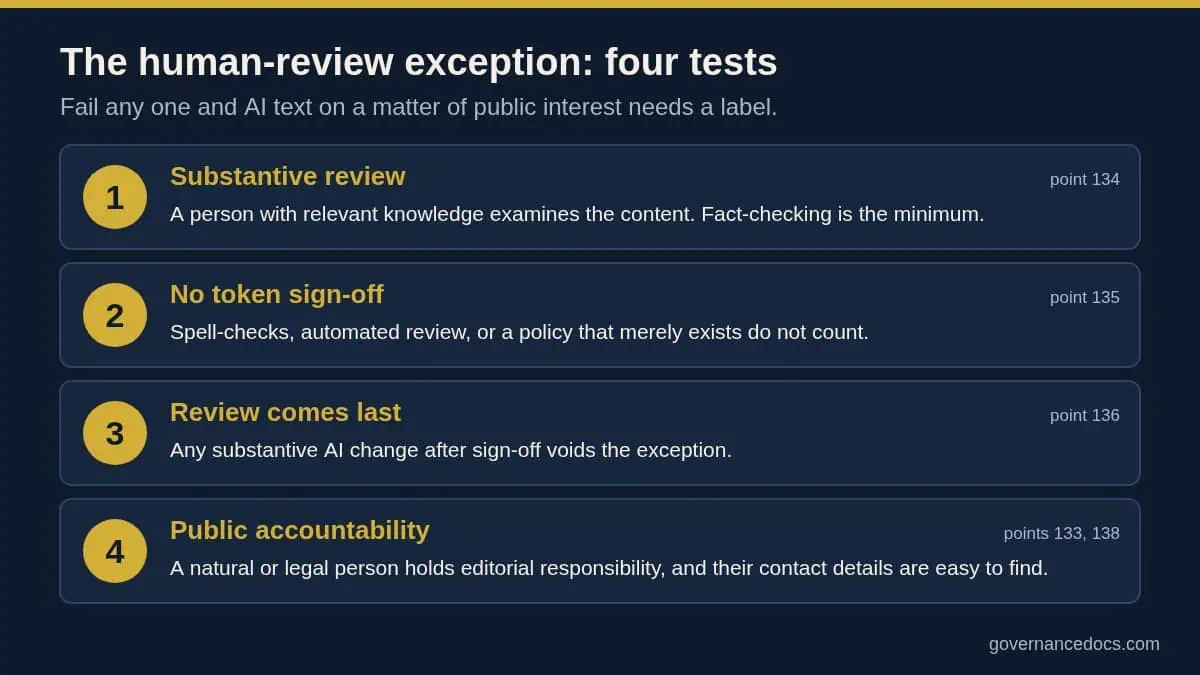
Two conditions, both required: human review or editorial control, and a natural or legal person holding editorial responsibility (point 133). That person can be the publishing company, and need not be a named individual.
- Review must be substantive. A person with relevant knowledge examines the content, and fact-checking is the minimum (point 134).
- These do not count: spell-checking, a policy that merely exists, automated review, and a cursory sign-off (point 135). An AI article checked by another AI and glanced over by an editor fails.
- Order matters. Any substantive AI change after sign-off voids the exception (point 136).
- Accountability is public. The identity and contact details of the responsible person or function should be easy to find, for example in website legal information (point 138).
- Paperwork is proportionate. Under the Code, signatories keep a policy naming who is responsible and the measures in place. They need not document each individual review (Section 2, Commitment 4). Media service providers can rely on their existing editorial procedures.
How the EU AI Act transparency obligations are enforced
National market surveillance authorities enforce Article 50, on their own initiative or after a complaint, and anyone with grounds can complain (point 151). The AI Office is the authority for systems built on a general-purpose model from the same provider; for Article 50(3) and 50(4) it is competent only if that provider is also the deployer (footnote 47). The European Data Protection Supervisor covers EU institutions.
| Who | Maximum fine under Article 99 |
|---|---|
| Companies | €15 million or 3% of total worldwide annual turnover, whichever is higher |
| SMEs, including start-ups, and small mid-caps | The same figures, whichever is lower (Article 99(6) and 99(6a)) |
| EU institutions, bodies and agencies | €750,000 |
Article 99(7) has authorities weigh gravity, intent or negligence, cooperation and the measures in place, so a transparency policy, a marking design record and a labeling log serve as mitigation as well as compliance. Our guide to EU AI Act penalties covers the tiers, and EU AI Act compliance cost covers the budget.
Other law keeps running alongside it. A label does not make content lawful, and it does not affect whether a hosting service must act on a notice under the Digital Services Act (point 96). Consumer law can require you to disclose AI functionality before a contract, even if the interaction is obvious under Article 50(1) (point 50). Data protection notices remain separate (point 52), and the AI literacy duty in Article 4 applies to the same providers and deployers (point 25).
A working checklist for the EU AI Act transparency obligations
| Step | What to do | Record to keep |
|---|---|---|
| 1. Inventory | List every system that converses, generates content, recognizes emotion or categorizes biometric data, including bought tools and in-house builds | AI system register |
| 2. Assign roles | Decide provider or deployer per system and per use; check contractors and agencies | Role decision with reasons |
| 3. Test the exceptions | Write down any reliance on “obvious”, standard editing or B2B; providers carry the assessment for “obvious” (point 42) | Short exception rationale per system |
| 4. Providers: disclose | Build first-interaction disclosure into the product, with reminders in riskier settings | Design record and screenshots |
| 5. Providers: mark and detect | Implement marking and a detection route; legacy generative systems by 2 December 2026 | Marking design, feasibility analysis, test results, upstream vendor evidence |
| 6. Deployers: label | Set a label standard per format, screen marketing imagery as well as obvious deepfakes, and pass the rule to agencies and distributors (point 12) | Labeling procedure and log |
| 7. Deployers: public text | Choose label or review; set the sign-off point last; publish the responsible contact | Editorial policy, contact details |
| 8. Decide on the Code | Sign the relevant sections, or run a gap analysis against them (point 148) | Signature or gap analysis |
| 9. Keep it current | Re-check on system change. The guidelines describe themselves as a first interpretation and will be reviewed (point 155) | Review log |
This sits alongside the wider file described in our guide to EU AI Act documentation requirements.
Frequently asked questions
When did the EU AI Act transparency obligations start to apply?
2 August 2026, under Article 113. The Digital Omnibus on AI moved the high-risk dates but not this one. It added only a transition to 2 December 2026 for the Article 50(2) duty on generative systems already on the market.
Does every chatbot have to say it is an AI?
Every AI system intended to interact directly with people must be designed so they are informed, unless that is obvious to a reasonably well-informed, observant and circumspect person. The guidelines limit that to cases with almost no doubt, and name helpdesk chatbots on online platforms as not exempt.
Does an internal employee chatbot need a disclosure?
Often not. The guidelines give an internal assistant for properly trained, AI-literate staff as an example of obvious interaction (point 45). That protection comes from the training and context, so an assistant rolled out to untrained staff or anyone outside the organization needs a fresh look.
Is watermarking mandatory?
Not under the Act. Article 50(2) requires machine-readable marking that is effective, interoperable, robust and reliable as far as technically feasible, and names no technique. Code signatories, however, commit to signed metadata and an imperceptible watermark for most formats.
Does AI translation need a mark or a label?
Under Article 50(2), the guidelines list AI translation of text as standard editing, so no machine-readable mark (point 92). Under 50(4), they treat an AI-supported translation of an article as text that relies on human review to escape labeling (Section 6.2.3 examples). If it informs the public on a matter of public interest, have a person review it.
Is AI-written marketing copy covered?
Advertising and product descriptions fall outside the text duty unless they make health, consumer safety or sustainability claims (Section 6.2.1 examples). AI imagery is a separate question: a product image that makes the item look better than it is counts as a deepfake.
Do the obligations apply to systems built before August 2026?
Yes for interaction disclosure and every deployer duty. For the Article 50(2) marking and detection duty, generative systems on the market before 2 August 2026 have until 2 December 2026 under Article 111(4).
Is signing the Code of Practice compulsory?
No. The Code is voluntary and Article 50 is law. Signing gives a recognized way of demonstrating compliance with Article 50(2), 50(4) and 50(5), but it is not conclusive evidence. A non-signatory should expect to explain its own measures in more detail.
Where this leaves you
Treat the EU AI Act transparency obligations as the part of the Regulation that already applies to you. Inventory every system that talks to people or generates content, decide for each whether you are provider or deployer, put disclosure at first interaction, mark synthetic output at generation, label deepfakes and unreviewed public-interest text, and keep the records. Use the guidelines’ examples to settle scope, use the Code as the benchmark whether or not you sign, and clear the 2 December 2026 marking deadline for any legacy generative system now.
References
- Commission guidelines on Article 50: the source of the point numbers in this guide.
- Article 50 of the AI Act: the article text.
- Code of Practice on Transparency of AI-generated Content: the Commission’s page with the Code, the EU icons and the signatory route.
- Commission opinion on the Code: the adequacy assessment of 8 July 2026.
- Regulation (EU) 2026/1744, the Digital Omnibus on AI: the amending regulation, including Article 111(4) and the new Article 50(7).
More on AI governance
- EU AI Act transparency obligations: you are here
- The EU AI Act explained
- EU AI Act deadlines and timeline
- Prohibited AI practices under Article 5
- EU AI Act penalties
- AI human oversight
An AI transparency policy, the Article 50 procedure, a disclosure notice template and a deepfake and synthetic content labeling procedure are in the EU AI Act Toolkit (60 templates), or start with the free templates.

Recent Posts
November 23, 2026

November 22, 2026

November 21, 2026

November 20, 2026

November 19, 2026