CART
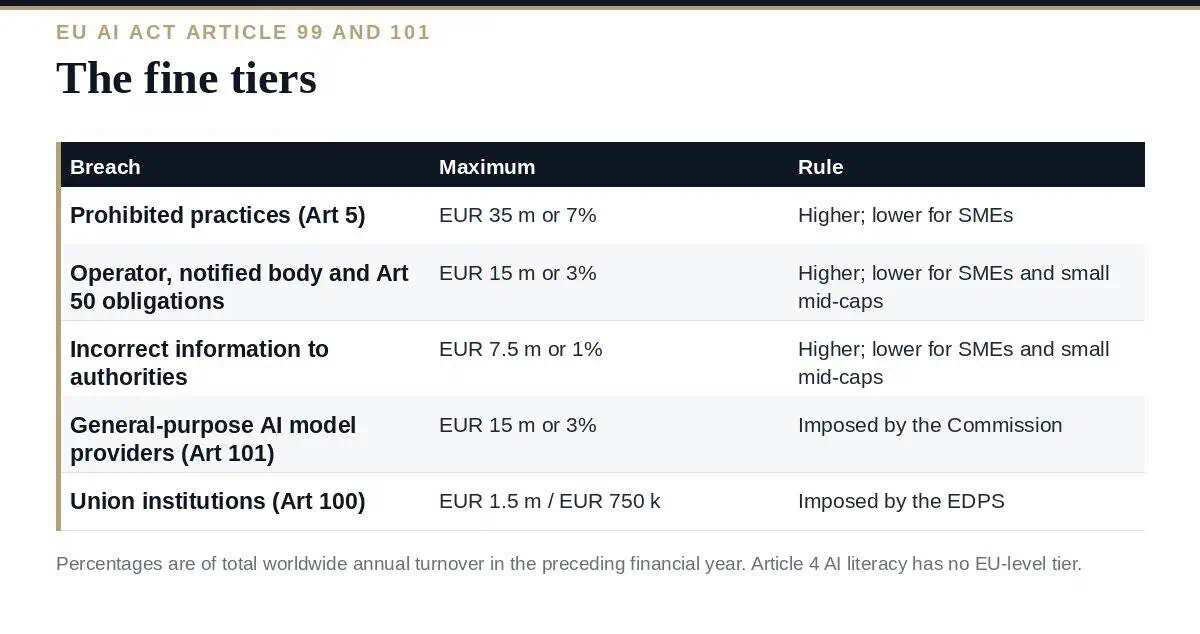
EU AI Act penalties come in three tiers: up to €35 million or 7% of worldwide annual turnover for a prohibited practice, up to €15 million or 3% for most other obligations, and up to €7.5 million or 1% for supplying incorrect information to authorities. In each case the fine is whichever is higher — except for SMEs and start-ups, where it is whichever is lower, a rule the Digital Omnibus on AI extended in part to small mid-caps in July 2026.
This guide sets out the tiers as Article 99 defines them, who can be fined for what, the separate regime for general-purpose AI model providers, the factors authorities must weigh, which obligations are already enforceable, and the widely repeated claim about AI-literacy fines that the Regulation’s text does not support.
Free gap assessment
Which AI Act obligations do you actually owe?
Score what is already in force separately from the high-risk duties that now land in 2027, free.
Run the free EU AI Act gap assessment → or View premium report sample
| Tier | Breach | Maximum fine | Article |
|---|---|---|---|
| 1 | Non-compliance with the prohibited AI practices in Article 5 | €35,000,000 or 7% of total worldwide annual turnover in the preceding financial year, whichever is higher | 99(3) |
| 2 | Non-compliance with obligations of providers (Art 16), authorised representatives (Art 22), importers (Art 23), distributors (Art 24), the value-chain duties in Art 25(2) and (4), deployers (Art 26), notified bodies (Art 31, 33(1), (3), (4), 34) and the transparency obligations in Art 50 | €15,000,000 or 3% of worldwide annual turnover, whichever is higher | 99(4) |
| 3 | Supplying incorrect, incomplete or misleading information to notified bodies or national competent authorities in reply to a request | €7,500,000 or 1% of worldwide annual turnover, whichever is higher | 99(5) |
Article 99(1) requires Member States to lay down the penalty rules — administrative fines, but also warnings and non-monetary measures — and to make them effective, proportionate and dissuasive, taking into account the interests and economic viability of SMEs, including start-ups. The fines are imposed by national market surveillance authorities, not by Brussels, which is why enforcement practice will vary by Member State.
For most companies the “whichever is higher” wording in the EU AI Act penalties means the percentage bites: a firm with €2 billion turnover faces up to €140 million under tier 1. Article 99(6) reverses the logic for SMEs, including start-ups: each fine shall be up to the percentages or amount in paragraphs 3, 4 and 5, whichever is lower. A start-up with €5 million turnover therefore faces a tier-1 ceiling of €350,000, not €35 million.
Regulation (EU) 2026/1744, the Digital Omnibus on AI, inserted Article 99(6a), extending the lower-of rule to small mid-cap enterprises — but only for tiers 2 and 3, not for the prohibited-practice tier. A small mid-cap is defined by reference to Commission Recommendation (EU) 2025/1099: an enterprise that is not an SME, employs fewer than 750 people, and has annual turnover not exceeding €150 million or a balance sheet total not exceeding €129 million.
| Company type | Tier 1 (Art 5) | Tier 2 (operators, Art 50) | Tier 3 (information) |
|---|---|---|---|
| Large enterprise | Higher of €35 m / 7% | Higher of €15 m / 3% | Higher of €7.5 m / 1% |
| Small mid-cap (< 750 staff, ≤ €150 m turnover or ≤ €129 m balance sheet) | Higher of €35 m / 7% | Lower of €15 m / 3% | Lower of €7.5 m / 1% |
| SME or start-up (Recommendation 2003/361/EC) | Lower of €35 m / 7% | Lower of €15 m / 3% | Lower of €7.5 m / 1% |
EU AI Act penalties for providers of general-purpose AI models sit in a separate article and are imposed by a different enforcer. Article 101(1) allows the Commission — in practice the AI Office — to impose fines not exceeding 3% of annual total worldwide turnover or €15 million, whichever is higher, for infringing the model-provider obligations in Chapter V, failing to comply with a request for documentation or information, failing to comply with a measure requested under Article 93, or failing to give access to a model for evaluation.
Under Article 113(b), Article 101 is the one part of Chapter XII whose application was deferred to the general application date of 2 August 2026, so the Commission’s fining power over model providers is live now.
EU AI Act penalties for Union institutions, bodies, offices and agencies are imposed by the European Data Protection Supervisor rather than by Member States: up to €1,500,000 for a prohibited practice and up to €750,000 for other obligations.
The ceilings on EU AI Act penalties are maxima. Article 99(7) requires the decision to take account of all relevant circumstances, and lists the factors:
Two of those factors are within your control before anything goes wrong: the technical and organizational measures you can show you had in place, and whether you found and reported the problem yourself. A documented governance system is mitigation evidence in its own right.
Chapter XII, which contains Articles 99 and 100, has applied since 2 August 2025 — but a fine needs an obligation that is itself in force. The application dates decide exposure:
| Obligation | Applies from | Penalty tier |
|---|---|---|
| Prohibited practices, Art 5 (original list) | 2 February 2025 | Tier 1 |
| Prohibited practices added by the Omnibus, Art 5(1)(ba), (bb), 5(1a), 5(1b) | 2 December 2026 | Tier 1 |
| General-purpose AI model obligations, Chapter V | 2 August 2025 (Commission fines from 2 August 2026) | Art 101: €15 m / 3% |
| Transparency obligations, Art 50 | 2 August 2026 | Tier 2 |
| Annex III high-risk obligations, Chapter III sections 1–3 | 2 December 2027 (moved from 2 August 2026) | Tier 2 |
| Annex I high-risk obligations (AI in regulated products) | 2 August 2028 (moved from 2 August 2027) | Tier 2 |
| Incorrect information to authorities | With the underlying obligation | Tier 3 |
The Omnibus moved the two high-risk dates and added four new prohibitions with their own date; it did not postpone the original Article 5 prohibitions, the AI-literacy duty or the model rules. Our EU AI Act deadlines guide has the full Article 113 table.
A claim repeated across vendor material — and, until recently, in some compliance toolkits — is that breaching the Article 4 AI-literacy duty carries a €7.5 million or 1% fine. Article 99 does not say that. Paragraph 4’s list of obligations that attract the tier-2 fine is exhaustive and does not include Article 4; paragraph 5’s €7.5 million tier is for supplying incorrect information to authorities. Article 4 was also rewritten by the Omnibus into an obligation to take measures that support the development of AI literacy. Member States may attach their own penalties under Article 99(1), but there is no EU-level tier for it.
Overstating your exposure is a mistake in the other direction, and it is common. Our guide to the prohibited AI practices covers the tier-1 conduct that is genuinely enforceable today.
What is the maximum fine under the EU AI Act?
€35 million or 7% of total worldwide annual turnover, whichever is higher, for a prohibited practice under Article 5. For SMEs and start-ups it is whichever is lower.
Are EU AI Act penalties already being enforced?
The penalty chapter has applied since 2 August 2025, and the prohibitions it enforces have applied since 2 February 2025. Transparency obligations became enforceable on 2 August 2026; high-risk obligations follow from December 2027 and August 2028.
Who imposes the fines?
National market surveillance authorities for operators under Article 99; the Commission for general-purpose AI model providers under Article 101; the European Data Protection Supervisor for Union institutions under Article 100.
Do deployers face fines, or only providers?
Deployers too. Article 99(4) lists Article 26 deployer obligations and Article 50 transparency duties, both at the tier-2 ceiling.
Does the lower-of rule apply to all smaller companies?
SMEs and start-ups get it for all three tiers. Small mid-caps, added by the Omnibus, get it for tiers 2 and 3 only — a prohibited practice by a small mid-cap still faces the higher-of ceiling.
Read EU AI Act penalties as a schedule rather than a single number: tier 1 for the prohibitions already in force, tier 2 for transparency now and high-risk obligations from December 2027, tier 3 for what you tell the authorities, and Article 101 for model providers. Work out which company-size rule applies to you, and note that the mitigation factors in Article 99(7) reward documented governance and self-reporting — which is a better reason to build the compliance file than the ceiling figures are.
The prohibited-practice screening procedure and checklist, AI system register and high-risk requirements checklist that evidence the Article 99(7) mitigation factors are in the EU AI Act Toolkit (60 templates), or start with the free templates.

October 11, 2026
October 11, 2026

October 11, 2026

October 11, 2026

October 11, 2026

