CART

The SWIFT CSCF — the Customer Security Controls Framework — is the control set behind Swift’s Customer Security Programme, and the single most useful thing to know about it is that your independent assessment does not have to be external.
A great many institutions have spent money on an outside firm they were never required to engage.
Free gap assessment
Where do you actually stand against ISO 27001?
Score every management system clause and all 93 Annex A controls, free, and get a prioritised gap list back.
Run the free ISO 27001 gap assessment → or View premium report sample
Swift describes the Customer Security Programme as a mandatory initiative that helps financial institutions protect their Swift footprint against cyber threats. Institutions implement security controls and attest their level of compliance against the CSCF.
The SWIFT CSCF separates mandatory from advisory controls, and each control comes with an objective, a scope and a stated risk driver. That last element is the part worth reading properly — the risk driver tells you what the control exists to prevent, which is what lets you argue a sensible implementation rather than a literal one.
Which controls apply depends on your Swift architecture. Scope is determined by your infrastructure type, not by your size, and getting the architecture classification wrong invalidates everything downstream.
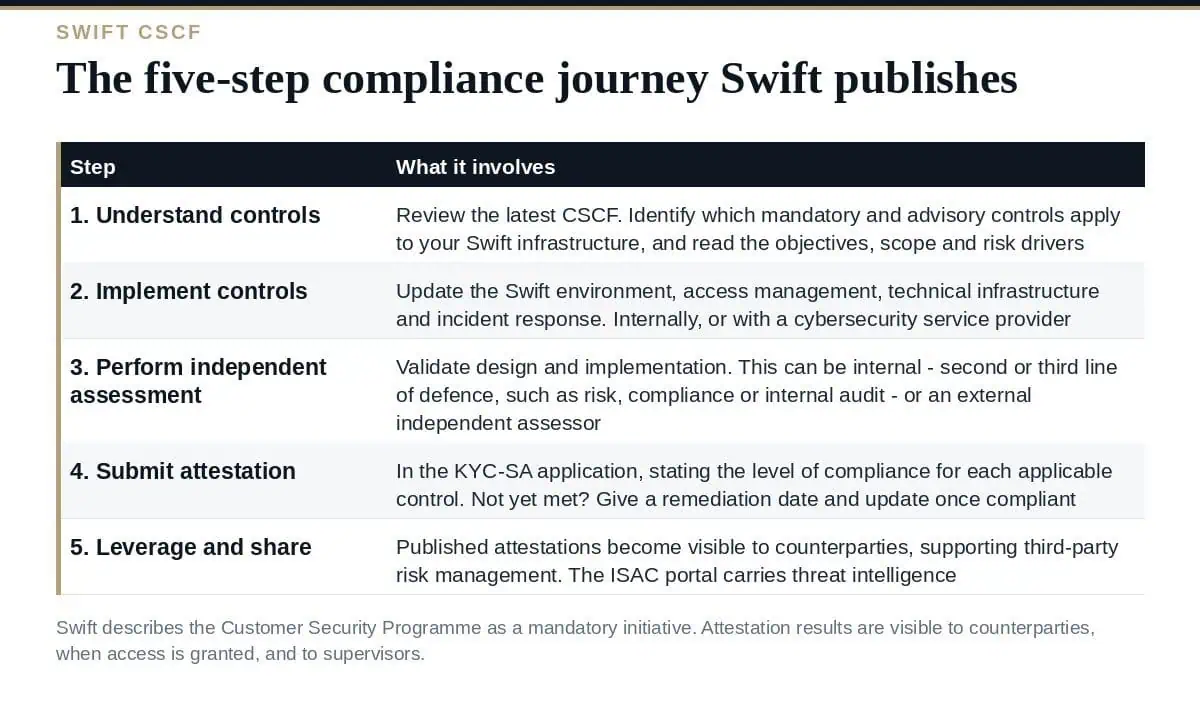
Swift publishes the compliance journey as five steps, and the sequencing is deliberate: understand the controls, implement them, validate through independent assessment, submit the attestation, then use and share the result.
Most SWIFT CSCF programmes compress steps one and two and pay for it at step three, when an assessor finds the architecture was classified before anyone read the scope definitions.
This is the SWIFT CSCF point that saves real money, and Swift states it plainly. Validation of the design and implementation of your controls can be performed internally by a second or third line of defence — risk, compliance or internal audit — or externally by an independent assessor.
Both routes are legitimate. The choice turns on genuine independence and competence, not on whether a logo appears on the report.
What matters practically:
For an institution assessed every year, building genuine internal capability changes the economics substantially. For one with a small team and no independent function, external is the honest answer.
SWIFT CSCF attestation is submitted through the KYC-SA application, stating your level of compliance for each applicable control.
Crucially, a control you have not yet met is not a failed attestation. Swift’s process is to provide a remediation date and update the attestation once compliant. An honest attestation with dated remediation plans is a supported outcome; an optimistic one that later unravels is not.
The consequence people underestimate is visibility. Once published, your attestation becomes visible to counterparties — when access is granted — and to supervisors, through KYC-SA and KYS. It is an input to other institutions’ third-party risk management, which is why counterparties increasingly ask about specific controls rather than accepting a summary.
Two resources are under-used.
The ISAC portal carries threat intelligence shared across the Swift community. For an institution whose threat picture is dominated by exactly the attacks the CSP exists to prevent, that is a more relevant feed than most commercial sources.
The directories — of certified CSP assessors and of cyber security service providers — exist so you can check that whoever you engage is what they claim to be.
| Framework | Relationship |
|---|---|
| ISO 27001 | An ISMS gives you access control, change management, logging and incident response evidence in a form the CSCF assessment can draw on. It is not a substitute — the CSCF is specific to the Swift footprint |
| DORA | For EU financial entities, ICT risk management and third-party oversight run alongside. The Swift environment is in scope of both |
| PCI DSS | A comparable model — prescriptive controls, defined scope, annual validation — and useful precedent if your organisation already runs one |
| SWIFT CSP attestation | The step-by-step attestation guide, covering the submission itself |
This guide reflects swift.com at 15 August 2026. The CSCF is revised on a regular cycle — always work from the latest published version.
The SWIFT CSP Compliance Toolkit provides 32 editable templates covering the architecture classification, the control implementation records, the independent assessment evidence and the attestation preparation artefacts.


October 15, 2026
October 15, 2026
October 14, 2026
October 14, 2026

October 14, 2026

