CART
Most PCI DSS programmes start by opening the standard at requirement 1 and working downwards. That is the most expensive possible order, and it answers a question nobody asked you.
Two things decide how a PCI DSS validation programme actually goes: who is requiring it of you, and what you tackle first. Neither is in requirement 1.
Free gap assessment
How much of PCI DSS v4 is actually in place?
Score all twelve requirements at sub-requirement level, free, including the ones that stopped being future-dated in 2025.
Run the free PCI DSS 4.0 gap assessment → or View premium report sample
The PCI Security Standards Council writes the standard. It does not make you comply with it.
The Council states this plainly: whether an entity is required to comply with, or validate compliance to, a PCI SSC standard is at the discretion of the organisations that manage compliance programmes — a payment brand, an acquirer, or another such entity.
That single fact resolves a surprising number of arguments:
Get that in writing before scoping anything. Programmes routinely over-build because nobody asked the acquirer what was actually required.
The audience is broader than “merchants who take card payments”. PCI DSS applies to entities that store, process or transmit cardholder data (CHD) and/or sensitive authentication data (SAD) — or that could impact the security of the cardholder data environment.
That last clause is the one that expands scope. A system holding no card data at all is in scope if it could affect the security of the environment that does — your identity provider, your jump hosts, your monitoring platform, your network management. Organisations that scope only on data location consistently under-scope.
The standard covers everyone in the chain: merchants, processors, acquirers, issuers and service providers.
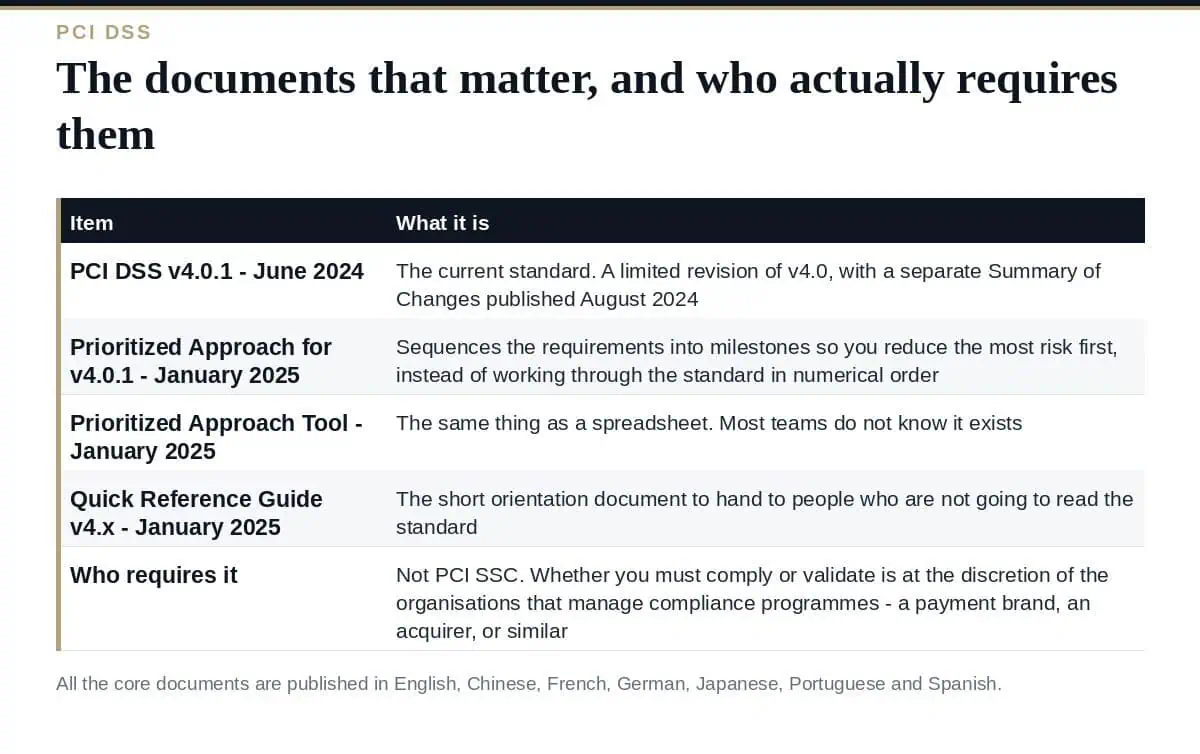
PCI DSS v4.0.1, published June 2024, is the current standard in the PCI SSC document library, and a separate Summary of Changes covers what moved from v4.0.
But the document most teams have never opened is the Prioritized Approach, updated for v4.0.1 in January 2025 — with an accompanying Prioritized Approach Tool as a spreadsheet.
It sequences the requirements into milestones ordered by risk reduction rather than by requirement number. The first milestone is the one that changes programmes: remove sensitive authentication data and limit cardholder data retention.
The logic is blunt and correct. Data you do not hold cannot be stolen, and every requirement that would have applied to it stops applying. Organisations that start here routinely shrink their environment — and their assessment — before implementing a single control.
Alongside it, the Quick Reference Guide v4.x (January 2025) is the document to hand to people who will never read the standard itself.
The PCI DSS validation ecosystem is worth understanding before you engage anyone, because the roles are not interchangeable.
| Role | What they do |
|---|---|
| QSA | Qualified Security Assessor — an independent organisation qualified and trained by PCI SSC to perform assessments and validate adherence |
| ASV | Approved Scanning Vendor — qualified to conduct external vulnerability scanning in line with the applicable requirement. A separate qualification from QSA |
| ISA | Internal Security Assessor — a company-level and individual certification letting your own staff perform internal assessments and drive consistent implementation |
| PCIP | Payment Card Industry Professional — an entry-level individual certification, useful for building internal understanding rather than for validating anything |
The ISA route is under-used. For an organisation assessed repeatedly, training internal assessors changes the economics and, more importantly, the quality of what a QSA is eventually handed.
| Standard | Relationship |
|---|---|
| ISO 27001 | An ISMS gives you the governance, risk and audit machinery PCI DSS assumes. It is not a substitute — PCI DSS is prescriptive where ISO 27001 is risk-based |
| SOC 2 | Overlapping evidence, different audience. Neither report satisfies the other’s requirement |
| CSA STAR | Where card processing sits in cloud services, the shared responsibility documentation serves both |
| GDPR | Cardholder data is personal data. Minimisation is the point where the two regimes agree completely — and the Prioritized Approach’s first milestone is a GDPR win as well |
Validation under PCI PIN Security follows different rules: no self-assessment route, a different assessor qualification, and a listing that expires two years after the assessor signs. Qualified PIN Assessor covers it.
This guide reflects the PCI SSC standards pages and document library at 15 August 2026, on which PCI DSS v4.0.1 is the current standard. PCI DSS validation requirements and dates come from your acquirer or payment brand — confirm them there. For the v4.0 changes specifically, see our PCI DSS v4.0 compliance guide, and for the documents an assessor actually asks for, our checklist of the PCI DSS documentation you must hold.
The PCI-DSS Toolkit provides 180+ editable templates covering the scope and cardholder data environment definition, the requirement-by-requirement implementation records, the policies the standard mandates, and the evidence an assessor asks for.


October 15, 2026

October 15, 2026
October 14, 2026
October 14, 2026
October 14, 2026

