
CART
No products in the cart.
ISO Compliance Insights & Best Practices
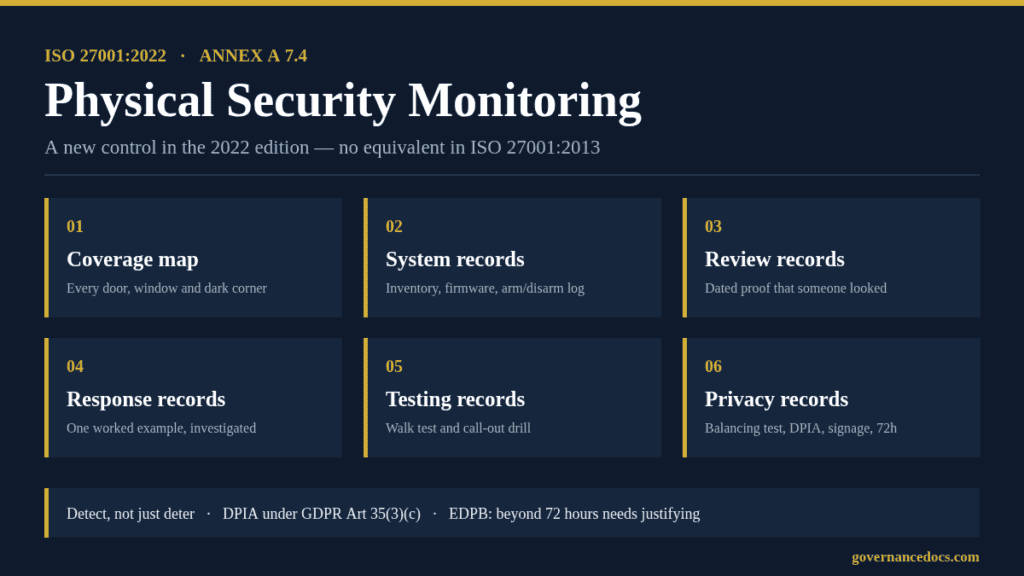
ISO 27001 physical security monitoring is the Annex A control that asks a question the 2013 edition never asked: if someone walked into your building tonight, would anyone know? Control A.7.4 was added in the 2022 edition, and it reads as a requirement that premises be continuously monitored for unauthorised physical access. Eleven words, one new line in your Statement of Applicability, and a surprising amount of work behind it — because this is the one Annex A control whose correct implementation can itself be unlawful if you get the paperwork wrong.
This guide covers what A.7.4 actually demands, how ISO 27001 physical security monitoring differs from the physical controls around it, the five methods ISO/IEC 27002 recognises, the review-and-respond limb almost everyone leaves out, and the data protection obligations that attach the moment you point a camera at a door. All of it is written for the organisation that has to pass an audit, not for a vendor trying to sell you cameras.
Free gap assessment
Where do you actually stand against ISO 27001?
Score every management system clause and all 93 Annex A controls, free, and get a prioritised gap list back.
Run the free ISO 27001 gap assessment → or View premium report sample
A.7.4 sits in the Physical theme of Annex A, which holds 14 of the standard’s 93 controls. The other three themes are Organizational (37), People (8) and Technological (34). Within that Physical group of 14, A.7.4 is the detective one.
The control statement is short: premises shall be continuously monitored for unauthorised physical access. ISO’s stated purpose for the control is to detect and deter unauthorised physical access, which is why ISO/IEC 27002:2022 classifies ISO 27001 physical security monitoring as both preventive and detective — a visible camera changes behaviour before it ever records anything useful.
What the statement does not say is equally important. It does not name a technology. It does not require CCTV. It does not require a documented policy, and a physical security monitoring policy does not appear on the list of ISO 27001 mandatory documents. It does not state a review frequency, a retention period, or a testing interval. Every number you have seen on a competitor’s page about this control came from that competitor, not from the standard.
Three things follow. First, ISO 27001 physical security monitoring is risk-based: a two-room office and a colocation cage do not get the same answer. Second, because nothing is prescribed, your justification has to be written down somewhere — the Statement of Applicability is where an auditor will look for it. Third, the evidence is behavioural, so you cannot pass this control by producing a document alone.
A.7.4 is one of the eleven controls introduced in ISO/IEC 27001:2022 with no predecessor in the 2013 edition. ISO 27001 physical security monitoring is not a renumbering of something older; it is a genuine gap that got filled. Look at where the old A.11.1 family went:
| ISO 27001:2013 | ISO 27001:2022 | Control type |
|---|---|---|
| A.11.1.1 Physical security perimeter | A.7.1 Physical security perimeters | Preventive |
| A.11.1.2 Physical entry controls A.11.1.6 Delivery and loading areas | A.7.2 Physical entry | Preventive |
| A.11.1.3 Securing offices, rooms and facilities | A.7.3 Securing offices, rooms and facilities | Preventive |
| A.11.1.4 Protecting against external and environmental threats | A.7.5 Protecting against physical and environmental threats | Preventive |
| A.11.1.5 Working in secure areas | A.7.6 Working in secure areas | Preventive |
| No equivalent | A.7.4 Physical security monitoring | Preventive and detective |
Read that right-hand column down the page. The 2013 edition asked you to build a perimeter, control the entrances, lock the rooms, shield against flood and fire, and supervise work in secure areas. Every one of those is a barrier. Not one of them asked whether you would find out that a barrier had failed.
So an organisation could have been fully certified against the 2013 edition with a locked server room nobody ever looked at. That is the gap ISO 27001 physical security monitoring closes, and it is why the control feels unfamiliar even to teams that have held a certificate for a decade. If you are mapping your whole control set across editions, our guide to the ISO 27001:2022 controls covers the full 93 and the four themes.
Free ISO 27001 risk assessment
Which of your risks sit above your appetite line?
Set your own risk criteria, pick from 61 information security risk scenarios, rate likelihood and impact, and decide how to treat each one. You get a heat map, a process score and the findings an auditor would raise, free.
Run the free risk assessment → or View premium report sample
Most Annex A control statements tell you what and leave when to the guidance. A.7.4 is unusual in that its own statement carries a temporal qualifier — premises shall be continuously monitored. That single adverb is where real-world arrangements fail, because it rules out three common setups:
“Continuously” does not mean a human stares at a screen all night. It means the detection capability is never off. NIST makes that distinction explicit in a way ISO does not: in NIST SP 800-53 Rev. 5, control enhancement PE-6(3) on video surveillance notes that monitoring the surveillance video is not required, although organisations may choose to do so. Recording continuously and reviewing selectively is a defensible reading of A.7.4. Recording selectively is not.
ISO/IEC 27002:2022 recognises surveillance systems used separately or in combination, and names guards, intruder alarms, video monitoring systems such as closed-circuit television, and physical security information management software, whether run in-house or by a monitoring service provider. Each ISO 27001 physical security monitoring option produces a different artefact, and that artefact is what your auditor samples.
| Method | What it actually detects | Evidence it produces | Privacy exposure |
|---|---|---|---|
| Security guards / manned reception | Unexpected people, tailgating, propped doors, behaviour | Patrol logs, shift handover notes, incident reports | Low (unless body-worn, or notes name individuals) |
| Intruder alarm system | Breach of a contact, movement in an armed zone, glass break | Event log, arm/disarm record, call-out records | Low |
| Video monitoring system (CCTV/VSS) | Who, when and what they did — after the fact | Footage, retention settings, access log to the footage | High — personal data, almost always |
| Physical access control system (PACS) logs | Credential use, failed reads, out-of-sequence entries | Badge event log, anti-passback exceptions, access reviews | Medium — identifies named employees |
| PSIM or monitoring service provider | Correlated events across all of the above | Correlated alert log, SLA and escalation records | High — adds a processor to your supply chain |
Two practical notes. A guard-only answer is perfectly valid for a small office and is often cheaper to evidence than a camera system, because it carries almost no data protection overhead. And the bottom row is where organisations accidentally create work: the moment a third party performs your ISO 27001 physical security monitoring, that provider sits inside the scope of your supplier controls (A.5.19 to A.5.22) and, where footage of identifiable people is involved, needs a processor contract as well.
The 27002 guidance for this control goes down to the level of hardware, which is unusual and worth knowing before a stage 2 audit. It describes three detector families and several installation conditions.
| Detector type | Triggers on | Typical placement | Common weakness |
|---|---|---|---|
| Contact detector | A contact being made or broken | Doors, windows, cabinet and rack doors | Defeated by entry through a wall, ceiling or raised floor |
| Motion detector (infra-red) | An object crossing the field of view | Corridors, unoccupied rooms, server rooms | False positives from HVAC, cleaners, pets, sunlight |
| Sound detector | A characteristic sound, e.g. breaking glass | Glazed frontages, ground-floor windows | Noisy sites; no detection of quiet forced entry |
Alongside the detectors, the guidance asks for conditions that are easy to check and often wrong in practice:
That last point is the one that catches technical teams. If an attacker can reach your camera management server, the control is gone before anyone reaches the door.
A.7.4’s statement stops at “monitored”, and that is where most implementations stop too — a system is installed, it records, and nobody looks. ISO’s purpose for the control is to detect, and detection you never act on is not detection. NIST spells out the missing limbs explicitly, and PE-6 is the cleanest free template available for filling the gap in an ISO 27001 physical security monitoring design:
| NIST SP 800-53 PE-6 | Requirement | What it adds to A.7.4 |
|---|---|---|
| PE-6a | Monitor physical access to detect and respond to physical security incidents | Names the response obligation A.7.4 only implies |
| PE-6b | Review physical access logs at a defined frequency and on defined events | Turns recording into an operated control |
| PE-6c | Coordinate review and investigation results with incident response | Connects physical detection to your IR process |
| PE-6(2) | Recognise defined intrusion classes and initiate defined automated responses | Makes alerting testable rather than aspirational |
| PE-6(4) | Monitor physical access to the system, not only the facility | Covers server rooms, media stores and comms rooms separately |
PE-6’s discussion also supplies something no ISO document gives you: a description of what suspicious physical access actually looks like. NIST names accesses outside normal working hours, repeated accesses to areas not normally accessed, accesses lasting unusual lengths of time, and out-of-sequence accesses. Turn those four into detection rules and your review process has content rather than a calendar reminder:
Those alerts have to land somewhere. Route ISO 27001 physical security monitoring alerts into the same process you already run for technical events — see our ISO 27001 incident response plan guide — because a physical alarm at 02:00 with no documented escalation path is a finding waiting to happen.
Here is the part almost every page on this control misses. A video monitoring system is not only how you satisfy A.7.4. It is an IP-connected system holding sensitive data, so it becomes an object of your other controls at the same moment it becomes a control itself. The EDPB’s technical breakdown of a video surveillance system — image capture, interconnections, image handling, data and activity management, and interfaces to other systems such as access control and fire alarm — maps almost one-to-one onto the Technological theme:
| VSS component | Risk if unprotected | Annex A control that applies |
|---|---|---|
| Cameras and sensors (image capture) | Default credentials, unpatched firmware, physical tampering | A.8.8 vulnerability management, A.8.9 configuration management |
| Network links (interconnections) | Footage interception; camera VLAN bridged to the corporate network | A.8.20 networks security, A.8.22 segregation of networks |
| Recorder or VMS server (image handling) | Footage deleted or exported by an attacker; remote disabling | A.8.2 privileged access rights, A.8.13 information backup |
| Operator and administrator accounts | Unlogged viewing of staff; no accountability for exports | A.8.15 logging, A.5.15 access control |
| Monitoring service provider interface | Third-party access to live feeds with no contractual limits | A.5.19–A.5.22 supplier relationships |
Treat the camera estate as a system of record. Put the VMS administrator accounts through the same regime as any other privileged account — our ISO 27001 privileged access guide covers the controls — and make sure footage access is captured in line with ISO 27001 logging requirements. Who watched what, and who exported it, is a question both auditors and data subjects can ask.
This is the risk that makes A.7.4 different from every other Annex A control. ISO 27001 physical security monitoring means processing personal data about identifiable people, including your own staff, in a context where they often cannot avoid being recorded. ISO/IEC 27002:2022 says as much: monitoring and recording mechanisms should be used with local laws and regulations in mind, including data protection and personal data protection legislation, and an impact assessment should be considered before CCTV is deployed.
For organisations in scope of the UK or EU GDPR, the authoritative free reference is the European Data Protection Board’s Guidelines 3/2019 on processing of personal data through video devices, adopted in final form on 29 January 2020. Five of its requirements attach directly to your implementation:
| Obligation | What the EDPB says | Where it lands in your ISMS |
|---|---|---|
| Lawful basis | Video surveillance under Article 6(1)(f) is lawful only where it is necessary for a legitimate interest that is not overridden by the data subject’s interests, rights and freedoms | Documented balancing test, referenced from the SoA entry for A.7.4 |
| DPIA | Mandatory under Article 35(3)(c) for systematic monitoring of a publicly accessible area on a large scale; the EDPB considers it reasonable to assume many video surveillance cases will need one | DPIA record, plus prior consultation with the regulator if high risk remains |
| Transparency | Two layers: a warning sign readable before entering the monitored area, roughly at eye level, plus fuller information available elsewhere. The sign must also disclose anything that would surprise the data subject, such as transmission to third parties outside the EU | Signage register — and the deterrent half of A.7.4 depends on it anyway |
| Retention | No fixed period, but footage should in most cases be erased, ideally automatically, after a few days; the longer the period, especially beyond 72 hours, the more justification is required | Retention configuration on the recorder, plus the written justification |
| Security of the footage | Article 32 applies to the surveillance data itself, and Article 25 requires data protection by design before collection begins | The Annex A controls in the table above |
Note the direction of the retention argument. Most organisations set 30 or 90 days because that is the recorder’s default, then cannot explain why. The EDPB’s reasoning is that damage is usually noticed within a day or two, so a short period is the starting point and anything longer needs a stated reason — a closed weekend, a holiday shutdown, or live litigation. If you are documenting the assessment itself, our DPIA for CCTV guide walks through the template.
One more trap worth naming: a lawful basis for ISO 27001 physical security monitoring is not a lawful basis for performance monitoring. The moment footage is used to check whether someone arrived late, you are processing for a new purpose with a different balance, and the original justification does not carry over.
Because A.7.4 has no mandatory document, the audit turns on records rather than policy. Build the ISO 27001 physical security monitoring pack around six sets and an auditor can close the control in twenty minutes:
Where a landlord or building manager runs the cameras, you still own the control. What you hold instead is the agreement, the coverage confirmation and the process for requesting footage — treated as a supplier arrangement, not as an exemption.
If your systems live in someone else’s data centre and your staff work from home, ISO 27001 physical security monitoring does not disappear — it moves.
Start with scope. The control applies to premises inside the boundary of your ISMS. For a cloud-hosted business that still has an office, the office is in scope even if no production system sits in it, because laptops, paper, whiteboards and network access do. Our guidance on the clean desk policy covers what is genuinely at risk in an ordinary office, and most of it is exactly what an intruder would take.
Then handle the data centre. Your provider’s monitoring is not your implementation of A.7.4; it is a supplier control you verify, normally through their ISO 27001 certificate scope or a SOC 2 Type II report — and specifically by checking that physical security monitoring appears in that scope rather than assuming it. Record the check, record its date, and repeat it when the report is reissued.
Finally, the genuinely premises-free case. An organisation with no premises in scope can exclude A.7.4 in the Statement of Applicability, but the justification has to be that there are no premises, not that ISO 27001 physical security monitoring is inconvenient. Expect the auditor to test it by asking where the company’s laptops are configured, where paper records are kept, and whether anyone has a home office holding equipment on behalf of the organisation. In practice very few organisations clear that bar.
This control attracts invented numbers more than most, so it is worth being blunt. ISO/IEC 27001:2022 states no frequency anywhere in A.7.4 — not for reviewing footage, not for testing detectors, not for reviewing the arrangement itself. ISO/IEC 27002:2022 does not supply one either. Published figures such as quarterly drills, weekly log sampling, annual policy review or 30-to-90-day retention are vendor conventions. They may be sensible, and you are free to adopt them, but they are your commitments rather than the standard’s requirements — and once written into your own procedure they become auditable against you.
The defensible approach is to derive each interval from risk and say so: review the access log weekly because the office is shared, walk-test the detectors twice a year because the landlord changed the layout, keep footage for 72 hours because that is what your incident pattern needs. A number with a reason behind it passes. A number copied from a blog does not.
No. A.7.4 requires continuous monitoring for unauthorised physical access; it does not name a technology. Guards, intruder alarms, access control logs and physical security information management software are all recognised options, used alone or together. For a small single-office organisation, an intruder alarm plus reviewed badge logs is often a stronger and cheaper form of ISO 27001 physical security monitoring than cameras, because it produces clean evidence with far less data protection overhead.
Only if the justification is genuine. If your ISMS scope includes any premises — an office, a storeroom, a comms cupboard — an auditor will expect ISO 27001 physical security monitoring to be applicable. Excluding it because your systems are cloud-hosted does not work, because the control is about premises rather than servers. Where the premises belong to a landlord or a colocation provider, the control stays applicable and is satisfied through the supplier arrangement.
ISO 27001 sets no period. Under the UK and EU GDPR, the European Data Protection Board’s position is that footage should in most cases be erased after a few days, ideally automatically, and that a period beyond 72 hours needs additional justification of why the purpose requires it. Set the shortest period that lets you detect and investigate the incidents you actually see, write down the reasoning, and configure the recorder to enforce it rather than relying on someone to delete.
Often, yes. Article 35(3)(c) of the GDPR makes a DPIA mandatory for systematic monitoring of a publicly accessible area on a large scale, and the EDPB considers it reasonable to assume that many video surveillance deployments will require one. Even where it is not strictly mandatory, a short assessment is the cheapest way to produce the balancing test your A.7.4 evidence pack needs anyway. If the assessment shows high residual risk, Article 36 requires you to consult your supervisory authority before you start processing.
Not as a mandatory document — A.7.4 does not ask for documented information, and no such policy appears among ISO 27001’s required documents. In practice most organisations fold ISO 27001 physical security monitoring into a wider physical security policy, because the control involves several teams, often a third party, and a legal basis, and that is hard to run on memory. If you write one, keep it to what you will genuinely do: coverage, who reviews what and when, escalation, retention, and who may view footage.
ISO 27001 physical security monitoring is a short control with a long tail: a coverage decision, a detection design, a review routine, an escalation path, and a privacy file that has to stand up on its own. None of it is difficult, but all of it has to exist before a stage 2 audit, and the parts that fail are almost always the records rather than the hardware.
If you would rather adapt than draft, the ISO 27001 Toolkit includes 165 editable templates covering the physical security controls alongside the full Annex A set, the Statement of Applicability and the risk documentation, for $149. It will not install your cameras, but it will give you the register, the policy and the review records an auditor asks for — and the ISO/IEC 27001:2022 standard itself remains the one document worth reading in the original before you commit to any of it.


October 15, 2026
October 15, 2026
October 14, 2026

October 14, 2026

October 14, 2026
