AS9100 supplier management is where aerospace quality systems most often break, because so much of the finished product is made, processed or tested outside your walls. AS9100 Rev D clause 8.4 takes ISO 9001’s requirements for “externally provided processes, products and services” and adds a register, risk-based controls, performance monitoring that includes on-time delivery, and a long list of requirements that must be flowed down through the supply chain.
This guide to AS9100 supplier management walks through what clause 8.4 requires, how to structure a supplier management process that auditors accept, and the flow-down clauses most purchase orders miss. It reflects AS9100D, which remains the certifiable revision as of October 2026.
Free gap assessment
Are you ready for the 2026 edition of ISO 9001?
Score yourself against the new edition, free, including the risk and opportunity split and the clause 10 renumbering that breaks converted checklists.
AS9100D uses “external provider” rather than “supplier,” and the scope is broad. It covers anyone providing a process, product or service that affects what you deliver: raw material mills, distributors, subcontract machinists, heat treaters, platers, NDT laboratories, calibration labs, design consultants and even sister sites in your own group. Customer-directed sources are still your external providers; the customer’s designation does not remove your responsibility to control them.
A common audit finding is an approved supplier list that covers material vendors but omits calibration services or outsourced inspection. If their output affects conformity, they belong in the process.
The Core AS9100 Supplier Management Requirements in Clause 8.4.1
Clause 8.4.1 requires a documented process for controlling external providers, one of only a few explicitly documented processes in AS9100D. The aerospace additions require you to:
Define responsibility and authority for approval status decisions, changes to approval status, and the conditions for controlled use of providers depending on that status
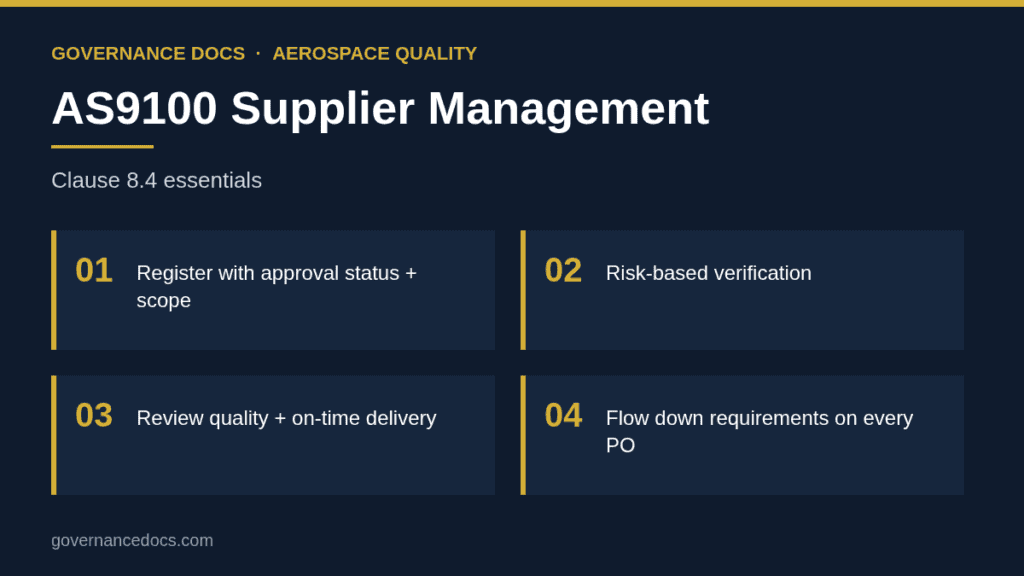
Maintain a register of external providers that includes approval status (for example approved, conditional or disapproved) and the scope of approval (for example product type or process family)
Periodically review provider performance, including process, product and service conformity and on-time delivery performance
Define actions to take when providers do not meet requirements
Define requirements for controlling documented information created by or retained by external providers
Ensure customer-designated or approved sources are used when the customer requires it
The register is the single document auditors ask for most often in supplier management. A good one answers these questions at a glance:
Field
Why it matters
Provider name and site address
Approval applies to a site, not a company group
Approval status
Approved, conditional, probation or disapproved, with dates
Scope of approval
What they are approved to supply, such as specific processes or material types
Basis of approval
AS9100 certificate, Nadcap accreditation, audit, first article, customer designation
Certification status and expiry
Checked in the IAQG OASIS database where applicable
Risk rating
Drives audit frequency and incoming inspection level
Performance metrics
Quality and on-time delivery for the review period
Next review date and owner
Evidence of periodic review
Scope of approval is the field most often missing. If you approved a shop for machining and later sent them a part needing anodizing, the register should show that the approval does not cover it.
Supplier Selection and Evaluation
AS9100D does not prescribe a selection method, but it expects criteria based on the provider’s ability to meet your requirements. Typical evidence, in increasing order of assurance:
Questionnaire and capability review
Third-party certification (AS9100, AS9110, AS9120 or ISO 9001), verified in OASIS
Successful first article inspection of a representative part
On-site audit by your quality team
Match the depth of evaluation to risk. A distributor of standard hardware with an AS9120 certificate may need nothing more than certificate verification and incoming inspection. A sole-source supplier of a flight-critical casting probably needs an audit.
Monitoring Performance, Including On-Time Delivery
The explicit mention of on-time delivery is one of the clearest aerospace additions. Your review must cover conformity and delivery, and you should be able to show the data. Most organizations calculate a scorecard monthly or quarterly using:
Quality: rejected quantity or lots, escapes found at customer, corrective action responsiveness
Delivery: percentage of lines delivered on or before the agreed date
Define thresholds that trigger action, such as a corrective action request, increased inspection, conditional status or removal. Our AS9100 on-time delivery guide covers how to measure delivery consistently, both for your own performance and for suppliers.
Verification of Purchased Products (Clause 8.4.2)
The level of control you apply depends on risk and the provider’s performance. AS9100D adds specific expectations:
Verification activities can include reviewing objective evidence, inspection on receipt, source inspection and delegation of verification to the provider.
Where you rely on provider test reports to accept product, such as material certificates, you need a process to evaluate that data, and for raw material, periodic validation of test reports is expected based on risk.
Where you delegate verification to the provider, define the scope and requirements and keep a register of delegations.
The AS9100 Supplier Management Flow-Down Checklist (Clause 8.4.3)
Clause 8.4.3 lists the information you must communicate to external providers, typically through purchase orders and quality clauses. The aerospace version adds several items to ISO 9001’s list. Use this as a checklist when reviewing your standard purchase order terms:
Identification of relevant technical data: specifications, drawings, process requirements, work instructions, including revision
Requirements for approval of products, methods, processes, equipment and release
Required competence and qualification of persons
Requirements for design, test, inspection and verification, including production process verification such as first article inspection
Use of statistical techniques for product acceptance, where applicable
Critical items, including key characteristics
Requirements for test specimens
Requirements for the provider’s quality management system
Requirements to use customer-designated or approved external providers, including special process sources
Requirement to notify you of nonconforming outputs and obtain approval for their disposition
Requirement to prevent the use of counterfeit parts
Requirement to notify you of changes to processes, products, services, providers or manufacturing location, and to obtain approval
Requirement to flow down applicable requirements to their own external providers
Right of access for you, your customer and regulatory authorities to facilities and records throughout the supply chain
Records retention requirements
Ensuring their people are aware of their contribution to conformity, product safety and the importance of ethical behavior
Check the exact wording against the standard, which is available as AS9100D from SAE, and add any customer-specific clauses your primes require.
Common AS9100 Supplier Management Audit Findings
Register missing scope of approval or approval basis
No evidence of periodic performance review, or reviews without on-time delivery data
Expired supplier certificates not noticed
Purchase orders that omit counterfeit prevention, change notification or right of access
Material certificates accepted without any validation process
Calibration and inspection service providers left out of the process
AS9100D expects controls proportionate to risk, and the strongest AS9100 supplier management processes make that link explicit. Rate each provider on factors such as product criticality, special processes, sole-source status, past performance and counterfeit exposure, then let the rating drive the control level:
Risk rating
Typical controls
Low
Certificate check in OASIS, standard incoming inspection, annual scorecard review
Medium
Capability review, first article on new parts, quarterly scorecard
High
On-site audit, source inspection or enhanced receiving inspection, monthly scorecard, defined escalation path
Document the rating method in your procedure so auditors can see why two suppliers receive different treatment. Consistent, risk-based AS9100 supplier management is far easier to defend than a one-size-fits-all approach.
AS9100 Supplier Management for Small Organizations
A small shop with twenty active suppliers does not need a supplier portal. A spreadsheet register, a one-page evaluation form, a quarterly scorecard tab and a standard set of purchase order quality clauses will satisfy AS9100D if they are kept current. The effort should go into keeping data accurate and acting on poor performance, not into tools.
Frequently Asked Questions
Do AS9100 suppliers have to be AS9100 certified?
No. AS9100D does not require external providers to hold any certification. You choose the controls based on risk. Many primes, however, require AS9100 or AS9120 certification of their suppliers by contract.
How often should suppliers be re-evaluated?
The standard says periodically and leaves frequency to you. Annual reviews are common, with more frequent reviews for high-risk or poorly performing providers.
Is an approved supplier list mandatory under AS9100?
Yes, in effect. Clause 8.4.1 requires a register of external providers with approval status and scope of approval.
What is the first step in AS9100 supplier management?
List every external provider whose output affects conformity, including service providers such as calibration and testing labs, then record approval status and scope for each in a register.